(seafood.vasep.com.vn) Ca Mau, widely regarded as the nation’s “shrimp capital”, continued its strong performance in 2025 as shrimp output reached nearly 600,000 tons, maintaining its position as Vietnam’s leading shrimp-producing locality.
The province benefits from an intricate canal network, an extensive coastline, a mild climate and a distinctive ecosystem (including mangrove forests and rice-shrimp farming systems) enabling the development of diversified shrimp farming models, ranging from extensive to super-intensive production with the application of high technology and international standards.
With its rich brackish and saline ecosystem advantages, Ca Mau holds the largest shrimp farming area in the country, exceeding 435,000 hectares and accounting for approximately 40% of Vietnam’s total acreage. Shrimp output reached nearly 595,000 tons, the province remains the national frontrunner. Furthermore, its seafood export turnover surpassed $2.5 billion, making a significant contribution to export growth and foreign exchange earnings.
Beyond expanding in scale, Ca Mau’s shrimp industry is pivoting toward high quality and long-term sustainability. The province currently now boasts over 37,000 hectares of shrimp farms certified under international standards such as VietGAP, GlobalGAP, ASC, BAP, Naturland and Selva Shrimp. Biosecure, low-water-exchange recirculating aquaculture systems have been scaled up to 1,500 hectares, delivering yields of 22-25 tons per hectare per crop.
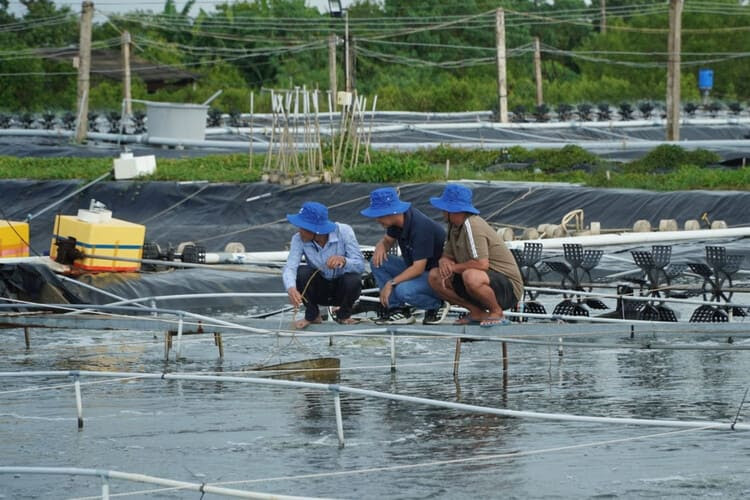 Scaling up biosecure and low-water-exchange recirculating shrimp farming models. Photo: Dan Viet
The structure of shrimp farming in the province is rapidly modernizing. Intensive and super-intensive farming areas now cover approximately 40,000 hectares, including 13,200 hectares under super-intensive production. At the same time, eco-shrimp farming integrated with mangrove protection remains a strategic priority, aligning with global green consumption trend and the market’s growing sustainability requirements.
Looking ahead, Ca Mau has set the goal of becoming the nation’s shrimp industry hub. To achieve this ambition, the local government has identified five key solution groups for focused implementation.
Accordingly, Ca Mau will continue to plan and develop concentrated farming zones aligned with the ecological conditions of each area, prioritizing high-tech super-intensive development alongside the conservation and expansion of ecological shrimp-forest and shrimp-rice models. The application of science, technology and digital transformation will be accelerated in broodstock management, feed control, environmental monitoring and disease prevention, while encouraging recirculating, low-emission farming models toward a circular economy and green growth.
Ca Mau is also focusing on synchronized infrastructure investment, particularly irrigation systems, power supply and transport networks serving farming zones. Key projects such as the Ca Mau - Dat Mui Expressway and the Hon Khoai multi-purpose port are being promoted to strengthen export logistics for shrimp products. Meanwhile, Ca Mau is encouraging the development of closed value chains, greater corporate investment in raw material zones, cooperative-based production and the branding of “Ca Mau Shrimp” associated with green standards, meeting the requirements of both domestic and international markets.