(seafood.vasep.com.vn) For many years, Vietnam’s seafood industry has been recognized as one of the country’s key export pillars. Products such as shrimp, pangasius, tuna, squid, octopus, and a wide range of other seafood have reached hundreds of markets worldwide. Yet behind these impressive export figures lies a significant challenge: a substantial share of Vietnam’s seafood export value still comes from minimally processed products, contract manufacturing, and raw material exports—segments characterized by low profit margins and high vulnerability to fluctuations in global prices.
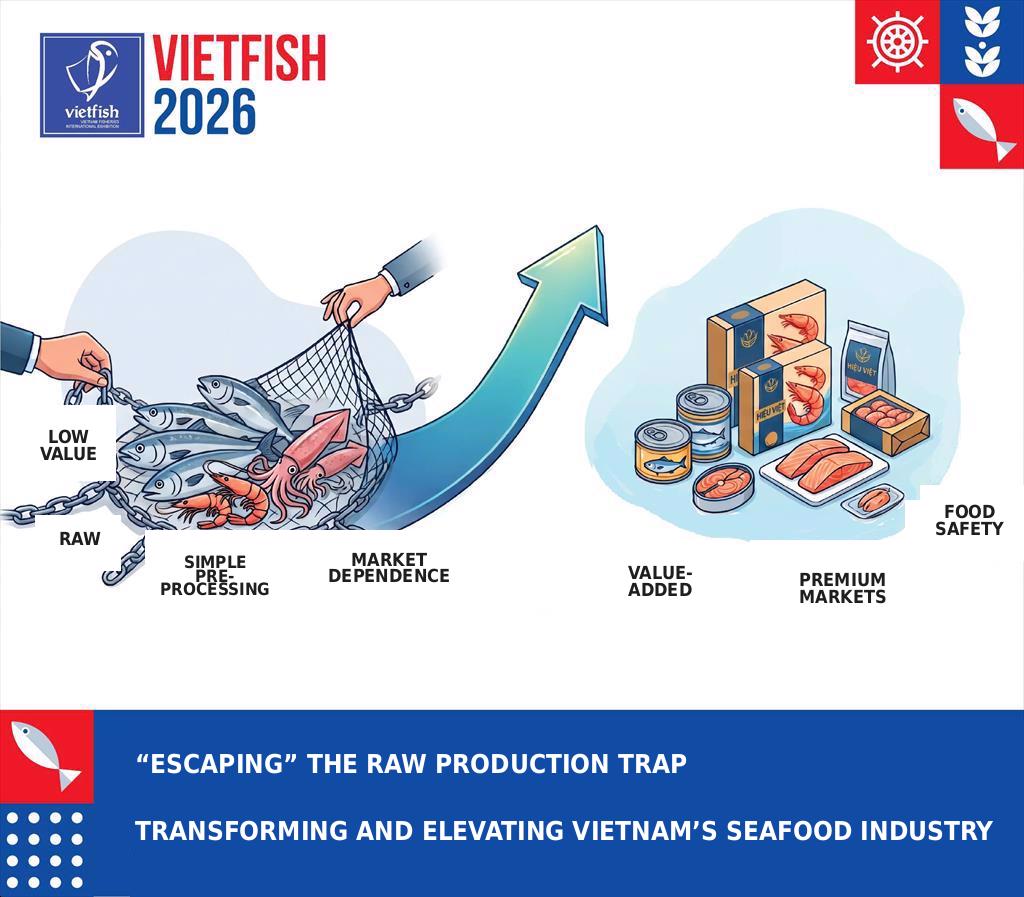
As international competition intensifies and market requirements become increasingly stringent, Vietnam’s seafood industry is approaching a critical turning point: moving beyond the low-value raw export model toward deep processing, value-added seafood products, and brand development. This transformation is not merely about changing product offerings; it represents a fundamental shift in business strategy, technological capability, and long-term corporate vision.
From raw exports to value creation
Traditionally, many Vietnamese seafood companies have focused on exporting minimally processed products such as frozen fillets, frozen shrimp, whole fish, semi-processed squid, or raw materials supplied to overseas processors, importers, and distribution networks. This business model enabled companies to integrate quickly into global supply chains by leveraging abundant raw materials and competitive labor costs.
However, the limitations of this model have become increasingly evident. Without deep processing, proprietary brands, or strong consumer positioning, companies are forced to compete primarily on price. As raw material, logistics, labor, energy, and compliance costs continue to rise, profit margins have become increasingly compressed.
Moreover, reliance on raw exports leaves companies heavily dependent on importers, intermediaries, and demand from a limited number of major markets. When importing countries introduce new regulations, technical barriers, or experience declining consumption, processors of minimally processed seafood often feel the impact immediately. As a result, investing in value-added seafood processing is no longer an experimental option but a strategic necessity for enhancing the competitiveness of Vietnam’s seafood industry.
Deep processing: Doubling or even tripling product value
One of the industry's most important development directions today is the production of value-added, convenient seafood products tailored to modern consumer preferences. Rather than exporting only frozen raw materials, companies are increasingly investing in products such as:
- Breaded shrimp, tempura shrimp, and sushi shrimp
- Pangasius portions, seasoned pangasius, and ready-to-cook grilled pangasius
- Conveniently packaged tuna products
- Ready-to-eat seafood and prepared frozen meals
- Seafood products designed for retail chains, restaurants, hotels, and e-commerce platforms
These products can generate significantly higher returns than minimally processed seafood. In many cases, once products are processed, packaged, branded, and marketed through appropriate distribution channels, their commercial value can increase by two to three times compared with raw exports.
This represents the difference between selling a frozen fish fillet and marketing a complete food product—with attractive packaging, a recognizable brand, carefully developed recipes, certified quality standards, sustainability credentials, and the convenience of being ready for consumers' kitchens around the world.
The shift toward value-added products also reduces dependence on price competition while enabling companies to access premium market segments, including modern retail chains, supermarkets, foodservice operators, hotels, and online grocery platforms.
A new mindset for Vietnam’s seafood enterprises
The transformation of Vietnam’s seafood industry is not driven solely by new production lines and advanced equipment—it begins with a strategic shift in corporate thinking. Instead of asking, "How can we sell more volume?" many companies are now asking, "How can we create greater value?"
Accordingly, seafood enterprises are focusing on several key priorities.
First, they are investing in advanced seafood processing technologies to improve product quality, extend shelf life, enhance food safety, and meet the specific standards of individual export markets.
Second, they are strengthening product development capabilities to create convenient foods tailored to the tastes and consumption trends of markets such as Japan, South Korea, Europe, the United States, and the domestic market.
Third, they are placing greater emphasis on building Vietnamese seafood brands—from packaging and origin stories to quality standards and sustainability commitments. In today's era of responsible consumption, a brand represents not only a logo but also trust in product quality, traceability, and environmental responsibility.
Fourth, companies are accelerating digital transformation, automation, and supply chain optimization to improve efficiency, reduce operational errors, increase productivity, and comply with increasingly demanding international requirements.
Vietfish 2026: Showcasing the transformation of Vietnam’s seafood industry
Against this backdrop, Vietfish 2026 – the Vietnam International Seafood Exhibition, taking place from August 19–21, 2026 at the Saigon Exhibition and Convention Center (SECC), Ho Chi Minh City, is expected to become one of the industry's most important annual events.
More than a conventional trade exhibition, Vietfish 2026 will showcase the evolving capabilities of Vietnam’s seafood sector—from value-added processing and innovative seafood products to automation technologies, cold-chain logistics, traceability solutions, modern packaging, and quality management systems.
The exhibition will provide companies with opportunities to introduce new product lines, demonstrate their compliance with international production standards, and connect with global buyers, importers, distributors, retailers, and technology providers. More importantly, it will serve as a platform for Vietnam to demonstrate that it is no longer merely a supplier of raw seafood materials, but an increasingly important producer of high-quality, value-added seafood products capable of competing successfully in global markets.
Vietfish 2026 will also strengthen connections between Vietnamese seafood companies and international retailers, distributors, and global supply chains—essential elements for building strong brands and expanding exports of value-added seafood products.
From increasing volume to increasing value
In the next phase of development, the success of Vietnam’s seafood industry will no longer be measured solely by export volumes, but by value creation, profitability, brand strength, and its position within global supply chains.
Escaping the "low-value raw export trap" is a long-term journey that requires sustained investment in technology, human resources, product innovation, quality standards, and market development. However, it is an essential path if Vietnam’s seafood industry is to achieve sustainable growth, enhance national value, and reduce its dependence on short-term market fluctuations.
Stay up to date with the latest news, event highlights, exhibitor information, and visitor registration for Vietfish 2026 by visiting the official website:
🌐 www.vietfish.com.vn
We look forward to welcoming you to Vietfish 2026 – Innovation • Sustainability!