(vasep.com.vn) Vietnam’s seafood exports in September 2026 are estimated at US$1.135 billion, up 11.9% year-on-year, bringing total exports in the first nine months of the year to US$9.103 billion, up 11.4%. Behind this double-digit growth, however, increasingly divergent market trends are emerging: China–Hong Kong and ASEAN posted strong growth, while the U.S., EU and Japan all recorded declines in September.
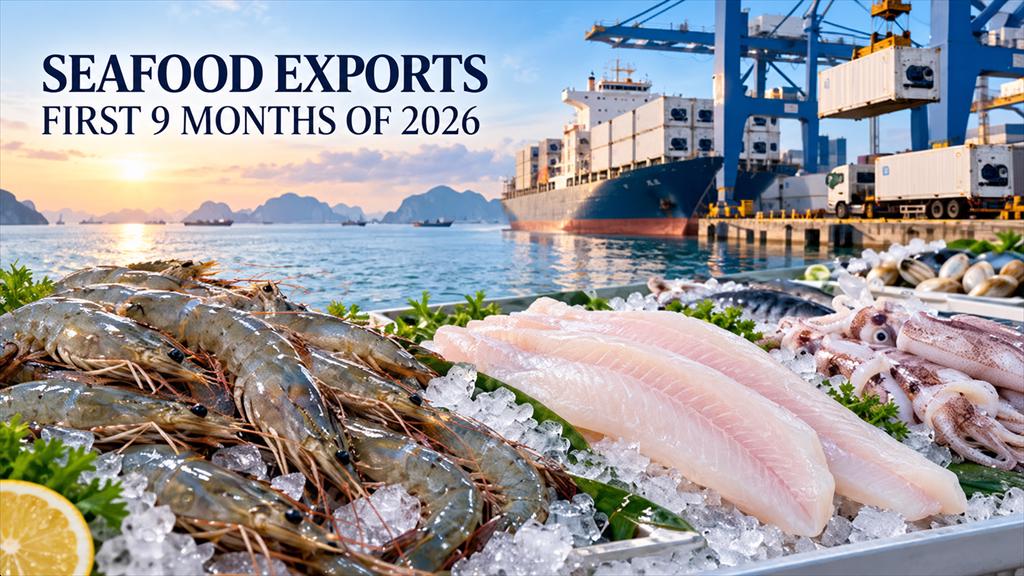
September export turnover remained above US$1.1 billion, with growth accelerating compared with August. However, export value was slightly lower than in the previous month. This suggests that the industry continued to maintain a high level of trade toward the end of the year, although growth remained uneven. Some product groups expanded rapidly, while shrimp, the largest export category, grew by only 3.9%.
Shrimp growth slows, while pangasius and marine products contribute more
Vietnam’s shrimp exports in September are estimated at US$467 million, bringing the nine-month total to US$3.75 billion, up 11%. Accounting for around 41% of total seafood exports, shrimp performance continues to have a major impact on the overall industry. The slower growth in September also indicates that further expansion in orders is facing pressure from supply competition and market absorption capacity.
Information presented at the Global Shrimp Forum in September showed that China’s shrimp imports were growing faster than consumption, while EU imports of raw shrimp declined and diverged across regions. In the U.S., frozen shrimp sales volumes fell in August despite higher revenue. These developments suggest that the growth in Vietnam’s shrimp exports cannot yet be considered a broad-based recovery in global demand.
Pangasius performed more positively in September, reaching approximately US$214 million, up 18.6%, bringing the nine-month total to US$1.74 billion, up 10.7%. Tighter supplies of some wild-caught whitefish have created additional opportunities for pangasius. In Japan, Kyokuyo’s continued promotion of pangasius through professional distribution channels is a noteworthy development, although the market remains relatively small. Competitive pricing and stable supply are helping the product attract greater interest.
Tuna exports reached approximately US$82 million in September, up 13.1%, bringing the nine-month total to US$716 million, up 3.5%. Monthly growth was stronger than the cumulative result, but the outlook remains dependent on import conditions in the U.S. and catch documentation requirements in the EU. Improving sales of canned tuna in the U.S. are supporting demand, but this has not yet translated into a corresponding increase in orders from Vietnam.
Other seafood groups also made significant contributions. Exports of fish and other fish products reached US$1.741 billion in the first nine months, up 12.2%; squid and octopus exports totaled US$606 million, up 15.4%; and crab, other crustaceans and related products reached US$354 million, up 31.6%. Shellfish exports continued to grow by 25.2% cumulatively, reaching US$231 million, although September alone recorded a 3.5% decline, indicating that growth momentum is beginning to slow.
China and ASEAN offset declines in major markets
China–Hong Kong was the standout market, with September export turnover reaching approximately US$315 million, up 39.9%. Cumulative exports reached US$2.3 billion, up 33%, accounting for around one-quarter of Vietnam’s total seafood exports. Based on the available data, the additional export value generated by this market accounted for approximately 62% of the industry’s total year-on-year increase.
Nevertheless, Chinese purchasing power needs to be viewed alongside domestic supply and competing imports. The resumption of fishing activities in the Yellow Sea–Bohai Sea area from early September has increased domestic seafood supplies, while the restoration of export eligibility for some Ecuadorian shrimp facilities has expanded buyers’ options. Vietnam’s strong growth may therefore come with increasing price pressure.
ASEAN exports reached nearly US$84 million in September, up 45.4%, bringing the nine-month total to US$620 million, up 21%. South Korea also recorded 16.4% growth in September, bringing nine-month exports to US$652 million, up 6.1%. Together with other markets, which recorded cumulative growth of 17.3%, these results have helped sustain overall industry growth as traditional markets face challenges.
Exports to the U.S. fell 3.4% in September to US$176 million, while the nine-month total reached US$1.43 billion, up just 0.9%. Additional tariff costs and MMPA and COA requirements continue to affect trade. Retail demand is also becoming increasingly mixed: canned seafood sales volumes increased, while fresh and frozen products recorded higher revenue mainly due to higher prices.
Exports to the EU declined 12.8% in September to US$93 million, bringing the nine-month total to US$843 million, down 3%. Japan recorded a 13.7% decline in September, leaving nine-month growth at just 0.8%, with export value reaching US$1.25 billion. The simultaneous declines in these two markets indicate that positive performance from pangasius and processed products has not been sufficient to drive overall growth across all product categories.
Growth slows in Q4, with full-year exports potentially reaching US$12 billion
Following the acceleration seen in the third quarter, Vietnam’s seafood exports are expected to slow in the fourth quarter. Many orders for year-end consumption have already been imported and delivered earlier, making it difficult for additional demand to remain at the high levels seen in recent months. With nine-month exports estimated at US$9.103 billion, full-year exports could reach approximately US$12 billion.
Challenges are emerging from both supply and demand. Shrimp, pangasius and tilapia are all facing limitations in raw material availability, while market competition is intensifying and buyers are becoming more cautious about prices. Wild-caught seafood exports are also constrained by limited supplies of suitable raw materials and increasingly stringent origin and traceability requirements. Therefore, even where demand remains, exporters’ ability to fulfill orders may be constrained.
China–Hong Kong and ASEAN will continue to support Vietnam’s seafood exports, but are unlikely to fully offset the slowdown in the U.S., EU and Japanese markets. Fourth-quarter export performance is likely to be lower than in the third quarter. Full-year exports may still exceed last year’s level, but the growth rate is expected to narrow significantly from the double-digit pace recorded during the first nine months of 2026.