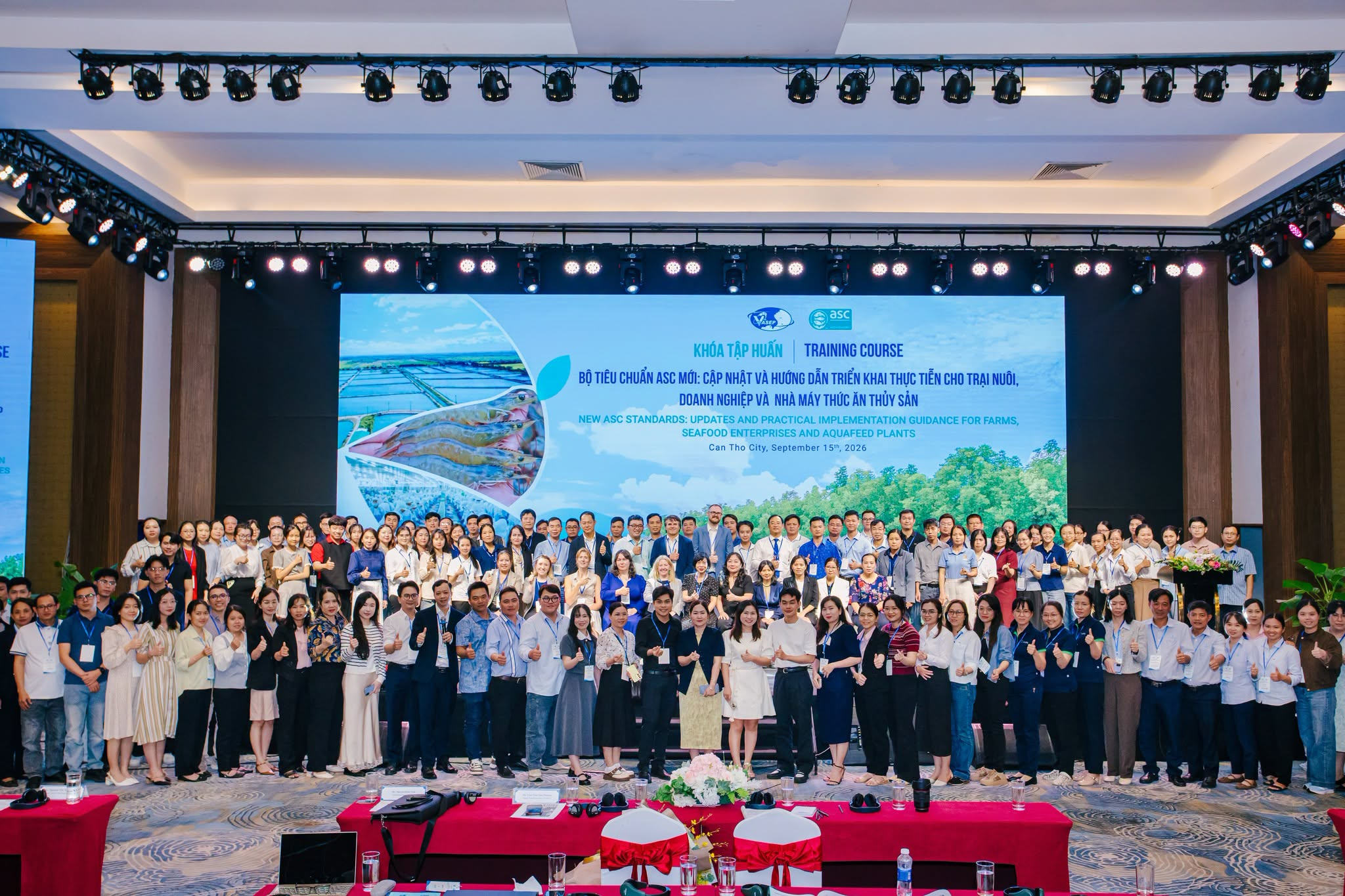
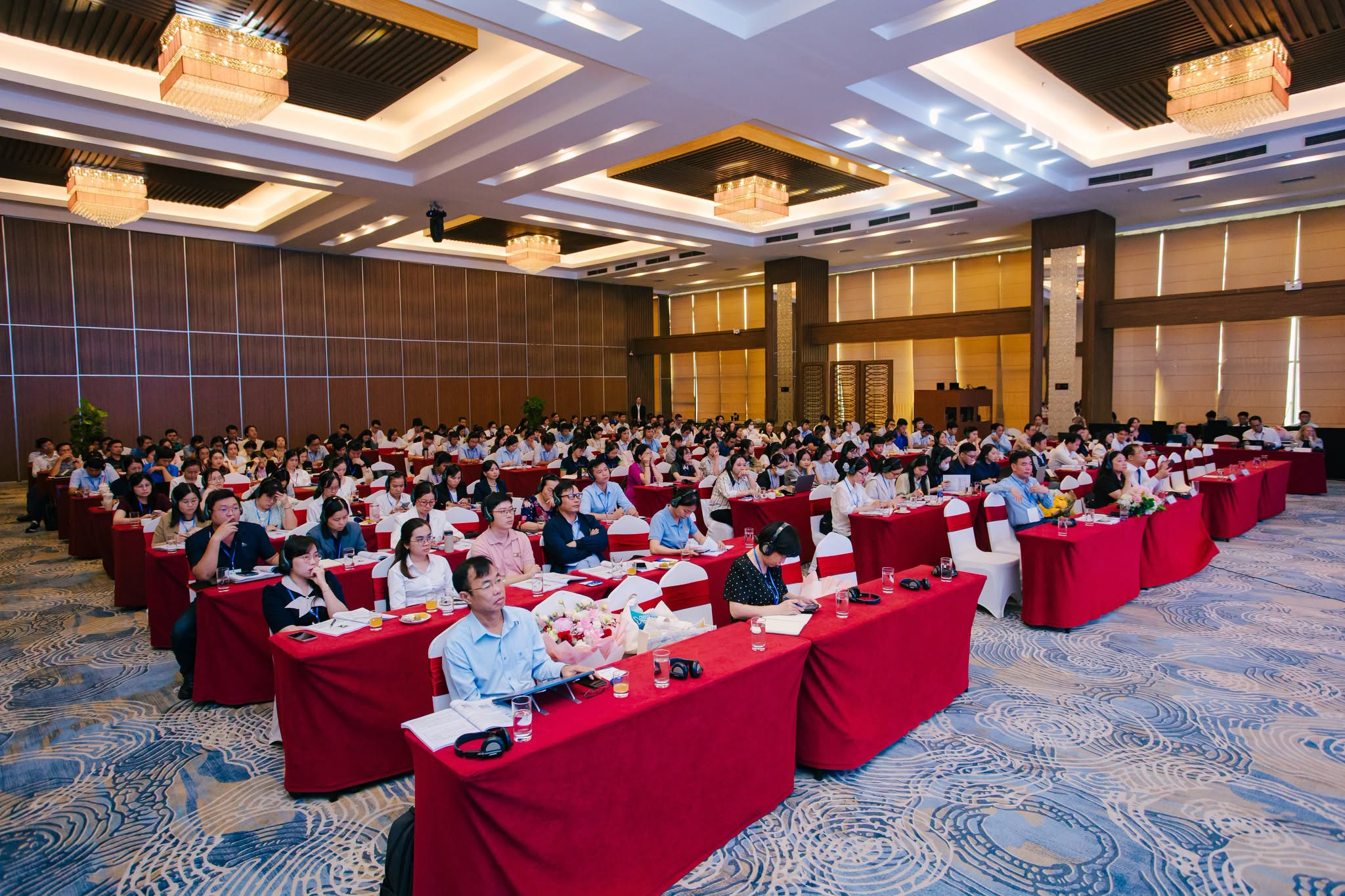
(vasep.com.vn) On September 15, 2026, in Can Tho, VASEP and ASC jointly organized a training course titled “New ASC standards: updates and practical implementation guidance for farms, businesses and aquafeed mills”. Beyond briefing stakeholders on updated ASC requirements for aquaculture facilities and feed production, the workshop dedicated substantial floor time to directly addressing on-the-ground compliance bottlenecks encountered by Vietnamese enterprises.
The training drew senior ASC specialists across standards development, environmental issues, human rights, animal health and welfare, aquafeed and the Aquaculture Improvement Program, along with representatives from VASEP and the business community.
The program covered key topics including the new ASC Farm Standard, traceability and assurance systems, environmental and social requirements, animal health and welfare, the ASC Feed Standard and the ASC Improver Program.
ASC shifts toward a whole-of-chain approach
According to information shared by ASC at the training, aquaculture will continue to play an increasingly important role in the global food supply. ASC forecasts that by 2030, seafood demand will increase by around 17% with farmed seafood supplying roughly 60% of total consumption as aquaculture output grows by 27% - with shrimp positioned as a core growth pillar.
ASC’s new approach therefore extends beyond farms to cover the entire chain, from feed ingredients and feed mills to farms, supply chains and final products. The new ASC Farm Standard is being developed to gradually replace separate standards for individual species, while strengthening requirements related to management, traceability, environmental and social performance, as well as animal health and welfare.
Vietnam is currently an important market within the ASC system. According to ASC, after 14 years of ASC certification in Vietnam, the number of certified shrimp farms has increased significantly. Vietnam currently ranks third in ASC-certified shrimp production and is the largest producer of ASC-certified pangasius.
Notably, social responsibility requirements are becoming increasingly specific. Principle 3 of the new Farm Standard includes 115 requirements across 13 areas, covering forced labor, child labor, discrimination, occupational health and safety, wages, working hours, grievance mechanisms and community engagement.
Regarding animal health and welfare, ASC emphasized the institutionalization of facility-tailored health management plans, systematic disease monitoring, robust biosecurity measures, water quality control, mortality rate mitigation, and strict standards governing harvest handling and humane slaughtering practices.
Feed becomes a crucial link in the certification chain
A key area drawing significant attention from enterprises was the ASC Feed Standard and raw material traceability requirements.
According to data released by ASC at the program, 148 feed mills in 34 countries are currently participating in the ASC program, including 124 certified mills and 24 undergoing assessment. Vietnam accounts for 20 mills in the program, including 13 certified sites and seven undergoing assessment.
The standard sets requirements covering the entire chain, from labor conditions, environmental performance and governance at feed mills to supplier due diligence, traceability of marine and plant-based ingredients, deforestation risks and land-use change. This demonstrates that responsibility for meeting market requirements is increasingly extending further upstream into the aquaculture supply chain.
VASEP relays 10 clusters of industry bottlenecks to ASC
A notable feature of the program was a dedicated session on recommendations and practical challenges faced by Vietnamese businesses.
VASEP representatives synthesized 10 major issue clusters raised by enterprises: antibiotic regulations and animal welfare; the TraceASC traceability system; buffer zones; salinity and groundwater levels; waste management; certification validity and suspension timing; assessment of multi-species farming areas; retrospective application of certification validity and several legal issues specific to Vietnam.
Responding directly at the event, ASC representatives clarified several pivotal points
Regarding antibiotics, ASC stated that the use of antibiotics for disease prevention is prohibited. However, when farmed animals become ill, treatment for animal welfare purposes is permitted. Shrimp lots that have undergone treatment must be segregated and cannot be sold as ASC-certified products. Regarding SEM, ASC acknowledged that the substance may occur naturally or be present at background levels in shrimp shells, and confirmed that residue testing must be conducted on the edible tissue—the shrimp meat—rather than the entire shrimp.
Regarding TraceASC, ASC said commercial data such as productivity, feed usage and stocking density would not be shared with competitors. To reduce repetitive data entry, ASC is developing a bulk data upload function using Excel and allowing management systems that comply with GDST to connect via API.
For issues related to buffer zones, groundwater and waste management, ASC also said it is applying or considering more flexible, risk-based approaches that take actual conditions into account. In particular, groundwater-level monitoring requirements apply only to farms located in areas classified as having “high” or “extremely high” water stress. For packaging of non-antibiotic chemicals, if Vietnamese law classifies the material as non-hazardous recyclable material, farms can demonstrate compliance through legal documentation and records from licensed recycling facilities.
From Certification Compliance to Whole-Chain Improvement
Beyond facilities already primed for certification, the ASC highlighted the ASC Improver Programme (AIP), designed to provide a phased pathway for farms and supply chains unable to meet full compliance immediately.
Aquaculture Improvement Projects under the AIP framework run for a maximum of three years, starting with a formal gap analysis, proceeding through milestone-based implementation, and undergoing independent verification with publicly disclosed progress reports. The objective is to establish a verifiable roadmap toward eventual ASC certification once prerequisites are met.
The training course in Can Tho therefore did more than help businesses update their understanding of a new set of standards. More importantly, it provided a forum for international requirements to be assessed against actual production conditions in Vietnam, enabling businesses to identify compliance gaps at an early stage while bringing unresolved issues to ASC for further consideration and refinement of implementation guidance.
As importing markets increasingly focus on traceability, social responsibility, animal welfare and even the sourcing of feed ingredients, proactive updates and early preparation will help Vietnam’s seafood supply chain reduce compliance risks and maintain access to markets with stringent requirements.