(vasep.com.vn) At the seminar “Global Seafood Markets and the Future Workforce: Trends, Opportunities and Directions for the Sustainable Development of Vietnam’s Fisheries Sector,” held as part of VIETFISH 2026, Ms. Shirlene Maria Anthonysamy, Fisheries Officer (Markets) and GLOBEFISH Coordinator at the Food and Agriculture Organization of the United Nations (FAO), presented initiatives aimed at promoting youth participation in fisheries and aquaculture.
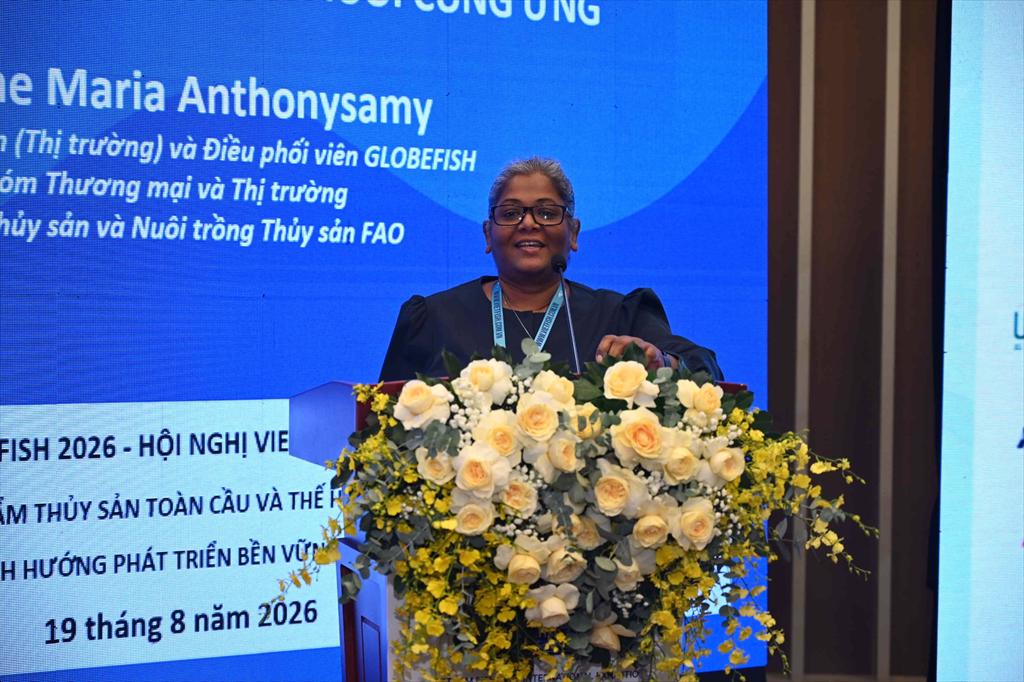
From the perspective of FAO GLOBEFISH, attracting young people is not simply about adding to the workforce. It is essential to ensuring generational succession, embracing new technologies, and building a capable pool of future leaders who can drive the value chain forward.
For many years, the fisheries sector’s workforce challenge has primarily been viewed through the lens of recruitment needs. FAO GLOBEFISH takes a broader approach: young people should not only be encouraged to enter the sector, but also given opportunities to learn, work, innovate and build a long-term professional identity within it.
Generational Renewal: A Prerequisite for Sustainable Development
The fisheries sector is simultaneously facing the need to protect resources, address climate change, respond to shifting consumer demand, embrace digitalization, ensure food safety, and meet increasingly stringent market standards. Without a new generation of workers, the entire value chain will struggle to preserve existing knowledge and will find it even more difficult to acquire and apply new skills.
According to FAO, youth participation goes beyond employment. It contributes to food security, sustains coastal livelihoods, preserves occupational heritage and creates momentum for innovation. However, young people still face barriers such as limited access to information, difficulties in accessing finance, unstable employment and limited opportunities to participate in policymaking.
Lessons from Different Countries
The experiences presented show that Norway has been more successful in achieving generational renewal thanks to the image of a technology-driven sector, a well-developed vocational education system and clear career pathways. Italy has maintained strong coastal community identities and family-based knowledge transfer, but its workforce continues to age due to economic pressures and an aging fishing fleet, which reduce the attractiveness of the profession.
In China, youth participation has increased alongside industrialization, technological development and the expansion of research in aquaculture. By contrast, the Philippines has faced difficulties in attracting young people to small-scale fisheries due to low incomes, high occupational risks and limited opportunities for career development.
The common lesson is that education, technology and clear career pathways are the three most powerful levers. Cultural traditions are important, but they cannot substitute for decent working conditions, appropriate incomes and opportunities for career advancement.
From Encouraging Participation to Building an Ecosystem
FAO GLOBEFISH proposes focusing on areas directly linked to the post-harvest value chain, markets and trade, including skills development; food safety; international trade; loss and waste reduction; labelling, certification and traceability; climate change; social responsibility; gender equality; digital technologies; access to finance; and infrastructure.
Ongoing activities include education and communication initiatives, youth-friendly publications, webinar series, interviews and career storytelling, as well as national-level surveys and assessments. This approach transforms young people from passive recipients of information into active participants in programme design.
GLOBEFISH is also a member of the FISHINFONetwork, a network connecting fisheries market information and advisory organizations across different regions. This platform creates opportunities for youth programmes to go beyond national boundaries and develop into international exchanges, internships and knowledge-sharing initiatives.
An Opportunity to Build VASEP NextGen
For Vietnam, developing a new generation of talent needs to reflect the sector’s dual characteristics. In industrial aquaculture and processing, demand is growing rapidly for skills in technology, data, automation, traceability and markets. In small-scale fisheries, the core issues are instead income, occupational safety, working conditions and the long-term viability of livelihoods.
VASEP NextGen could serve as a platform connecting four key stakeholders: government agencies, the association, businesses and educational institutions. The programme should go beyond networking activities to establish mentoring systems linking business leaders with young professionals, internship networks, future-skills training, innovation competitions, and opportunities for young people to participate in real-world business projects.
Proposed Cooperation between Vietnam and FAO GLOBEFISH
The presentation proposed that the two sides jointly organize seminars and training programmes; establish a national network involving universities, training organizations and businesses; create internship opportunities at FAO GLOBEFISH; promote activities at universities; contribute to GLOBEFISH publications; and provide data and support surveys on youth in fisheries and aquaculture.
VASEP could serve as the business focal point for this initiative. A suitable starting point would be to conduct a national survey on the skills needs and barriers facing young people, select a number of businesses and universities to pilot an internship-and-mentoring programme, and then evaluate the results before scaling it up.
The final message is clear: the fisheries sector cannot simply ask young people to carry the profession forward. The sector itself must change to become a career of choice — more modern, safer, fairer and with clearer pathways for professional development. When these conditions are in place, young people will not merely join the sector; they will have the opportunity to become the driving force behind its transformation.