(seafood.vasep.com.vn) Vietnam's tilapia exports to Japan posted strong growth in the first half of 2026, while a promising new trend has emerged in the value-added product segment. Notably, Vietnamese tilapia fillets have been exported to Japan for use in sushi and sashimi, creating new opportunities to enhance the value of the industry in one of the world's most demanding seafood markets.
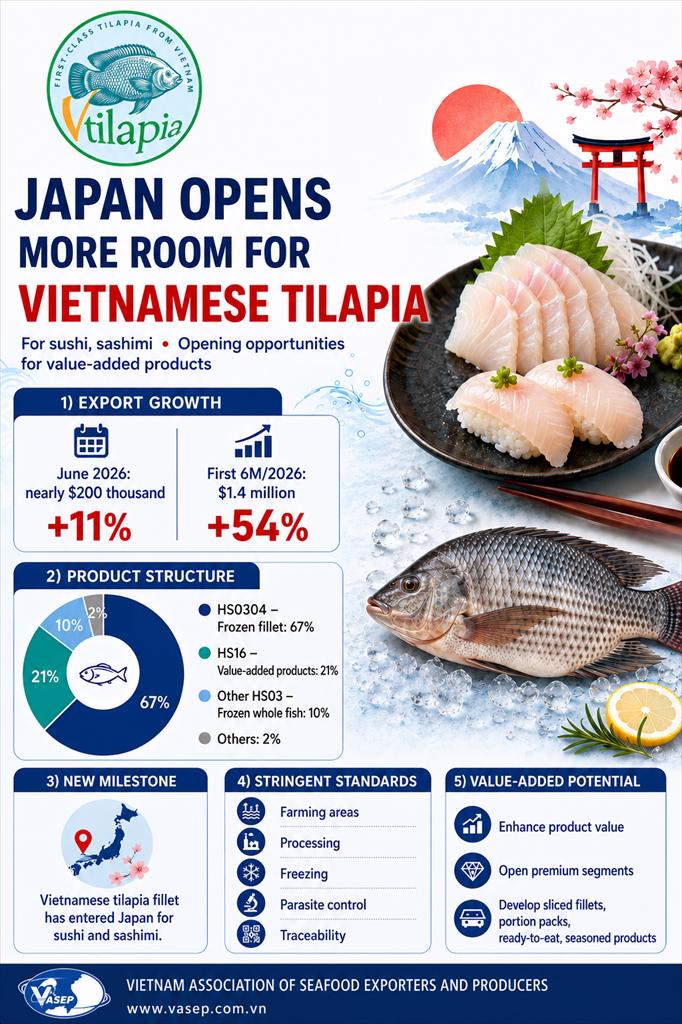
Exports up 54% in the first half of 2026
According to trade statistics, Vietnam's tilapia exports to Japan reached nearly USD 200,000 in June 2026, up 11% year-on-year. Cumulative exports for the first six months of the year totaled approximately USD 1.4 million, representing a 54% increase compared with the same period in 2025.
Frozen tilapia fillets under HS code 0304 accounted for the largest share of exports, making up approximately 67% of total export value. Other frozen fish products under HS Chapter 03 represented 10%, while value-added products under HS Chapter 16 accounted for around 21%, with the remainder consisting of other product categories.
This export structure indicates that Vietnam's tilapia shipments to Japan remain heavily concentrated in frozen fillets, while demand for higher-value processed products has begun to emerge.
From a conventional whitefish to a sushi ingredient
One of the most notable milestones in 2026 has been the successful export of Vietnamese tilapia fillets to Japan for sushi and sashimi processing. After years of investment in farming and processing systems tailored to the premium value-added food segment, the products have received positive feedback from Japanese customers for both quality and taste.
To be used in sushi and sashimi, tilapia must comply with stringent requirements covering farming conditions, water quality, raw materials, processing, freezing technology, parasite control, food safety, and full traceability. The successful entry of Vietnamese products into this segment demonstrates that domestic producers are now capable of managing the entire production chain and meeting the rigorous standards of a high-end market.
The appearance of Vietnamese tilapia on sushi menus also helps reshape market perceptions of the species. Once regarded primarily as a whitefish exported in whole or frozen fillet form, tilapia is now being positioned as an ingredient for premium products that demand higher standards of quality, presentation, and culinary experience.
Creating new room for value-added products
Compared with the United States and Brazil—which currently account for a larger share of Vietnam's tilapia exports—Japan may not generate dramatic export volumes in the short term. However, the market's strategic value lies in its ability to establish benchmark quality standards and pave the way for premium processed seafood products.
Successfully exporting tilapia for sushi and sashimi not only increases the value generated from each unit of raw material but also creates opportunities for processors to develop a broader portfolio of products, including sliced fillets, portion-controlled packs, ready-to-eat items, seasoned products, and other value-added offerings.
The 54% export growth recorded in the first half of 2026, together with the shift toward frozen fillets and value-added products, suggests that Japan is opening a new avenue for Vietnam's tilapia industry. Beyond market expansion, this development marks an important step in the industry's transformation—from exporting conventional seafood products to supplying premium, high-value segments with stringent quality requirements.