(vasep.com.vn) Total export value in 9 months reached over US$ 206 million, up nearly 31% year on year. It is the surge in exports to key markets such as China, Taiwan and Russia, especially to Russia (particularly upped 118% year on year), that boosted the export value of this commodity.
South Korea: In these 4 months, Vietnam surimi exports to Korea have grown gradually. Korea, importing 32% of total surimi from Vietnam, continued to be the biggest consumption market in the first 9 months of 2014, with the total export value of over US$ 66.7 million, up 5% year on year.
Statistics from International Trade Centre (ITC) reveals that from January to August, surimi imports of Korea were equivalent to that of the same period last year. Vietnam, made up over 54% of total surimi imports of Korea, was the biggest major supplier to South Korea. China was the runner-up with nearly 18% of the market share.
ASEAN: This year, surimi imports of ASEAN countries (except for Vietnam) tends to increase compared to the same period last year. ASEAN is currently importing these items from more than 35 countries inside and outside the block. In particular, Vietnam and Indonesia are two countries most exported products to ASEAN countries.
Until September 2014, surimi imports from Vietnam to ASEAN have enjoyed 2-digit growth rates. Particularly in September, export value surimi from Vietnam into Thailand upped nearly 47%, into Singapore upped nearly 28% and into Malaysia upped nearly 50%. Total surimi export value to ASEAN in the first 9 months of 2014 reached over US$ 47 million, up 53% year on year. Thailand, as the biggest surimi import market in ASEAN, was also known as the biggest importer of surimi from Vietnam. It is noted that exports from Thailand were on upward trend.
China: In September 2014, China, made up over 15% of Vietnam’s total surimi exports, kept on its rank at No. 3 in Vietnam’s surimi markets. Vietnam surimi exports to China in the first 9 months of 2014 reached nearly US$ 31 million, up 58%year on year.
Japan: From January to August 2014, Japan’s surimi imports were more than US$ 372 million, upped nearly 13% year on year. Thailand, the origin for 20% of total surimi imported by Japan, was the leading surimi supplier to Japan. After July, China surpassed Vietnam to be ranked the 2nd in surimi exports to Japan. Vietnam surimi exports to Japan were accounted for over 7.2% of total surimi imported of Japan. According to Vietnam Customs, surimi exports from Vietnam from January to September 2014 reached over US$ 24 million, up over 48% year on year.
Russia: After seafood import ban, whitemeat fish imports for process to Russia decreased. In order to compensate for the decline, Russian enterprises shifted their imports to Asian countries. As a result, in September, Vietnam’s surimi exports to Russia rocketed with growth rate of 143%. Surimi exports from Vietnam to Russia in the first 9 months of 2014 reached over US$ 8 million, up 118% year on year.
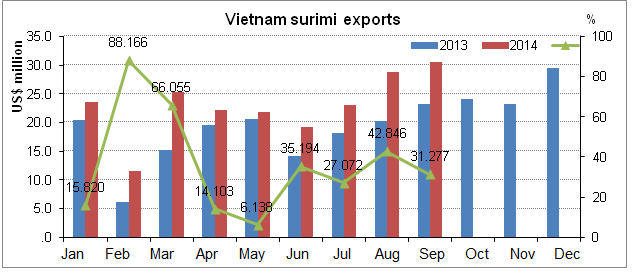
Marine catch of Vietnam in the first 9 months of 2014 upped year on year, solving raw material problems. Surimi exports of Vietnam are expected to continue their increasing trend until the end of the year.