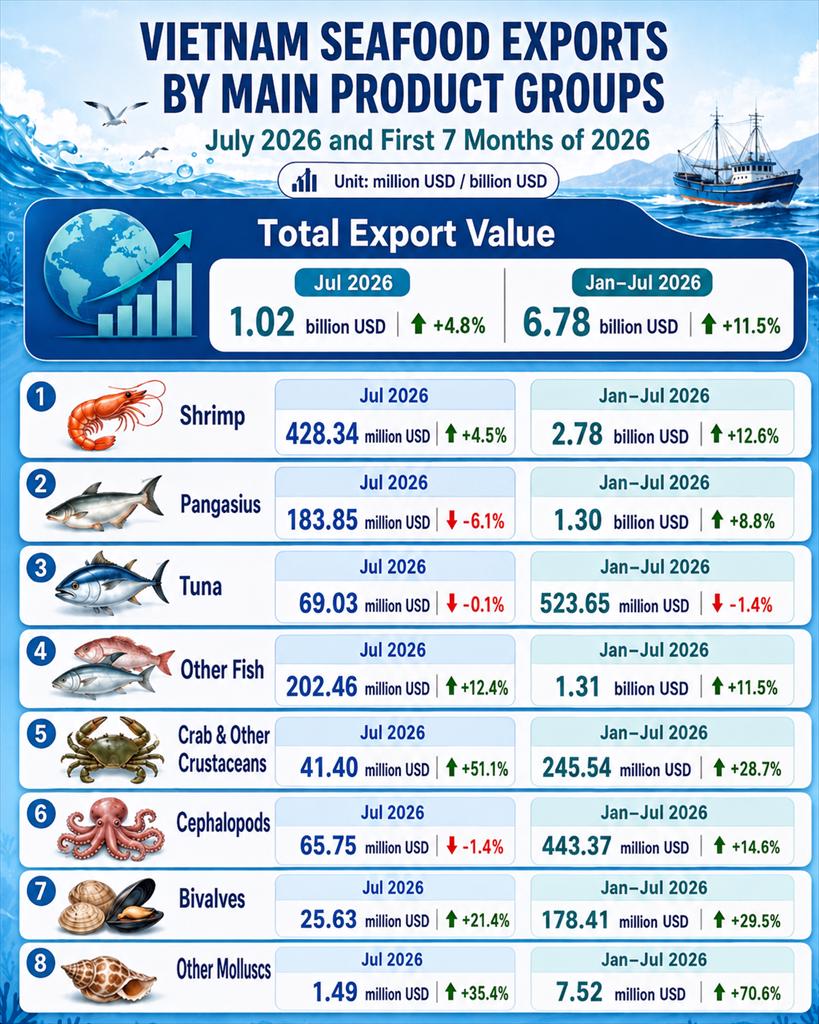
(seafood.vasep.com.vn) Vietnam’s seafood exports reached nearly USD 1.02 billion in July 2026, up 4.8% compared with the same month in 2025. In the first seven months of the year, export turnover totaled nearly USD 6.78 billion, an increase of 11.5% year on year. Surpassing the USD 1 billion mark in July further reinforces expectations that Vietnam’s seafood exports could exceed USD 12 billion for the full year.
However, the July figures also send a clear signal that the most favorable phase of growth may have passed. Overall export growth slowed to 4.8%, while pangasius exports declined 6.1%, tuna exports were virtually flat, and shipments to the EU, South Korea, and the Middle East all recorded double-digit declines.
More importantly, beginning 24 July, Vietnamese seafood exports to the United States became subject to an additional 12.5% Section 301 tariff. Due to the lag between contract signing and shipment arrival, the full impact has not yet been reflected in July export data but is expected to become more apparent from August onward and throughout the fourth quarter.
Shrimp exports reach USD 2.78 billion, but Ecuador is rapidly expanding in Vietnam’s core market segments
Shrimp exports totaled more than USD 428 million in July, up 4.5% year on year. During the first seven months, exports reached nearly USD 2.78 billion, increasing 12.6% and accounting for approximately 41% of Vietnam’s total seafood export value.
The 4.5% growth recorded in July was considerably lower than the average growth rate during the first seven months, indicating that shrimp exports are still expanding but at a slower pace than earlier this year. A significant share of current growth is driven by lobster exports to China, while whiteleg shrimp and black tiger shrimp face increasingly intense competition in the U.S., EU, and Japanese markets.
The greatest competitive pressure comes from Ecuador. Ecuadorian shrimp production continues to expand rapidly, not only in head-on shrimp but also in headless, peeled, and value-added products. This marks an important shift, as Ecuador is moving beyond its traditional role as a low-cost raw shrimp supplier to compete directly with Asian processors in the value-added segment.
In the U.S. market, Vietnam also faces a tariff disadvantage. Under the USTR decision issued on 23 July, Vietnamese seafood is subject to a 12.5% Section 301 tariff, while Ecuador, India, Indonesia, and several competing suppliers face a 10% rate.
Although the 2.5 percentage-point difference may appear modest, it is significant for frozen shrimp contracts with thin profit margins. The new tariff is also applied in addition to MFN duties and any applicable anti-dumping or countervailing duties, depending on the country and exporter. As a result, U.S. importers have stronger grounds to request Vietnamese suppliers to lower prices, share tariff costs, or shorten contract terms.
Shrimp export performance during the remainder of the year will largely depend on three factors: China's demand for lobsters, Vietnam's ability to retain value-added shrimp orders in Japan and the EU, and the extent to which U.S. buyers shift purchases toward Ecuador, India, or Indonesia after the new tariff takes effect.
Pangasius exports fall 6.1% in July, but high cod and pollock prices create new opportunities in the EU
Pangasius exports reached nearly USD 184 million in July, down 6.1% year on year. Nevertheless, exports during the first seven months still totaled nearly USD 1.3 billion, up 8.8%.
The July decline reflects adjustments by major markets following strong purchasing during the first half of the year. Chinese buyers slowed purchases of certain larger-sized fish, while exports to the United States have yet to show a meaningful recovery. Consequently, domestic raw material prices have become increasingly differentiated by fish size: medium-sized fish suitable for EU fillet production are selling better than larger fish primarily destined for China.
Despite this, pangasius is presented with an important opportunity in the global whitefish market. Prices for Atlantic cod, haddock, and Alaska pollock remain elevated due to lower catch quotas, rising harvesting costs, and ongoing uncertainty surrounding Russian supplies. This has encouraged European processors to increasingly consider pangasius and tilapia as alternatives for fish fingers, fish burgers, frozen meal portions, and foodservice applications.
This opportunity does not mean pangasius will automatically replace cod or pollock. EU buyers continue to require sustainability certification, traceability, consistent fillet color, and reliable long-term supply programs.
Beginning 10 January 2026, EU importers are required to use the CATCH system to submit catch certificates and related documentation for imported wild-caught seafood. Information from paper certificates—including product codes, species, fishing vessels, and fishing trips—must be entered accurately.
Although CATCH does not apply directly to farmed pangasius in the same way, it increases compliance costs and risks for wild-caught whitefish products, creating a relative advantage for pangasius if exporters successfully position it as a substitute. Nevertheless, Vietnamese pangasius continues to be indirectly affected by the seafood sector's IUU yellow card and the cautious purchasing approach adopted by EU importers.
Pangasius exports could recover in the fourth quarter if exporters secure contracts replacing cod and pollock during the year-end consumption season. Greater potential lies in portion-cut, breaded, and ready-to-cook products rather than continuing to rely almost exclusively on frozen fillets.
Tuna exports reach USD 524 million but lose growth momentum
Tuna exports totaled more than USD 69 million in July, slipping 0.1%, while cumulative exports during the first seven months reached nearly USD 524 million, down 1.4% year on year.
The July data suggest that the strong growth recorded in June was largely temporary. Many shipments were delivered ahead of the implementation of the new U.S. tariff policy, causing July exports to return to virtually flat growth.
Tuna is among the sectors facing the strongest double impact in the U.S. market. First, the 12.5% Section 301 tariff is added to existing import duties. Second, the Marine Mammal Protection Act (MMPA) requirements have been fully enforced since 1 January 2026 for fisheries that have not been recognized as comparable by the United States.
NOAA has confirmed that Vietnam is among the countries denied comparability recognition for certain fisheries. Products sharing the same country of origin and HTS codes as restricted fisheries must therefore be accompanied by an Admissibility Certification of Origin (COA) to demonstrate that the species, fishing area, and harvesting method are not subject to import restrictions.
For tuna, these requirements directly affect both domestically harvested raw materials and imported tuna processed in Vietnam. Exporters must maintain full traceability covering fishing vessels, fishing gear, fishing grounds, harvesting countries, and consistency between the COA and import documentation. Even minor discrepancies in fishery codes, fishing areas, or HTS classifications may result in shipments being detained for inspection.
In the EU market, tuna continues to face pressure from the IUU yellow card, the CATCH system, and EVFTA rules of origin. Imported raw materials sourced outside the agreement often fail to satisfy origin requirements or become subject to tariff quotas. Consequently, although skipjack tuna prices may occasionally improve, any benefit from lower raw material costs is difficult to offset rising compliance expenses and tariffs.
Tuna exports are therefore unlikely to experience significant growth during the remainder of the year. Markets such as Russia, Egypt, Israel, the Philippines, and CPTPP members may partly compensate for weaker exports, but their scale remains insufficient to replace demand from the U.S. and EU.
Crab exports surge 51%, becoming July's fastest-growing seafood category
Exports of crabs and other crustaceans exceeded USD 41 million in July, jumping 51.1%, while cumulative exports reached nearly USD 246 million, up 28.7%. Exports of bivalve mollusks totaled USD 25.6 million, increasing 21.4%, with seven-month exports exceeding USD 178 million, up 29.5%.
These were the two fastest-growing seafood categories during July. For crabs, the U.S. remained a key market. On 11 May 2026, NOAA reinstated comparability recognition for Vietnam's swimming crab fishery following an additional review, eliminating the risk of an import ban for this fishery.
However, recognition does not eliminate COA requirements for designated HTS codes. Exporters must still prove that shipments are not sourced from restricted fisheries or ineligible raw materials. Since NOAA may continue updating its lists of HTS codes, fisheries, and fishing areas, documentation risks remain.
Bivalve mollusk exports continued growing thanks to demand from the EU, the United States, and several Asian markets. Nevertheless, clams and other coastal harvested products are also subject to increasingly stringent requirements regarding harvesting areas, food safety, and traceability.
By contrast, cephalopod exports reached nearly USD 66 million, down 1.4% in July, although cumulative exports still increased 14.6%. The monthly decline suggests that the growth momentum for squid and octopus is beginning to weaken as raw material prices remain high and demand softens in several Asian markets.
Exports to China rise 24.7%, while the EU and South Korea post double-digit declines
China and Hong Kong remained Vietnam's largest seafood market in July, importing more than USD 267 million, up 24.7% year on year. During the first seven months, exports reached nearly USD 1.74 billion, an increase of 34.5%.
Much of the seafood sector's overall export growth has come from this market. Lobsters, whiteleg shrimp, pangasius, crabs, and several other seafood products have all benefited. Without the additional USD 445 million generated by exports to China and Hong Kong during the first seven months, Vietnam's overall seafood export performance would have been considerably less positive.
Exports to the United States exceeded USD 159 million in July, increasing 6.3%, while cumulative exports reached more than USD 1.05 billion, up just 0.3%. These figures do not yet fully reflect the impact of the Section 301 tariff, as the new measure was announced by USTR only on 23 July. Its full effects will become more evident in shipments cleared from late July onward.
Exports to Japan totaled more than USD 144 million in July, rising 3.8%, while cumulative exports increased 2.6%. Exports to CPTPP markets reached more than USD 1.783 billion during the first seven months, up 8.1%, making the bloc one of Vietnam's more stable export regions.
By contrast, exports to the EU declined 10.9% in July and 2.7% during the first seven months. South Korea fell 10.8% in July, ASEAN decreased 6%, and the Middle East dropped 16%.
The EU decline reflects not only weaker demand but also stricter compliance requirements. Since the beginning of 2026, the digitalization of documentation through the CATCH system has increased the risk of customs delays whenever catch certificates, product codes, weights, vessel information, or processing records are inconsistent. CATCH became mandatory for EU importers on 10 January 2026, covering seafood products under Chapter 03 as well as HS 1604–1605.
Section 301 tariffs will become fully visible from August
Despite achieving USD 6.784 billion in exports during the first seven months, making the USD 12 billion annual export target still achievable, growth during the remainder of the year is expected to slow considerably from the current 11.5% pace.
The most direct challenge comes from the U.S. Section 301 tariff. The 12.5% tariff imposed on Vietnam has three immediate implications.
First, new contracts with U.S. buyers are likely to be renegotiated, with importers requesting lower FOB prices, tariff-sharing arrangements, or shorter-term agreements.
Second, Vietnam is placed at a competitive disadvantage compared with Ecuador, India, and Indonesia, which are subject to a 10% tariff. This difference is particularly important for whiteleg shrimp, canned tuna, and standard frozen seafood products.
Third, the new tariff is applied on top of MFN duties, anti-dumping duties, and countervailing duties where applicable. As a result, purchasing decisions will increasingly be made based on individual exporters and specific product codes rather than simple country-to-country comparisons.
On a positive note, Vietnam has introduced regulations prohibiting imports of goods produced using forced labor, effective from early September 2026. This provides a basis for continued discussions with the United States. However, in the short term, there has been no official indication that the 12.5% Section 301 tariff will be adjusted in the near future.