(seafood.vasep.com.vn) Vietnam’s seafood exports recorded strong growth in the first half of 2026, but the performance was increasingly uneven across products, markets and enterprises. VASEP’s newly released premium report provides the detailed data and analysis needed to understand what lies behind the headline figures and prepare for the more challenging months ahead.
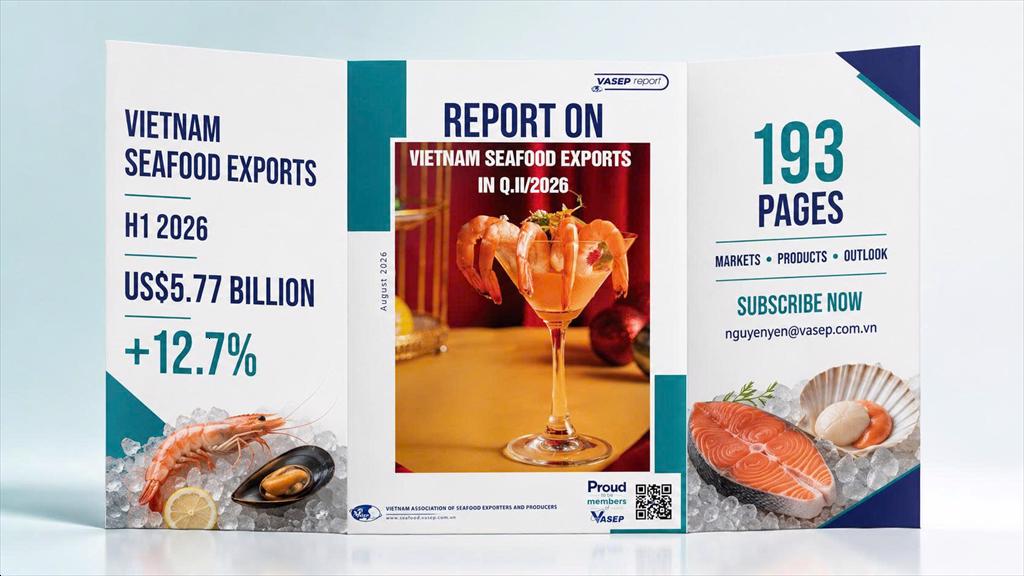
Vietnam’s seafood exports reached US$5.77 billion in the first six months of 2026, up 12.7% year on year. The second quarter alone generated more than US$3.12 billion, an increase of 11%.
Shrimp remained the industry’s leading export product, earning US$2.35 billion and accounting for over 40% of total seafood exports. Pangasius exports reached US$1.11 billion, while cephalopod, crab, swimming crab and mollusks also delivered encouraging growth.
Yet the headline numbers tell only part of the story.
Growth slowed in the second quarter compared with the first. Export performance became more differentiated among major markets, while changes in tariffs, trade remedies, traceability requirements and international supply flows created a more complex business environment.
To help seafood businesses and stakeholders navigate these developments, the Vietnam Association of Seafood Exporters and Producers has published the Report on Vietnam Seafood Exports in Q2/2026, a 193-page premium publication featuring comprehensive statistics, market intelligence and outlook scenarios for the remainder of the year.
A major shift in Vietnam’s seafood export map
One of the most important developments in the first half of 2026 was the continued shift of export growth toward Asia.
China and Hong Kong became Vietnam’s largest seafood destination, with exports reaching US$1.47 billion, up 36.4% year on year. The market was the principal contributor to the industry’s overall expansion, driven by strong demand for lobster, crab, shrimp and pangasius.
ASEAN also emerged as one of the fastest-growing regional markets, while South Korea maintained positive momentum. In contrast, exports to the United States edged down by 0.8%, and shipments to the EU declined by 1.1%. Japan remained relatively stable.
What is driving this restructuring of trade flows? Which markets are providing sustainable growth, and which are benefiting mainly from short-term changes in inventories, tariffs or purchasing cycles? How should exporters balance fast-growing Asian destinations with traditional high-value markets?
The full VASEP report examines these questions through detailed market and product data that are not available in the public summary.
In-depth analysis by product and market
The report provides dedicated chapters covering:
- Vietnam’s seafood production, exports, imports and exporter structure;
- Shrimp production, product composition, export prices and market performance;
- Pangasius exports to China, the United States, the EU, Mexico, the United Kingdom and Brazil;
- Tuna exports by product category and major destination;
- Squid and octopus trade, including market trends in South Korea, Japan, China and the EU;
- Mollusks, crab, swimming crab, other crustaceans, fish cakes and surimi;
- Competitive positions of major supplying countries in key international markets;
- Vietnam’s leading exporters by product and destination; and
- Market and product outlooks for the second half of 2026.
Supported by more than 100 detailed tables and figures, the publication allows readers to move beyond aggregate growth rates and examine changes in product structure, destination markets, export prices, supplier competition and enterprise performance.
New regulatory and competitive pressures
The second half of 2026 is expected to present a different set of challenges from those seen during the pandemic and the subsequent logistics crisis.
Trade flows are increasingly being redirected by tariffs and trade-remedy measures. Additional supplies from Ecuador, India and other major exporting countries may intensify competition in China and the EU, particularly in price-sensitive segments.
At the same time, market access is being reshaped by stricter compliance requirements. In the United States, businesses must monitor anti-dumping and countervailing duties, tariffs, the Marine Mammal Protection Act, Certificate of Admissibility requirements and the Seafood Import Monitoring Program. In the EU, anti-IUU fishing controls and the CATCH system are raising expectations for digital traceability and the legality of raw materials. China is also tightening enterprise registration, documentation, quarantine and border-control requirements.
The report explains how these developments may affect individual seafood sectors and why compliance capacity, transparent supply chains and data management are becoming as important as price and product quality.
Three scenarios for Vietnam’s 2026 seafood exports
Can Vietnam’s seafood exports exceed US$12 billion in 2026?
VASEP’s report presents three scenarios for the second half of the year: a base scenario, a positive scenario and a cautious scenario. The base case projects full-year exports at approximately US$12.1-12.3 billion, supported by demand from China, ASEAN and several CPTPP markets.
However, the final result will depend on the pace of demand recovery in the United States and the EU, international competition, trade policies, technical barriers, input costs and the ability of Vietnamese enterprises to expand value-added processing.
Rather than providing a single headline forecast, the report identifies the assumptions, growth drivers and risks associated with each scenario, enabling businesses to develop more informed production, sales and market strategies.
Who should subscribe?
The Report on Vietnam Seafood Exports in Q2/2026 is designed for:
- Seafood producers, processors and exporters;
- International importers, distributors and retail buyers;
- Investors, financial institutions and business consultants;
- Government agencies and trade-promotion organizations;
- Market analysts, research institutions and industry associations; and
- Logistics, feed, technology and other seafood supply-chain companies.
For businesses making decisions on procurement, production planning, customer development, market diversification or investment, access to timely and structured data can provide a critical competitive advantage.
The complete report is a premium VASEP publication and is available by paid subscription.
To subscribe, request pricing or obtain further publication information, please contact:
Ms. Nguyen Hai Yen – Publisher
Email: nguyenyen@vasep.com.vn
Mobile: +84 868 093 697 / +84 858 582 626
Subscribe to the full VASEP Q2/2026 Report to access the data behind the market movements—and prepare your business for the next phase of Vietnam’s seafood export growth.