The year 2021 is coming to an end and the concerns regarding the Covid-19 pandemic are gradually affecting both Vietnam and the world. With this in mind, Vinh Hoan looks ahead to the new year with hopefully more optimistic signals regarding the fight against the pandemic.
Many challenges stem from the old year
The 4th pandemic wave has caused many impacts to Vietnam's pangasius industry. According to predictions from experts, Vietnam's pangasius industry still faces significant challenges in the coming year, such as the out-of-sync supply in fingerlings, increased farming costs.
Due to the national lockdown starting from July 2021, many factories were closed. As a result, farmers with their hands tied could not harvest and had no choice but to keep the fish in the ponds. When the lockdown was lifted, the industry faced oversized fish which falls out of the common sizes for many major markets (e.g., the U.S. and the EU).
Under lockdowns and transportation restrictions, farmers were either not restocking their ponds or restocking sparingly from July to October 2021. Vietnam is now past the primary stocking season. According to Mr. Tran Dinh Luan, General Director of the General Department of Fisheries (Ministry of Agriculture and Rural Development), 130 pangasius hatcheries nationwide, of which 96 are operating. The number of seeds produced during the gap period decreased sharply. In 3 consecutive months (6,7,8), seed production decreased by 82.7%, respectively; 70.9% and 20.8% over the same last year. Mr. Luan said: "There is a risk of shortage of raw materials for processing and exporting by the end of this year and the beginning of 2022". (*)
In addition, fish feed cost has gone up 30% in the last ten months in 2021, putting heavy pressure on pangasius farming. The challenge in animal feeds in 2021 is expected to continue into 2022. The same headwinds from lower crop yields due to global climate change to higher transportation costs and lack of shipping equipment from North and South America to Asia.
The difficulties of 2021 are more or less related to the Covid-19 pandemic and will continue to be challenged in 2022.
Claim the leading position
In the context of the pangasius export industry facing many difficulties, Vinh Hoan Corp manages to react proactively with solutions for both medium and long term plans in production resources and export plans. During an interview with Forbes Vietnam, Mdm. Truong Thi Le Khanh, the Chairwoman, said: “In Vinh Hoan, productivity has increased by 10% over the past time. Maintaining a safe production state, step by step, Vinh Hoan manages to restore production up to 50%, 60%, and 80% of capacity when welcoming new groups of workers into the factory. Thanks to the early prediction of the situation, Vinh Hoan proactively deployed “3 on the spot”. Since then, we have been fortunate to control the epidemic and continuously expand in phases.”
Going forward, Vinh Hoan is hopeful that disruption to processing capacity can be minimized thanks to increasing vaccination rates in southern provinces, where pangasius factories are located, and more business-supportive policies (i.e., less severe measures in COVID-19 containment). All Vinh Hoan employees have been fully vaccinated.
In addition, to be proactive in accommodation for workers amid the ongoing pandemic, Vinh Hoan has constructed company apartments, a few hundred of which have been used as a temporary dormitory during the lockdown, and the rest will be finished for a complete modern residential area in the following months. This is not only part of the contingency plan but also one of Vinh Hoan's important employee's welfare programs.
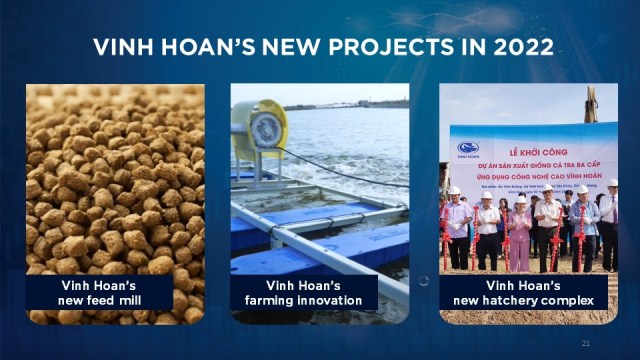
With the foreseen challenges of raw material shortage and increased farming and processing costs in 2022, Vinh Hoan is committed to its continuous efforts maintaining supply capabilities and efficiency with the two strategic new projects to be in operation early of the year. One is the feed mill to start April 2022, and the other is the high-tech hatchery complex to serve as a farming innovation hub for the group and a further upstream integration expansion.
Although the challenges are predicted for the new year, with the vision towards sustainability, in 2022, Vinh Hoan continues to develop its circular economy model with strong investments and commitments to a zero-waste pathway.
Source:
(*) http://vasep.com.vn/san-pham-xuat-khau/ca-tra/nguyen-lieu/nganh-ca-tra-doi-dien-nguy-co-thieu-nguyen-lieu-keo-dai-22883.html
(vasep.com.vn) Vietnam’s shrimp exports reached US$3.7 billion in the first nine months of 2026, up 11% year on year. Although growth has been supported by China and several markets within the CPTPP, momentum is slowing as exports to the United States and the European Union decline. Tariff pressures, international competition, and raw material challenges are creating significant hurdles for exporters in the final months of the year.
(vasep.com.vn) Markets are changing faster, buyer requirements are becoming more demanding, and trade barriers are growing increasingly complex. In this environment, seafood businesses need more than an understanding of current market conditions. They need a longer-term perspective to answer a critical question: Where will growth opportunities come from in 2027–2029, and what should businesses do now to prepare? This is one of the key reasons why VASEP is organizing Vietnam Seafood Summit 2026.
(vasep.com.vn) In the first eight months of 2026, Vietnam’s pangasius exports to the Middle East reached US$113 million, up 7% year on year from the same period in 2025. Growth has become more pronounced in recent months. In August alone, exports to the region totaled US$20 million, an increase of 24%. This indicates that demand for Vietnamese pangasius in the Middle East is gradually recovering after a slowdown in March, although the pace of recovery varies across markets.
(vasep.com.vn) China’s shrimp imports continued to grow strongly in 2026, while Vietnam’s shrimp exports to the market also recorded notable growth. However, behind these positive figures lie two distinct trends: Chinese consumption is growing more slowly than imports, and lobster accounts for a substantial share of Vietnam’s shrimp exports to China, making its product mix significantly different from those of Ecuador and India. Exporters therefore need to assess each segment carefully to understand the opportunities and risks.
(vasep.com.vn) Changing markets, shifting buyer demand, and increasingly complex trade barriers are raising a key question for Vietnam’s seafood industry: Where will the new growth opportunities lie in 2027–2029?
(seafood.vasep.com.vn) As of the end of August 2026, Vietnam’s tilapia exports to the United States reached $21 million, representing a steep 48% year-over-year decline and accounting for 23% of the country's total tilapia export turnover. Frozen fillets accounted for 78% with the remainder consisting of whole frozen tilapia and frozen cuts.
(seafood.vasep.com.vn) After a volatile first half of the year, Vietnam’s pangasius exports to Brazil registered robust growth in July and August 2026. In August alone, export turnover reached $19 million, surging 73% compared to the same period in 2025. Cumulatively for the first eight months, total export value reached $124 million, reflecting an 8% year-over-year increase.
(seafood.vasep.com.vn) Besides modifying their boats, many fishermen in Dak Lak province are making efforts to venture out to sea to harvest seafood during the rough sea season.
(seafood.vasep.com.vn) At the Responsible Seafood Summit and TCRS Shrimp Summit 2026, organized by the GSA (Global Seafood Alliance) in Bangkok, Thailand, the conversation about the future of the shrimp industry began with one of its most important foundations: seedstock quality.
(seafood.vasep.com.vn) In the first eight months of 2026, Vietnam’s tuna exports to Lithuania surpassed $14 million, up 8% year on year. While the increase remains modest, it is notable given the continued pressure on Vietnamese tuna exports to the EU as a whole. More importantly, export turnover to Lithuania has shown a clearer recovery in recent months, making the market a destination worth monitoring for Vietnamese businesses in Europe.
VASEP - HIỆP HỘI CHẾ BIẾN VÀ XUẤT KHẨU THỦY SẢN VIỆT NAM
Chịu trách nhiệm: Ông Nguyễn Hoài Nam - Phó Tổng thư ký Hiệp hội
Đơn vị vận hành trang tin điện tử: Trung tâm VASEP.PRO
Trưởng Ban Biên tập: Bà Phùng Thị Kim Thu
Giấy phép hoạt động Trang thông tin điện tử tổng hợp số 138/GP-TTĐT, ngày 01/10/2013 của Bộ Thông tin và Truyền thông
Tel: (+84 24) 3.7715055 – (ext.203); email: kimthu@vasep.com.vn
Trụ sở: Số 7 đường Nguyễn Quý Cảnh, Phường An Phú, Quận 2, Tp.Hồ Chí Minh
Tel: (+84) 28.628.10430 - Fax: (+84) 28.628.10437 - Email: vasephcm@vasep.com.vn
VPĐD: số 10, Nguyễn Công Hoan, Ngọc Khánh, Ba Đình, Hà Nội
Tel: (+84 24) 3.7715055 - Fax: (+84 24) 37715084 - Email: vasephn@vasep.com.vn