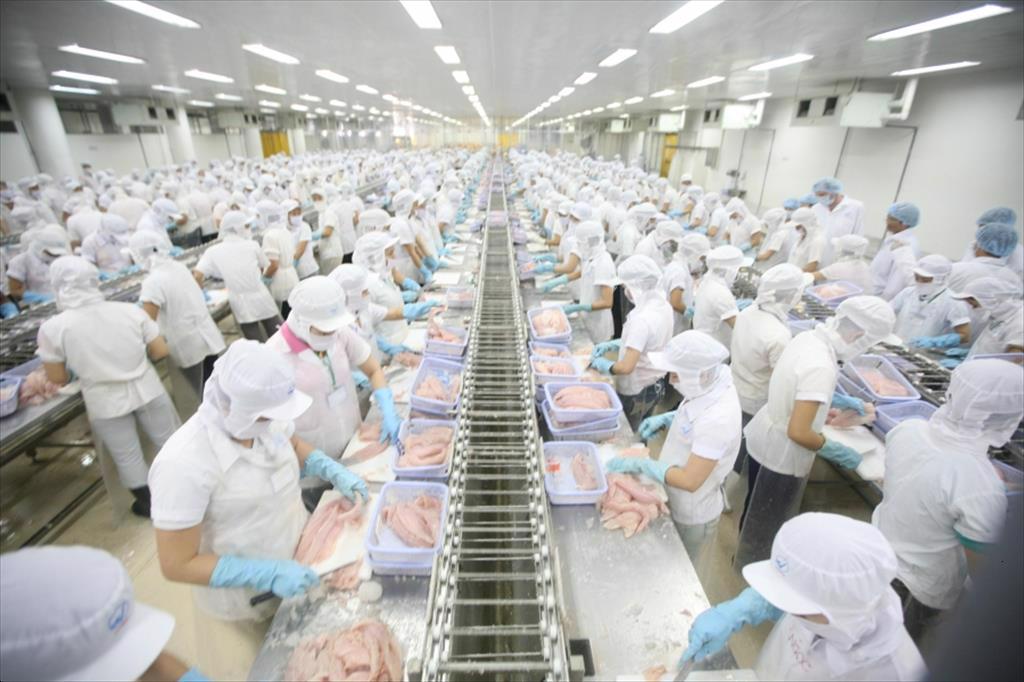
The Vietnamese seafood industry is actively adapting to new European Union (EU) regulations on maximum residue levels (MRLs) of inorganic arsenic in fish and other seafood.
Recently, Việt Nam's SPS Office (Sanitary and Phytosanitary Notification Authority and Enquiry Point), received notification from the SPS Committee Secretariat of the World Trade Organization (WTO) regarding a draft amendment by the European Food Safety Authority (EFSA) to Regulation (EU) No 2023/915, which sets maximum residue levels (MRLs) for inorganic arsenic in fish and other seafood.
According to the Deputy Director of Việt Nam’s SPS Office, Ngô Xuân Nam, over the past five years, no inorganic arsenic contamination has been detected in Vietnamese seafood. However, in response to the new EU regulations, proactive adaptation is now a key focus for the industry.
The EU has increased border inspections on several Vietnamese agricultural products, Nam said.
"Although the EU's draft regulation specifically addresses inorganic arsenic and we have not detected its presence in our seafood in recent years, this does not mean we should be complacent," Nam said.
Proactively adapting to SPS measures imposed by import markets, especially the EU, is a strategy that regulatory bodies in Việt Nam are actively implementing.
To ensure compliance, Việt Nam’s SPS Office has swiftly updated relevant authorities, agencies and industry associations including the Department of Quality, Processing, and Market Development, Directorate of Fisheries and Fisheries Surveillance, Department of Food Safety (Ministry of Health) and Việt Nam Association of Seafood Exporters and Producers (VASEP).
Meanwhile, the Directorate of Fisheries and the Department of Fisheries Surveillance (under the Ministry of Agriculture and Environment) has directed monitoring programmes to assess and control inorganic arsenic levels in aquaculture water and sediment.
Nam said that arsenic contamination is rarely detected in seafood processing, but is mainly present in farming environments, particularly in the water, therefore, strict water quality control in aquaculture areas is crucial.
On the business side, Vietnamese seafood producers and processors are strengthening monitoring of inorganic arsenic levels in raw materials. Companies are also investing in advanced technology and production processes to ensure products meet EU food safety standards.
EU’s new regulation
Under the EU's draft amendment, that is expected to be officially issued and taken effect in July this year, the MRLs for inorganic arsenic in fish and seafood will range from 0.05 to 1.5 ppm.
The EU will allow some existing seafood products on the market to remain available until their expiration dates.
The draft regulation specifies MRLs based on the wet weight of the product. If fish are exported whole, the MRLs will be calculated based on size of the entire fish.
In addition to fish, the EU is also applying MRLs for inorganic arsenic to crustaceans such as crabs and bivalve molluscs like scallops.
Previously, the EU had not set specific limits for inorganic arsenic in fish and seafood. This new draft regulation aims to solicit feedback from WTO member countries, while prioritising consumer health protection within the EU and aligning with SPS Agreement requirements.
In reality, some aquatic organisms naturally accumulate trace amounts of inorganic arsenic due to its presence in water and sediment. Arsenic enters the food chain via water and sediment pollution, aquatic organisms absorbing arsenic through respiration and contaminated feed sources
Additionally, seafood contamination can result from industrial and agricultural activities, such as mining and metallurgy industries, pesticide, dye and textile manufacturing, discharge of arsenic-containing wastewater, fertiliser and pesticide runoff into rivers and lakes, untreated household wastewater and natural arsenic leaching from the surface into groundwater
As the EU strengthens its controls on inorganic arsenic in imported seafood, Vietnamese exporters are actively adjusting to maintain market access. Industry players are enhancing quality control measures to ensure compliance.
This strategy also reinforces the reputation and brand of Vietnamese seafood.
Currently, Vietnamese seafood holds a 3.7 per cent share of the EU’s total seafood imports. Việt Nam is the fifth-largest non-EU seafood supplier into the EU market and the second-largest from Asia, after China.
Last year, the Vietnamese seafood industry achieved impressive export growth, reaching US$10 billion, a 12 per cent increase from 2023. Of these, exports to the EU amounted to $1 billion.
According to VASEP, the EU-Việt Nam Free Trade Agreement (EVFTA) is expected to boost Vietnamese seafood exports by approximately two per cent annually over the period 2020 to 2030.
Source: Viet Nam News
(seafood.vasep.com.vn) The EU remains a critical market for Vietnamese shrimp; however, purchasing demand and import patterns are undergoing notable changes. According to Vietnam Customs data, as of September 15, 2026, Vietnam’s shrimp exports to the EU reached nearly $374 million, down 5% year-over-year and accounting for 10.7% of the country’s total shrimp export value. Meanwhile, the EU’s stotal shrimp imports through July 2026 contracted by 7% in volume, exhibiting divergent trends across Southern Europe, Northwestern Europe and Eastern Europe. These dynamics necessitate that Vietnamese enterprises closely monitor individualized market demand, rather than approaching the EU as a monolithic consumer block.
(seafood.vasep.com.vn) In the first eight months of 2026, Vietnam’s exports of surimi and fish cakes remained relatively stable year-over-year compared to 2025. Following a contraction in the initial months, export performance demonstrated improvement from June onward, peaking in August. However, the recovery has been uneven, characterized by divergent trends across major markets: robust growth was recorded in China, Japan, Malaysia, the United States, and Taiwan, whereas export volumes to South Korea, Indonesia, and select European markets contracted.
(seafood.vasep.com.vn) Pangasius remains one of Dong Thap’s key aquaculture species, with the province focusing on developing an integrated value chain covering seed production, commercial farming, deep processing and by-product utilization. The province is promoting high-tech, circular pangasius farming models featuring reduced water exchange and enhanced biosecurity, aiming to improve production efficiency and strengthen control over raw material quality.
(vasep.com.vn) Vietnam’s seafood exports in September 2026 are estimated at US$1.135 billion, up 11.9% year-on-year, bringing total exports in the first nine months of the year to US$9.103 billion, up 11.4%. Behind this double-digit growth, however, increasingly divergent market trends are emerging: China–Hong Kong and ASEAN posted strong growth, while the U.S., EU and Japan all recorded declines in September.
(vasep.com.vn) In the first eight months of 2026, Brazil became the largest market for Vietnamese tilapia, with export value reaching US$44 million, up 22,142% year-on-year and accounting for 49% of Vietnam’s total tilapia exports. In August alone, exports to Brazil reached US$4 million. However, behind this remarkable growth is a market that is imposing increasingly stringent requirements on imported supplies.
(vasep.com.vn) Vietnam’s tuna exports sustained their upward trajectory in August 2026, though the pace remained modest at just 2%. The month saw divergent trends across key markets: the US maintained its leading position, Japan and Canada improved, Russia surged and the EU continued to experience a steep downturn. These developments suggest that exporters are entering the final months of the year amid a market environment marked by greater uncertainty.
(seafood.vasep.com.vn) Congalsa has acquired the entire charter capital of Lenger Seafood Vietnam, giving it full ownership of the business and its Nam Dinh processing facility.
(seafood.vasep.com.vn) Ninh Binh Province is entering a peak period of action against illegal, unreported and unregulated (IUU) fishing, focusing on thoroughly addressing violations, closely monitoring fishing vessels at ports and preventing vessels from violating regulations and operating illegally in foreign waters ahead of the European Commission’s (EC) upcoming inspection in 2026.
(vasep.com.vn) The application of biotechnology in seed production is increasingly viewed as a strategic imperative to upgrade pangasius fingerling quality, optimize farming efficiency and anchor sustainable industry development.
(vasep.com.vn) On September 15, 2026, in Can Tho, VASEP and ASC jointly organized a training course titled “New ASC standards: updates and practical implementation guidance for farms, businesses and aquafeed mills”. Beyond briefing stakeholders on updated ASC requirements for aquaculture facilities and feed production, the workshop dedicated substantial floor time to directly addressing on-the-ground compliance bottlenecks encountered by Vietnamese enterprises.
VASEP - HIỆP HỘI CHẾ BIẾN VÀ XUẤT KHẨU THỦY SẢN VIỆT NAM
Chịu trách nhiệm: Ông Nguyễn Hoài Nam - Phó Tổng thư ký Hiệp hội
Đơn vị vận hành trang tin điện tử: Trung tâm VASEP.PRO
Trưởng Ban Biên tập: Bà Phùng Thị Kim Thu
Giấy phép hoạt động Trang thông tin điện tử tổng hợp số 138/GP-TTĐT, ngày 01/10/2013 của Bộ Thông tin và Truyền thông
Tel: (+84 24) 3.7715055 – (ext.203); email: kimthu@vasep.com.vn
Trụ sở: Số 7 đường Nguyễn Quý Cảnh, Phường An Phú, Quận 2, Tp.Hồ Chí Minh
Tel: (+84) 28.628.10430 - Fax: (+84) 28.628.10437 - Email: vasephcm@vasep.com.vn
VPĐD: số 10, Nguyễn Công Hoan, Ngọc Khánh, Ba Đình, Hà Nội
Tel: (+84 24) 3.7715055 - Fax: (+84 24) 37715084 - Email: vasephn@vasep.com.vn