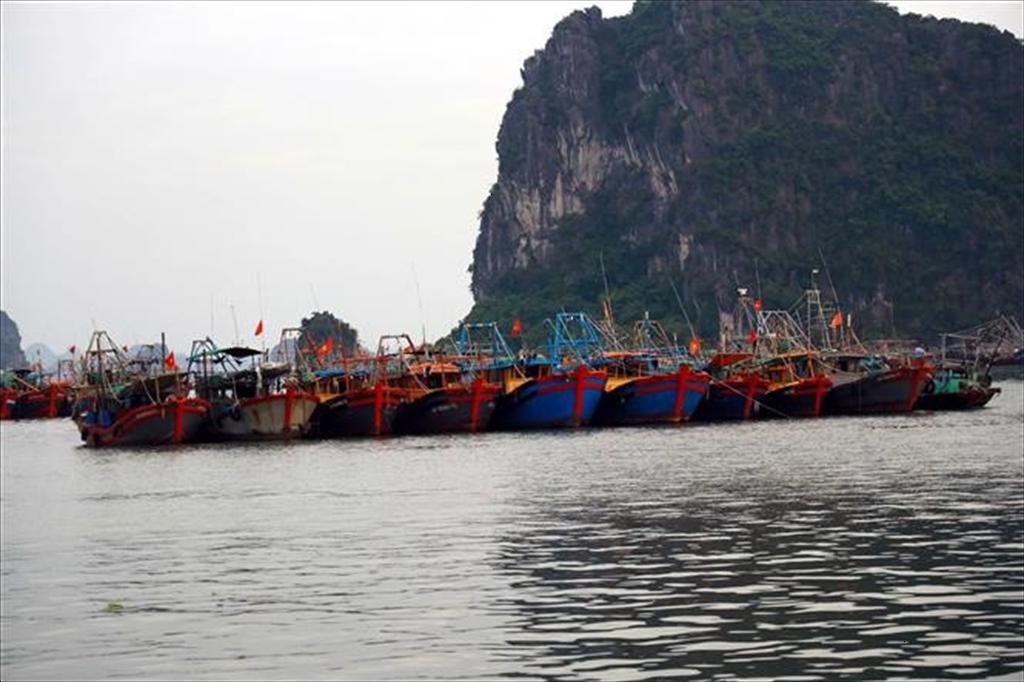
According to the Quang Ninh Department of Agriculture and Environment, in recent years the province’s fight against IUU fishing has been implemented in a comprehensive, methodical and determined manner. The province has advised, issued and coordinated the issuance of more than 40 directives and regulatory documents related to IUU prevention, gradually improving the legal framework and management mechanisms in line with practical conditions.
Many important policies have been rolled out, such as consolidating the provincial Steering Committee on IUU prevention; revising fishing vessel management regulations toward greater practicality; issuing the 2025 IUU prevention plan; and progressively decentralizing vessel management to the grassroots level, ensuring clear assignment of responsibilities and accountability.
At the same time, communication and legal dissemination activities have been intensified through flexible approaches. In 2025, fisheries and fisheries surveillance forces organized 48 communication trips, reaching and guiding nearly 5,000 fishermen; distributed tens of thousands of leaflets, documents and bulletins; and held numerous training courses and conferences to raise awareness among fishermen and local officials about IUU prevention in association with the protection of aquatic resources.
To date, 100% of eligible fishing vessels in the province—totaling 4,123 boats—have completed registration and been granted fishing licenses in accordance with regulations. As a result, Quang Ninh has become one of four localities nationwide to complete fishing license issuance ahead of schedule. Notably, all vessels measuring 15 meters or more in length have installed and maintained connectivity of Vessel Monitoring System (VMS) devices, enabling strict monitoring and control of fishing activities at sea.
In addition to these achievements, Quang Ninh frankly acknowledges that certain shortcomings and limitations remain, which must be addressed to fully meet the EC’s recommendations. Accordingly, the province is focusing resources and implementing synchronized measures to further enhance the effectiveness of IUU prevention in the coming period.
Quang Ninh continues to unify leadership and direction from the provincial to grassroots levels, considering IUU prevention a key, priority and urgent political task. The province is determined to “take action” against IUU fishing and join the nation in promptly removing the EC’s “yellow card” warning.
The province has set specific targets, including resolutely preventing fishing vessels from violating foreign waters; ensuring 100% of vessels 15 meters and above maintain continuous VMS connectivity; and guaranteeing that 100% of aquatic products landed at ports are monitored and traceable. At the same time, the province will continue to refine institutions and support mechanisms while strictly handling IUU violations, especially breaches related to VMS equipment regulations.
Notably, in 2026, Quang Ninh will conduct two peak inspection and enforcement campaigns in January and February to review compliance with IUU regulations. These campaigns are considered an important preparation step ahead of the EC’s fifth inspection visit to Vietnam. The province will also maintain a 24/7 hotline to protect aquatic resources, ensuring that 100% of reports are received, verified and handled in accordance with regulations.
Alongside management and enforcement efforts, Quang Ninh will continue investing in fisheries infrastructure, particularly fishing ports and storm shelter anchorage areas. The province is expected to ensure conditions for the announcement of four fishing ports: Cai Rong (Class II), Tien Toi (Class III), Phuc Tien (Class III), and Co To (Class III).
In addition, the province will strengthen communication and training for fishermen, while promoting activities to restore and regenerate aquatic resources in 2026. Various social resources will be mobilized to participate in restocking activities, especially during peak periods, in line with national directives.
(vasep.com.vn) Markets are changing faster, buyer requirements are becoming more demanding, and trade barriers are growing increasingly complex. In this environment, seafood businesses need more than an understanding of current market conditions. They need a longer-term perspective to answer a critical question: Where will growth opportunities come from in 2027–2029, and what should businesses do now to prepare? This is one of the key reasons why VASEP is organizing Vietnam Seafood Summit 2026.
(vasep.com.vn) In the first eight months of 2026, Vietnam’s pangasius exports to the Middle East reached US$113 million, up 7% year on year from the same period in 2025. Growth has become more pronounced in recent months. In August alone, exports to the region totaled US$20 million, an increase of 24%. This indicates that demand for Vietnamese pangasius in the Middle East is gradually recovering after a slowdown in March, although the pace of recovery varies across markets.
(vasep.com.vn) China’s shrimp imports continued to grow strongly in 2026, while Vietnam’s shrimp exports to the market also recorded notable growth. However, behind these positive figures lie two distinct trends: Chinese consumption is growing more slowly than imports, and lobster accounts for a substantial share of Vietnam’s shrimp exports to China, making its product mix significantly different from those of Ecuador and India. Exporters therefore need to assess each segment carefully to understand the opportunities and risks.
(vasep.com.vn) Changing markets, shifting buyer demand, and increasingly complex trade barriers are raising a key question for Vietnam’s seafood industry: Where will the new growth opportunities lie in 2027–2029?
(seafood.vasep.com.vn) As of the end of August 2026, Vietnam’s tilapia exports to the United States reached $21 million, representing a steep 48% year-over-year decline and accounting for 23% of the country's total tilapia export turnover. Frozen fillets accounted for 78% with the remainder consisting of whole frozen tilapia and frozen cuts.
(seafood.vasep.com.vn) After a volatile first half of the year, Vietnam’s pangasius exports to Brazil registered robust growth in July and August 2026. In August alone, export turnover reached $19 million, surging 73% compared to the same period in 2025. Cumulatively for the first eight months, total export value reached $124 million, reflecting an 8% year-over-year increase.
(seafood.vasep.com.vn) Besides modifying their boats, many fishermen in Dak Lak province are making efforts to venture out to sea to harvest seafood during the rough sea season.
(seafood.vasep.com.vn) At the Responsible Seafood Summit and TCRS Shrimp Summit 2026, organized by the GSA (Global Seafood Alliance) in Bangkok, Thailand, the conversation about the future of the shrimp industry began with one of its most important foundations: seedstock quality.
(seafood.vasep.com.vn) In the first eight months of 2026, Vietnam’s tuna exports to Lithuania surpassed $14 million, up 8% year on year. While the increase remains modest, it is notable given the continued pressure on Vietnamese tuna exports to the EU as a whole. More importantly, export turnover to Lithuania has shown a clearer recovery in recent months, making the market a destination worth monitoring for Vietnamese businesses in Europe.
(seafood.vasep.com.vn) Vietnam’s squid and octopus exports exceeded $527 million in the first eight months of 2026, marking a 15% year-on-year increase. This growth is particularly notable given the strong baseline established in 2025, when export turnover for the same period reached $458 million, a 13% rise from 2024.
VASEP - HIỆP HỘI CHẾ BIẾN VÀ XUẤT KHẨU THỦY SẢN VIỆT NAM
Chịu trách nhiệm: Ông Nguyễn Hoài Nam - Phó Tổng thư ký Hiệp hội
Đơn vị vận hành trang tin điện tử: Trung tâm VASEP.PRO
Trưởng Ban Biên tập: Bà Phùng Thị Kim Thu
Giấy phép hoạt động Trang thông tin điện tử tổng hợp số 138/GP-TTĐT, ngày 01/10/2013 của Bộ Thông tin và Truyền thông
Tel: (+84 24) 3.7715055 – (ext.203); email: kimthu@vasep.com.vn
Trụ sở: Số 7 đường Nguyễn Quý Cảnh, Phường An Phú, Quận 2, Tp.Hồ Chí Minh
Tel: (+84) 28.628.10430 - Fax: (+84) 28.628.10437 - Email: vasephcm@vasep.com.vn
VPĐD: số 10, Nguyễn Công Hoan, Ngọc Khánh, Ba Đình, Hà Nội
Tel: (+84 24) 3.7715055 - Fax: (+84 24) 37715084 - Email: vasephn@vasep.com.vn