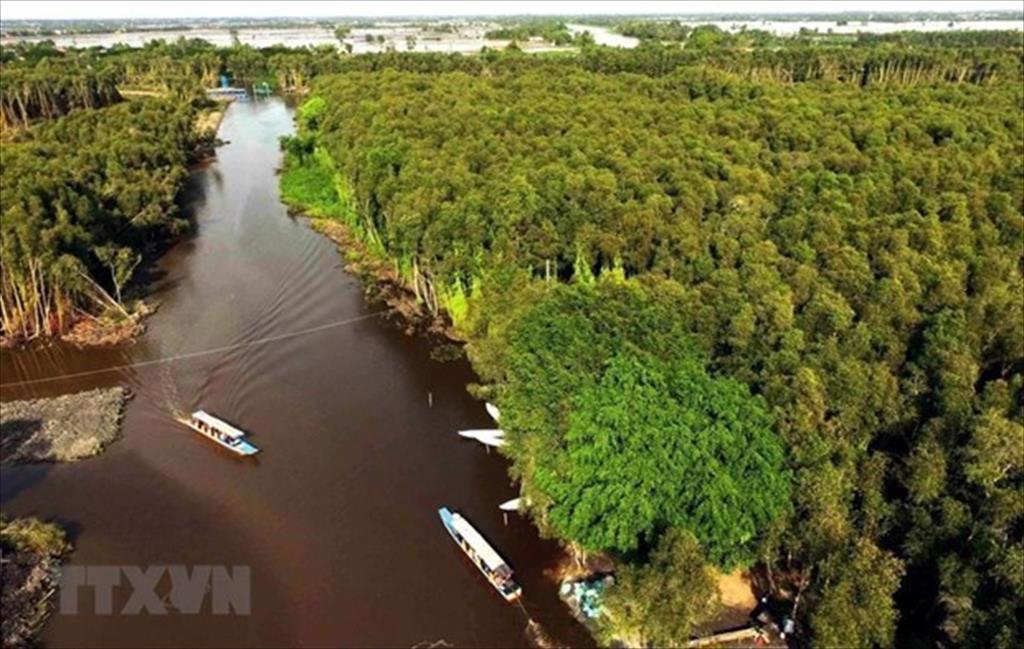
A draft master plan for the Mekong Delta for 2021-2030 and vision to 2050, recently released to collect public feedback, views climate change as not only a challenge but also an opportunity for local development.
Deputy Minister of Planning and Investment Tran Quoc Phuong said the draft features three guiding viewpoints, with the first respecting the ecosystem’s natural functioning, proactively adapting to climate change, and considering saltwater and brackish water as development resources. The second is viewing climate change as not only a challenge but also an opportunity to change production models and re-organise the regional development space towards effectiveness and sustainability. The third is changing mindsets about food security, aligning fisheries, fruit growing, and rice production with markets, developing high-quality agriculture in combination with services, ecotourism, and industry, especially the processing industry, and promoting the value and competitiveness of local agricultural products.
If approved, the planning will serve as the basis for effectively allocating and mobilising resources for development in Vietnam’s largest agricultural hub. That will help achieve sustainable development and adaptation to climate change in line with the spirit of the Government’s Resolution No 120/NQ-CP on the region’s sustainable development, as well as contribute to the Government’s efforts to join the global response to climate change, Phuong noted. Voicing her country’s support, Dutch Ambassador Elsbeth Akkerman said that as both Vietnam and the Netherlands are highly vulnerable to climate change, the two governments need to continue coordination and work out suitable solutions for responding to the global phenomenon, especially in the Mekong Delta. To carry out the official master plan, she said that given its limited financial sources, Vietnam should build a concrete financial mechanism for implementation. The ambassador suggested the Government provide part of the funding and play the leading role in efforts while calling for support from sponsors and development aid funds along with assistance from private investment funds and via public-private partnerships. At a recent workshop on the Mekong Delta’s sustainable development in adapting to climate change, Deputy Minister of Natural Resources and Environment Le Cong Thanh said climate change is becoming increasingly severe and unpredictable, greatly affecting every socio-economic aspect. In Vietnam, the Government has issued many policies and taken strong action to adapt to its growing impacts. One of the highlights of 2020 was the country completing updates to the Nationally Determined Contribution and the issuance of a national plan on climate change adaptation for 2021-2020, with a vision to 2050./.
(vasep.com.vn) Vietnam’s shrimp exports reached US$3.7 billion in the first nine months of 2026, up 11% year on year. Although growth has been supported by China and several markets within the CPTPP, momentum is slowing as exports to the United States and the European Union decline. Tariff pressures, international competition, and raw material challenges are creating significant hurdles for exporters in the final months of the year.
(vasep.com.vn) Markets are changing faster, buyer requirements are becoming more demanding, and trade barriers are growing increasingly complex. In this environment, seafood businesses need more than an understanding of current market conditions. They need a longer-term perspective to answer a critical question: Where will growth opportunities come from in 2027–2029, and what should businesses do now to prepare? This is one of the key reasons why VASEP is organizing Vietnam Seafood Summit 2026.
(vasep.com.vn) In the first eight months of 2026, Vietnam’s pangasius exports to the Middle East reached US$113 million, up 7% year on year from the same period in 2025. Growth has become more pronounced in recent months. In August alone, exports to the region totaled US$20 million, an increase of 24%. This indicates that demand for Vietnamese pangasius in the Middle East is gradually recovering after a slowdown in March, although the pace of recovery varies across markets.
(vasep.com.vn) China’s shrimp imports continued to grow strongly in 2026, while Vietnam’s shrimp exports to the market also recorded notable growth. However, behind these positive figures lie two distinct trends: Chinese consumption is growing more slowly than imports, and lobster accounts for a substantial share of Vietnam’s shrimp exports to China, making its product mix significantly different from those of Ecuador and India. Exporters therefore need to assess each segment carefully to understand the opportunities and risks.
(vasep.com.vn) Changing markets, shifting buyer demand, and increasingly complex trade barriers are raising a key question for Vietnam’s seafood industry: Where will the new growth opportunities lie in 2027–2029?
(seafood.vasep.com.vn) As of the end of August 2026, Vietnam’s tilapia exports to the United States reached $21 million, representing a steep 48% year-over-year decline and accounting for 23% of the country's total tilapia export turnover. Frozen fillets accounted for 78% with the remainder consisting of whole frozen tilapia and frozen cuts.
(seafood.vasep.com.vn) After a volatile first half of the year, Vietnam’s pangasius exports to Brazil registered robust growth in July and August 2026. In August alone, export turnover reached $19 million, surging 73% compared to the same period in 2025. Cumulatively for the first eight months, total export value reached $124 million, reflecting an 8% year-over-year increase.
(seafood.vasep.com.vn) Besides modifying their boats, many fishermen in Dak Lak province are making efforts to venture out to sea to harvest seafood during the rough sea season.
(seafood.vasep.com.vn) At the Responsible Seafood Summit and TCRS Shrimp Summit 2026, organized by the GSA (Global Seafood Alliance) in Bangkok, Thailand, the conversation about the future of the shrimp industry began with one of its most important foundations: seedstock quality.
(seafood.vasep.com.vn) In the first eight months of 2026, Vietnam’s tuna exports to Lithuania surpassed $14 million, up 8% year on year. While the increase remains modest, it is notable given the continued pressure on Vietnamese tuna exports to the EU as a whole. More importantly, export turnover to Lithuania has shown a clearer recovery in recent months, making the market a destination worth monitoring for Vietnamese businesses in Europe.
VASEP - HIỆP HỘI CHẾ BIẾN VÀ XUẤT KHẨU THỦY SẢN VIỆT NAM
Chịu trách nhiệm: Ông Nguyễn Hoài Nam - Phó Tổng thư ký Hiệp hội
Đơn vị vận hành trang tin điện tử: Trung tâm VASEP.PRO
Trưởng Ban Biên tập: Bà Phùng Thị Kim Thu
Giấy phép hoạt động Trang thông tin điện tử tổng hợp số 138/GP-TTĐT, ngày 01/10/2013 của Bộ Thông tin và Truyền thông
Tel: (+84 24) 3.7715055 – (ext.203); email: kimthu@vasep.com.vn
Trụ sở: Số 7 đường Nguyễn Quý Cảnh, Phường An Phú, Quận 2, Tp.Hồ Chí Minh
Tel: (+84) 28.628.10430 - Fax: (+84) 28.628.10437 - Email: vasephcm@vasep.com.vn
VPĐD: số 10, Nguyễn Công Hoan, Ngọc Khánh, Ba Đình, Hà Nội
Tel: (+84 24) 3.7715055 - Fax: (+84 24) 37715084 - Email: vasephn@vasep.com.vn