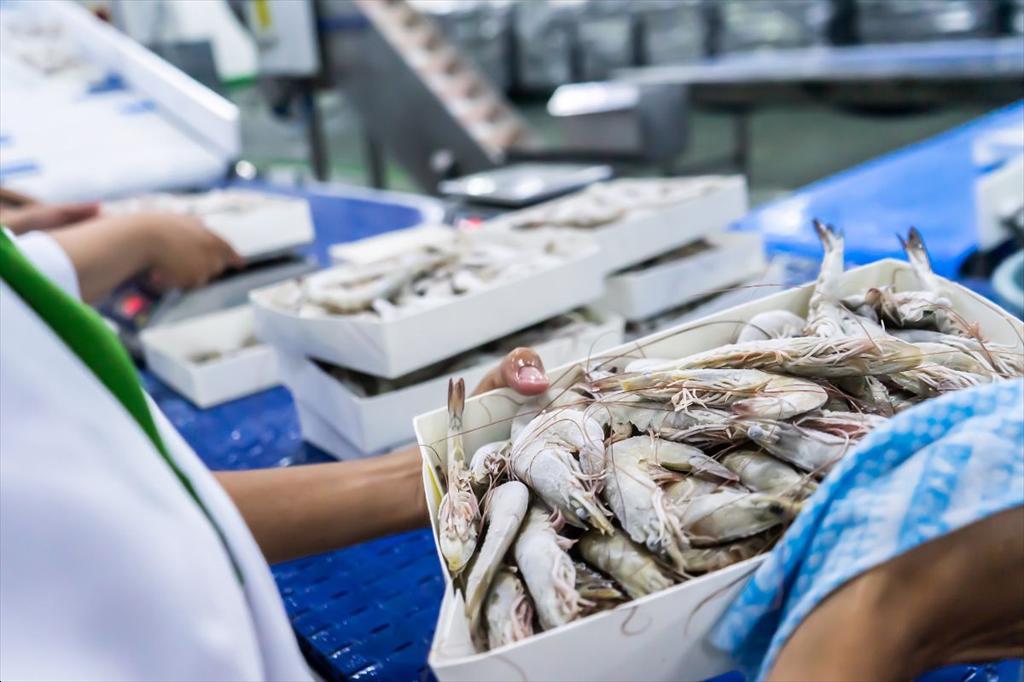
In the first five months, seafood exports reached $4.67 billion. According to the Vietnam Association of Seafood Processing and Export (VASEP), seafood exports reached US$1.02 billion in May 2026, a slight increase of 0.6%. For the first five months of the year, the total export value reached US$4.67 billion, an 11% increase compared to the same period in 2025. Within this overall picture, shrimp and pangasius continue to be the two main drivers, while the Chinese market plays a crucial role in boosting growth.
Shrimp continued to be the largest export item with a value of US$1.9 billion, an increase of 11.5%, accounting for approximately 40.4% of the total value of seafood exports. The growth of this item was driven by the recovery of demand in some Asian markets, processed products, and the export of lobster to China.
Meanwhile, pangasius exports reached $905 million, an increase of 12.6%. This product group has an advantage due to its relatively stable supply, competitive price, and suitability for the increasingly popular trend of frugal consumption in many markets.
Notably, a 30% drop in global pollock production, coupled with rising fuel costs, has led to a sharp increase in the price of whitefish raw materials. In this context, some importers are shifting towards more stable-supply farmed fish species such as pangasius and tilapia, opening up more opportunities for Vietnamese products.
In the second half of 2026, the growth of the fisheries sector will depend on its ability to adapt to market changes. The growth of shrimp and pangasius exports is also linked to positive developments in the Chinese and Hong Kong markets – currently Vietnam's largest seafood import regions. In the first five months of the year, seafood exports to China and Hong Kong reached US$1.2 billion, a 40.5% increase compared to the same period last year. Increased demand for shrimp, pangasius, crab, mollusks, and many other high-value seafood products has significantly supported the overall export growth of the industry.
However, along with the opportunities, the Chinese market is also shifting strongly towards official imports, strengthening quality control, biosafety, business registration, farming area codes, and traceability. The fact that Order 280, effective from June 1, 2026, replaces Order 248 shows that the standardization requirements for exporting businesses are becoming increasingly stringent.
Market fragmentation, increased compliance requirements.
Not all product groups maintained their growth momentum, such as shrimp and pangasius. Tuna exports in the first five months of the year decreased by 6%, to $372 million. The main reasons were the shortage of domestic raw materials and increasingly stringent requirements for traceability.
In addition, US regulations on the protection of marine mammals, seafood import control programs, and the European Union's (EU) anti-illegal fishing regulations are increasing compliance costs, prolonging documentation time, and affecting the ability to secure orders.
Many other seafood groups continued to record positive growth. Exports of squid and octopus reached US$304 million, up 18%; crabs and other crustaceans reached US$160 million, up 19%; and shellfish reached US$122 million, up 22.8%. These items continue to have opportunities in Japan, South Korea, China, the United States, and the EU, especially in the processed and value-added product segments. However, growth still heavily depends on the availability of legally sourced and imported raw materials. Fuel costs, logistics, and increasingly stringent origin certification requirements are directly impacting production volume, raw material prices, and delivery schedules.
Looking at the markets, the export picture also shows a clear divergence. While China and Hong Kong experienced strong growth, exports to the United States decreased by 10% to $689 million; exports to the EU decreased by 2.2% to $435.6 million. These two markets continue to exert significant pressure regarding tariffs, trade protection measures, traceability, food safety, combating illegal fishing, and sustainable development standards. Conversely, Japan increased by 0.4%, South Korea by 4%, and ASEAN by 16.8%, continuing to play a crucial role in helping businesses diversify their output and reduce dependence on a few large markets.
Despite positive signs, both the shrimp and pangasius industries still face many pressures. For shrimp, businesses are facing increasing competition from Ecuador, India, and Indonesia. In many localities, the trend of raising large-sized shrimp to increase value is also creating a certain mismatch with the demand for smaller-sized shrimp in some markets.
Meanwhile, the pangasius industry faces persistently high prices for fingerlings, along with rising costs of feed, transportation, and other production inputs. Exports to the United States also continue to be impacted by trade protection measures and stringent traceability requirements.
Based on the results of the first five months of the year, VASEP Deputy Secretary General Le Hang predicted that seafood exports in 2026 could increase by about 8-10%, with a turnover exceeding 12 billion USD if China continues to maintain positive demand, pangasius fish retains its competitive advantage in price, shrimp improves its competitiveness, and seafood groups resolve obstacles related to IUU fishing, raw material certification, and traceability.
(seafood.vasep.com.vn) At the Responsible Seafood Summit and TCRS Shrimp Summit 2026, organized by the GSA (Global Seafood Alliance) in Bangkok, Thailand, the conversation about the future of the shrimp industry began with one of its most important foundations: seedstock quality.
(seafood.vasep.com.vn) In the first eight months of 2026, Vietnam’s tuna exports to Lithuania surpassed $14 million, up 8% year on year. While the increase remains modest, it is notable given the continued pressure on Vietnamese tuna exports to the EU as a whole. More importantly, export turnover to Lithuania has shown a clearer recovery in recent months, making the market a destination worth monitoring for Vietnamese businesses in Europe.
(seafood.vasep.com.vn) Vietnam’s squid and octopus exports exceeded $527 million in the first eight months of 2026, marking a 15% year-on-year increase. This growth is particularly notable given the strong baseline established in 2025, when export turnover for the same period reached $458 million, a 13% rise from 2024.
(seafood.vasep.com.vn) Vietnamese pangasius is gaining traction in Japan, where competitive prices and reliable supplies have helped the fish enter professional distribution channels and a major sushi chain.
(vasep.com.vn) A circular economy does not create a “new type of shrimp” or a new certification. Its value lies in helping the shrimp value chain use resources more efficiently, stabilize production, generate additional value from by-products and build the data and evidence needed to meet increasingly stringent market requirements. This was the perspective shared by VASEP at the Public-Private Partnership (PPP) Forum on Promoting a Circular Economy in the Shrimp Industry in the Mekong Delta, held in Can Tho on September 21.
(vasep.com.vn) Vietnam’s pangasius exports to CPTPP markets reached $264 million in the first eight months of 2026, up 12% year-on-year and accounting for 17% of the nation’s total pangasius export turnover. In August alone, export value reached $34 million, inching up 3%.
(seafood.vasep.com.vn) Golden pompano is being selected as a high-value species for the development of high-tech marine aquaculture in Lam Dong Province. In 2026, the provincial Agricultural Extension Center launched a golden pompano farming model using circular HDPE cages in Lien Huong Commune, opening opportunities to apply technology to marine farming at a scale suited to local coastal conditions.
(vasep.com.vn) Vietnam’s shrimp exports reached $3.3 billion in the first eight months of 2026, up 12% year on year. However, growth momentum is moderating and market divergece is becoming more pronounced, while the US and EU continue to present significant challenges. The latest insights from the Global shrimp forum 2026 (GSF 2026), held in early September, also indicate that the final months of the year will remain highly competitive as global supply continues to expand and buyers place greater emphasis on quality, product specifications, supply consistency and the ability to meet market-specific demand.
(vasep.com.vn) Vietnam’s pangasius exports continued to grow in August 2026, bringing total export value in the first eight months of the year to US$1.5 billion, up 10% year-on-year. August exports alone reached US$205 million, up 6%. However, market performance has become increasingly divergent, with China and Brazil posting positive growth while the U.S. continued to record a sharp decline.
(vasep.com.vn) Vietnam’s seafood exports reached US$1.14 billion in August 2026, up 6.4% year on year, bringing the total for the first eight months to more than US$8.0 billion, an increase of 11.9%. Monthly export value remained above US$1 billion, but August growth was only around half the rate recorded cumulatively through the first eight months. This indicates that the eight-month result was supported significantly by stronger performance in earlier months, while market conditions are entering a less predictable period.
VASEP - HIỆP HỘI CHẾ BIẾN VÀ XUẤT KHẨU THỦY SẢN VIỆT NAM
Chịu trách nhiệm: Ông Nguyễn Hoài Nam - Phó Tổng thư ký Hiệp hội
Đơn vị vận hành trang tin điện tử: Trung tâm VASEP.PRO
Trưởng Ban Biên tập: Bà Phùng Thị Kim Thu
Giấy phép hoạt động Trang thông tin điện tử tổng hợp số 138/GP-TTĐT, ngày 01/10/2013 của Bộ Thông tin và Truyền thông
Tel: (+84 24) 3.7715055 – (ext.203); email: kimthu@vasep.com.vn
Trụ sở: Số 7 đường Nguyễn Quý Cảnh, Phường An Phú, Quận 2, Tp.Hồ Chí Minh
Tel: (+84) 28.628.10430 - Fax: (+84) 28.628.10437 - Email: vasephcm@vasep.com.vn
VPĐD: số 10, Nguyễn Công Hoan, Ngọc Khánh, Ba Đình, Hà Nội
Tel: (+84 24) 3.7715055 - Fax: (+84 24) 37715084 - Email: vasephn@vasep.com.vn