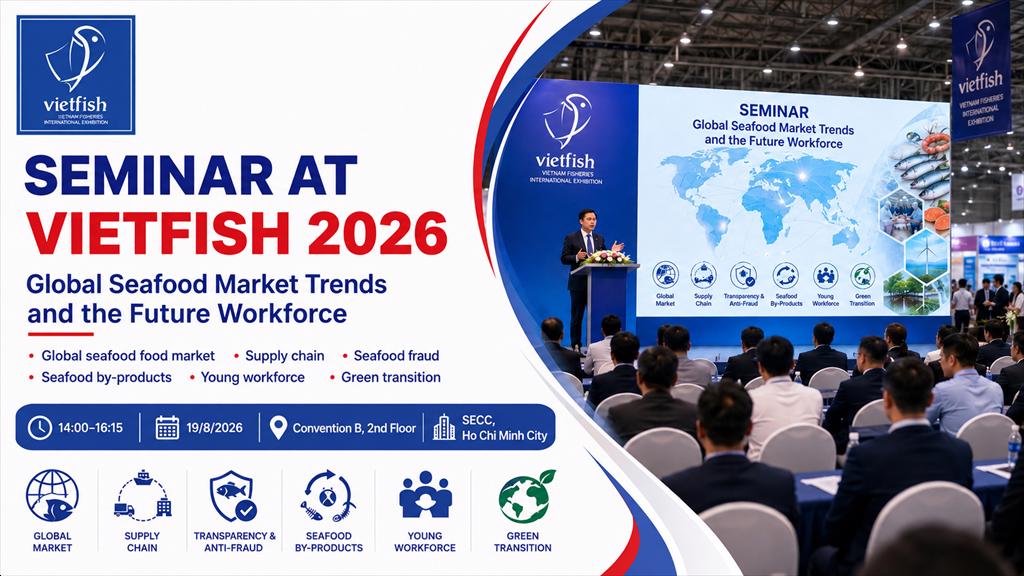
As the global seafood market continues to evolve rapidly, seafood businesses must adapt not only to changing consumer demand and price movements but also to new requirements regarding supply chain resilience, transparency, food safety, sustainability, and corporate social responsibility. The seminar is designed to provide seafood enterprises, government agencies, research institutions, and industry stakeholders with a broader perspective on the trends reshaping global seafood trade.
One of the seminar's highlights will be a presentation on global seafood market trends and emerging supply chain requirements by Ms. Shirlene Maria Anthonysamy, Fishery Market Officer and FAO GLOBEFISH Coordinator. Her presentation is expected to provide valuable insights into international market developments, changing import and consumption patterns, and the increasingly stringent requirements of retailers, buyers, and consumers worldwide.
Another key session will address seafood fraud and its impact on trade, consumer confidence, and the industry's reputation, presented by Ms. Esther Garrido Gamarro, Fishery Officer at FAO. The discussion will examine the growing importance of product authenticity, traceability, quality assurance, and transparency as trust and accountability become increasingly critical in international seafood trade.
The seminar will also feature a presentation on adding value to seafood by-products by Professor Dr. Trang Si Trung, Rector of the School of Fisheries and Life Sciences, Nha Trang University. This topic is particularly relevant as Vietnam's seafood industry seeks to embrace the principles of the circular economy by maximizing resource utilization, minimizing waste, and increasing value throughout the processing chain.
Beyond market and product issues, the seminar will place strong emphasis on the future workforce of the seafood industry. FAO GLOBEFISH will introduce initiatives aimed at attracting young professionals to the seafood sector and discuss opportunities for collaboration with Vietnamese educational institutions. These discussions are particularly important as the industry continues its transition toward high-tech production, modern management practices, and greener, more sustainable development.
The seminar will also explore green transformation in the seafood industry through a presentation by Mr. Tran Anh Xuan, Country Representative of ABB Motion Vietnam. His presentation will focus on global trends, evolving market expectations, and practical lessons for Vietnamese seafood businesses seeking to improve production efficiency, reduce energy consumption, and meet increasingly demanding sustainability standards.
With participation from experts representing FAO, academia, technology companies, and the seafood industry, the seminar promises practical discussions that will help Vietnamese seafood enterprises better understand long-term market trends, anticipate emerging requirements, and prepare for the industry's ongoing transformation.
Seminar Information
Title: Global Seafood Market and the Future Workforce: Trends, Opportunities, and Sustainable Development Pathways for Vietnam's Seafood Industry
Date & Time: 2:00 p.m. – 4:15 p.m., August 19, 2026
Venue: Convention Room B, Level 2, SECC, Ho Chi Minh City
Language: Vietnamese – English
Contact: Ms. Nguyen Trang
Email: nguyentrang@vasep.com.vn
Mobile: +84 906 151 556
Website: https://daotao.vasep.com.vn/
👉 Register in advance to reserve your seat: https://forms.gle/j3LmksFC9DoX1zJj7
(vasep.com.vn) VASEP has officially announced the program for Vietnam Seafood Summit 2026 (VSS 2026), featuring five in-depth sessions covering industry outlooks, trade barriers, buyer demand, the domestic market, and solutions to improve productivity and reduce costs across the seafood value chain.
(vasep.com.vn) Vietnam’s shrimp exports reached US$3.7 billion in the first nine months of 2026, up 11% year on year. Although growth has been supported by China and several markets within the CPTPP, momentum is slowing as exports to the United States and the European Union decline. Tariff pressures, international competition, and raw material challenges are creating significant hurdles for exporters in the final months of the year.
(vasep.com.vn) Markets are changing faster, buyer requirements are becoming more demanding, and trade barriers are growing increasingly complex. In this environment, seafood businesses need more than an understanding of current market conditions. They need a longer-term perspective to answer a critical question: Where will growth opportunities come from in 2027–2029, and what should businesses do now to prepare? This is one of the key reasons why VASEP is organizing Vietnam Seafood Summit 2026.
(vasep.com.vn) In the first eight months of 2026, Vietnam’s pangasius exports to the Middle East reached US$113 million, up 7% year on year from the same period in 2025. Growth has become more pronounced in recent months. In August alone, exports to the region totaled US$20 million, an increase of 24%. This indicates that demand for Vietnamese pangasius in the Middle East is gradually recovering after a slowdown in March, although the pace of recovery varies across markets.
(vasep.com.vn) China’s shrimp imports continued to grow strongly in 2026, while Vietnam’s shrimp exports to the market also recorded notable growth. However, behind these positive figures lie two distinct trends: Chinese consumption is growing more slowly than imports, and lobster accounts for a substantial share of Vietnam’s shrimp exports to China, making its product mix significantly different from those of Ecuador and India. Exporters therefore need to assess each segment carefully to understand the opportunities and risks.
(vasep.com.vn) Changing markets, shifting buyer demand, and increasingly complex trade barriers are raising a key question for Vietnam’s seafood industry: Where will the new growth opportunities lie in 2027–2029?
(seafood.vasep.com.vn) As of the end of August 2026, Vietnam’s tilapia exports to the United States reached $21 million, representing a steep 48% year-over-year decline and accounting for 23% of the country's total tilapia export turnover. Frozen fillets accounted for 78% with the remainder consisting of whole frozen tilapia and frozen cuts.
(seafood.vasep.com.vn) After a volatile first half of the year, Vietnam’s pangasius exports to Brazil registered robust growth in July and August 2026. In August alone, export turnover reached $19 million, surging 73% compared to the same period in 2025. Cumulatively for the first eight months, total export value reached $124 million, reflecting an 8% year-over-year increase.
(seafood.vasep.com.vn) Besides modifying their boats, many fishermen in Dak Lak province are making efforts to venture out to sea to harvest seafood during the rough sea season.
(seafood.vasep.com.vn) At the Responsible Seafood Summit and TCRS Shrimp Summit 2026, organized by the GSA (Global Seafood Alliance) in Bangkok, Thailand, the conversation about the future of the shrimp industry began with one of its most important foundations: seedstock quality.
VASEP - HIỆP HỘI CHẾ BIẾN VÀ XUẤT KHẨU THỦY SẢN VIỆT NAM
Chịu trách nhiệm: Ông Nguyễn Hoài Nam - Phó Tổng thư ký Hiệp hội
Đơn vị vận hành trang tin điện tử: Trung tâm VASEP.PRO
Trưởng Ban Biên tập: Bà Phùng Thị Kim Thu
Giấy phép hoạt động Trang thông tin điện tử tổng hợp số 138/GP-TTĐT, ngày 01/10/2013 của Bộ Thông tin và Truyền thông
Tel: (+84 24) 3.7715055 – (ext.203); email: kimthu@vasep.com.vn
Trụ sở: Số 7 đường Nguyễn Quý Cảnh, Phường An Phú, Quận 2, Tp.Hồ Chí Minh
Tel: (+84) 28.628.10430 - Fax: (+84) 28.628.10437 - Email: vasephcm@vasep.com.vn
VPĐD: số 10, Nguyễn Công Hoan, Ngọc Khánh, Ba Đình, Hà Nội
Tel: (+84 24) 3.7715055 - Fax: (+84 24) 37715084 - Email: vasephn@vasep.com.vn