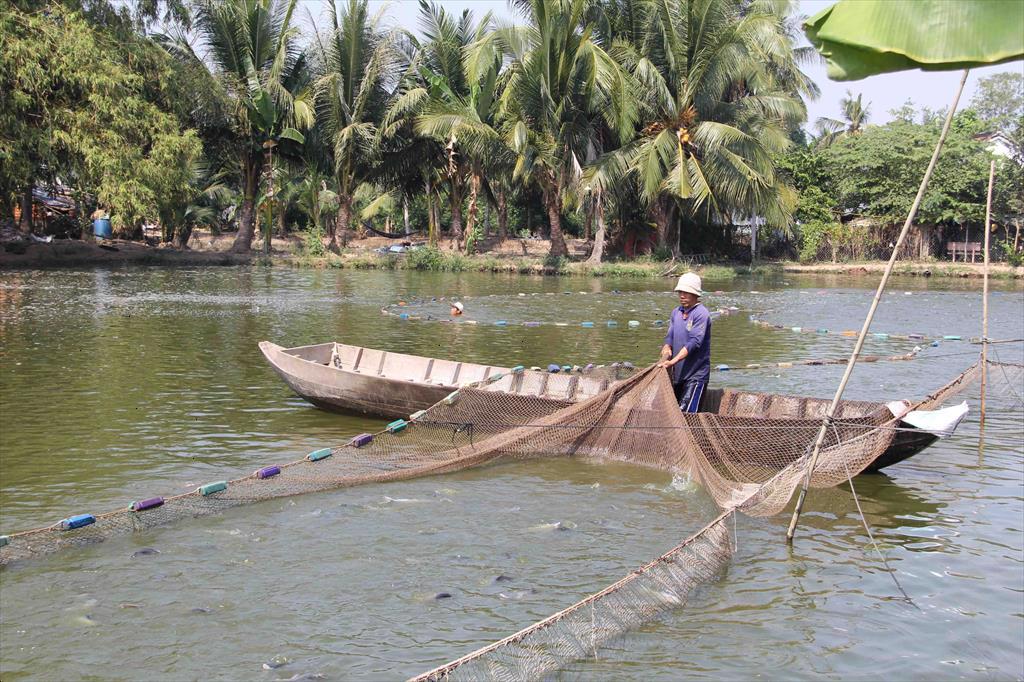
Production and consumption of aquatic products are difficult due to the impact of the COVID-19 epidemic. All levels, functional sectors and people in the Mekong Delta localities are implementing many timely solutions to stabilize and maintain the development of aquaculture activities. Recently, Working Group 970 of the Ministry of Agriculture and Rural Development (MARD) coordinated with relevant units to organize an online seminar connecting the chain of seafood production and consumption with Mekong Seafood. Connection Co., Lts under Mekong Food Group (MFG) in Ho Chi Minh City. Thereby, many businesses, households, cooperatives and aquaculture cooperative groups and representatives of the agriculture sector in the Mekong Delta regions have timely grasped information about market demand, facilities and necessary requirements to be able to supply, develop and produce a variety of seafood for export.
Currently, Mekong Seafood Connection Co., Ltd under MFG needs to buy about 1,000-1,500 tons of seafood every month. Therefore, the Company has a need to associate with businesses, households, cooperatives and groups of aquaculture in the Mekong Delta. Thereby, this link will help build material areas to form a chain of production, processing and export of aquatic products such as giant freshwater shrimp, white shrimp, black tiger shrimp, pangasius, frog legs, and tilapia, clams, scallops and a number of other products being promoted for trade such as eel, clown knifefish and sea fish...
Aquaculture in the Mekong Delta has affirmed its important role in the structure of agricultural production and contributed more and more to the socio-economic development of the whole region and the whole country. Previously, the aquaculture area of the region was only about 400,000 ha, but in recent years it has reached 800,000 ha, the annual output is more than 3 million tons and is accounting for a very large proportion of the total area and output of aquaculture in the country.
Mr. Le Huu Toan, Deputy Director of Kien Giang Province's Department of Agriculture and Rural Development, said: "By the end of August, farmers in 7 coastal districts of the province harvest about 1,500 tons of aquatic products of all kinds, including 1,056 tons. giant freshwater shrimp, 65 tons of white-leg shrimp, 100 tons of sea crabs, 126 tons of grouper, in addition to blood cockles, cobia... Therefore, the province is continuing to promote the supply-demand connection, supporting people product consumers. The province expects businesses to come to the locality to learn and sign contracts in principle for long-term association. Based on that, the Agriculture sector will direct production, arrange suitable seasons and material areas, and support production cooperatives according to the criteria of the ordering enterprise, ensuring a sustainable supply of raw materials. ".
(vasep.com.vn) Markets are changing faster, buyer requirements are becoming more demanding, and trade barriers are growing increasingly complex. In this environment, seafood businesses need more than an understanding of current market conditions. They need a longer-term perspective to answer a critical question: Where will growth opportunities come from in 2027–2029, and what should businesses do now to prepare? This is one of the key reasons why VASEP is organizing Vietnam Seafood Summit 2026.
(vasep.com.vn) In the first eight months of 2026, Vietnam’s pangasius exports to the Middle East reached US$113 million, up 7% year on year from the same period in 2025. Growth has become more pronounced in recent months. In August alone, exports to the region totaled US$20 million, an increase of 24%. This indicates that demand for Vietnamese pangasius in the Middle East is gradually recovering after a slowdown in March, although the pace of recovery varies across markets.
(vasep.com.vn) China’s shrimp imports continued to grow strongly in 2026, while Vietnam’s shrimp exports to the market also recorded notable growth. However, behind these positive figures lie two distinct trends: Chinese consumption is growing more slowly than imports, and lobster accounts for a substantial share of Vietnam’s shrimp exports to China, making its product mix significantly different from those of Ecuador and India. Exporters therefore need to assess each segment carefully to understand the opportunities and risks.
(vasep.com.vn) Changing markets, shifting buyer demand, and increasingly complex trade barriers are raising a key question for Vietnam’s seafood industry: Where will the new growth opportunities lie in 2027–2029?
(seafood.vasep.com.vn) As of the end of August 2026, Vietnam’s tilapia exports to the United States reached $21 million, representing a steep 48% year-over-year decline and accounting for 23% of the country's total tilapia export turnover. Frozen fillets accounted for 78% with the remainder consisting of whole frozen tilapia and frozen cuts.
(seafood.vasep.com.vn) After a volatile first half of the year, Vietnam’s pangasius exports to Brazil registered robust growth in July and August 2026. In August alone, export turnover reached $19 million, surging 73% compared to the same period in 2025. Cumulatively for the first eight months, total export value reached $124 million, reflecting an 8% year-over-year increase.
(seafood.vasep.com.vn) Besides modifying their boats, many fishermen in Dak Lak province are making efforts to venture out to sea to harvest seafood during the rough sea season.
(seafood.vasep.com.vn) At the Responsible Seafood Summit and TCRS Shrimp Summit 2026, organized by the GSA (Global Seafood Alliance) in Bangkok, Thailand, the conversation about the future of the shrimp industry began with one of its most important foundations: seedstock quality.
(seafood.vasep.com.vn) In the first eight months of 2026, Vietnam’s tuna exports to Lithuania surpassed $14 million, up 8% year on year. While the increase remains modest, it is notable given the continued pressure on Vietnamese tuna exports to the EU as a whole. More importantly, export turnover to Lithuania has shown a clearer recovery in recent months, making the market a destination worth monitoring for Vietnamese businesses in Europe.
(seafood.vasep.com.vn) Vietnam’s squid and octopus exports exceeded $527 million in the first eight months of 2026, marking a 15% year-on-year increase. This growth is particularly notable given the strong baseline established in 2025, when export turnover for the same period reached $458 million, a 13% rise from 2024.
VASEP - HIỆP HỘI CHẾ BIẾN VÀ XUẤT KHẨU THỦY SẢN VIỆT NAM
Chịu trách nhiệm: Ông Nguyễn Hoài Nam - Phó Tổng thư ký Hiệp hội
Đơn vị vận hành trang tin điện tử: Trung tâm VASEP.PRO
Trưởng Ban Biên tập: Bà Phùng Thị Kim Thu
Giấy phép hoạt động Trang thông tin điện tử tổng hợp số 138/GP-TTĐT, ngày 01/10/2013 của Bộ Thông tin và Truyền thông
Tel: (+84 24) 3.7715055 – (ext.203); email: kimthu@vasep.com.vn
Trụ sở: Số 7 đường Nguyễn Quý Cảnh, Phường An Phú, Quận 2, Tp.Hồ Chí Minh
Tel: (+84) 28.628.10430 - Fax: (+84) 28.628.10437 - Email: vasephcm@vasep.com.vn
VPĐD: số 10, Nguyễn Công Hoan, Ngọc Khánh, Ba Đình, Hà Nội
Tel: (+84 24) 3.7715055 - Fax: (+84 24) 37715084 - Email: vasephn@vasep.com.vn