Export revenue recovered
According to data from the Ministry of Agriculture and Rural Development, agricultural, forestry, and fishery export turnover in April reached 5.14 billion USD, an increase of 19.7% compared to April 2023. Specifically, main agricultural product exports reached 2.83 billion USD (up 29.2%), forestry products 1.39 billion USD (up 18.6%), and livestock 40.8 million USD (up 5.9%). Production input reached 157 million USD (up 0.5%). Seafood sale alone is 730 million USD (down 1.5%). Overall, in the first 4 months, all export commodity groups increased, so export turnover increased, reaching 19.06 billion USD.
Of which, coffee exports had the highest growth rate, reaching 2.5 billion USD, an increase of more than 54% over the same period last year. Next is rice: after 4 months, 3 million tons were exported, with a turnover of 1.93 billion USD, up 13.5% in volume and 23.7% in value over the same period last year. Vietnam's rice exports continue to dominate key markets, with large consumption demand for output.
Corresponding to the overall growth of the country, the export situation at enterprises also brought positive results in the first quarter of 2024. Specifically, at PAN Group, a corporation operating in the agricultural sector (food), the shrimp export segment recorded a strong recovery compared to the low base in the same period in 2023. Some main markets, such as Japan and the US, have seen a clear return to growth in orders. Accordingly, the shrimp segment's revenue during the period reached 1,460.7 billion VND, an increase of nearly 45% compared to the first quarter of 2023, and profit after tax reached 57.2 billion VND, an increase of 18%.
The revenue of VINH HOAN CORP in March 2024 reached 1,089 billion VND, an increase of 5% over the same period last year. Accumulated in the first 3 months of 2024, Vinh Hoan achieved revenue of 2,811 billion VND, an increase of 25% over the same period in 2023.
Increase processing and improve efficiency
In the coming time, Vietnam's export of many agricultural and food products are forecast to continue to be positive when demand recovers in major markets.
In the field of seafood, an analytical report from VCBS Securities Company points out that, after inventories in the US began to decline sharply in the fourth quarter of 2023, the demand for imported pangasius has shown positive signs of new orders. In addition, Russian pollock was subject to a 13.7% tax rate by EU countries from the beginning of 2024, and the US has imposed a ban on importing aquatic products originating from Russia from the end of December 2023. Therefore, Vietnamese pangasius has increased advantages in the US and EU markets. Rising prices of Chinese tilapia due to supply shortages also give Vietnamese pangasius a more competitive advantage in the US market.
In addition, China is expected to be Vietnam's key seafood export market when the economy shows positive signs after the COVID-19 epidemic and pangasius demand recovers. Besides, the favorable geographical location helps lower transportation costs compared to other markets. In addition, China's decision to stop importing seafood from Japan will bring opportunities for Vietnam.
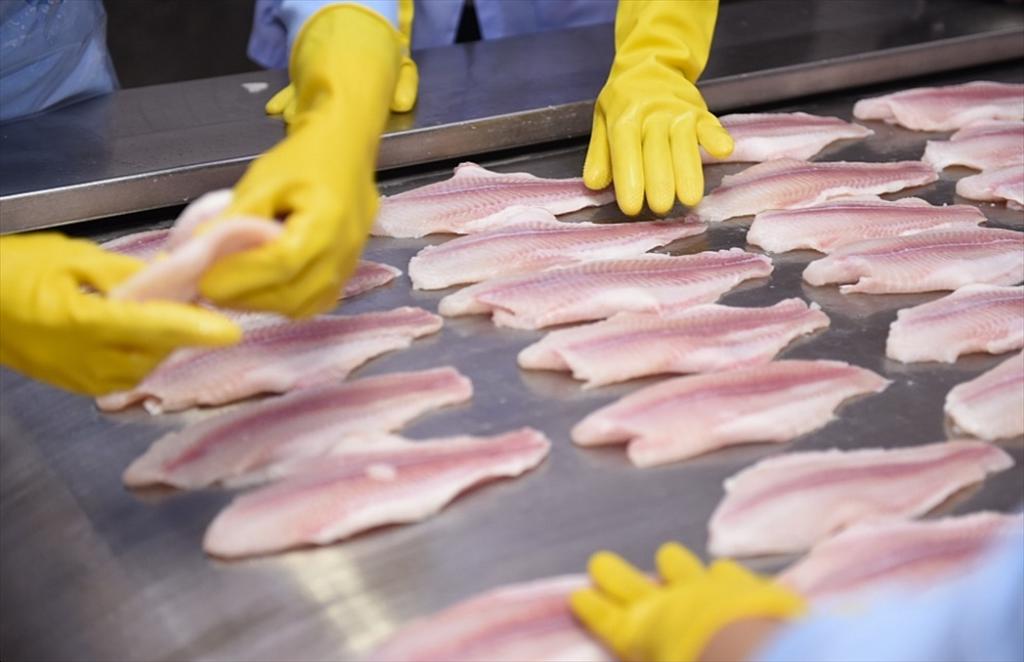
Besides positive factors in export activities, businesses themselves also proactively take many solutions to enhance product value and improve production and business efficiency. Typically, in the pangasius export segment of PAN Group, although export output in the first quarter of 2024 was lower than the same period last year (revenue decreased slightly by 1.6%), it is due to the shift to processed deep products, added value, so the gross profit margin recorded a sharp increase; profit after tax grew by 22%.
The Group's value-added products, such as breaded, sliced, and ready-to-eat, have been gradually accepted by export markets, with the advantage of farming areas and 100% control of the value chain. Accordingly, PAN Group will continue to promote investment in machinery and equipment to expand the scale of this segment in the near future.
Meanwhile, PAN Group's confectionery segment is carried out through its member company, Bibica. Bibica has exported a number of strong products, such as crackers, hard candy, and cookies, to Japan and Korea with very good reception. This has contributed to Bibica achieving 51% growth in revenue and nearly 5 times profit in the first quarter of 2024.
Similarly, at VINH HOAN CORP, while revenue from the main product, pangasius, decreased by 2% and by-products also decreased by 23%, revenue from other mixed products increased by 27%, reaching 176 billion VND. copper, collagen, and gelatin products increased by 43%, reaching 108 billion VND. Notably, revenue from rice products grew strongly by 210%, reaching 34 billion VND.
At NAFOODS GROUP, in the first quarter of 2024, the company's export output of processed fruit products increased by 5% over the same period. However, due to the decrease in the price of input materials such as passion fruit, Nafoods' revenue during the period decreased by nearly 23% to 311 billion VND. However, thanks to continued improvement in supply chain management efficiency, the gross profit margin improved, helping profit after tax grew by 2%, reaching 13.6 billion VND.
(searfood.vasep.com.vn) Vietnam’s tilapia exports continued to post positive results in the first eight months of 2026, with total export value reaching US$90 million, up 43% year-on-year. However, exports in August alone stood at US$11 million, down 8%, reflecting uneven market developments. Brazil remained the leading market, while Japan recorded notable growth, opening up new opportunities for Vietnamese tilapia products.
(vasep.com.vn) Vietnam’s shrimp exports reached US$3.3 billion in the first eight months of 2026, up 12% year on year. However, growth has begun to slow and become more differentiated across markets, while the U.S. and EU continue to present significant challenges. The latest insights from the Global Shrimp Forum 2026 (GSF 2026), held in early September, also indicate that the final months of the year will remain highly competitive as global supply continues to expand and buyers increasingly focus on quality, product specifications, supply stability and the ability to meet market-specific demand.
(seafood.vasep.com.vn) In August 2026, Vietnam’s seafood exports reached $1.14 billion, up 6% year on year. Cumulative eight-month exports rose 11.8% to $8.00 billion, though momentum has cooled compared to the 12.8% growth seen through July. China - Hong Kong and ASEAN are offsetting weakness in the U.S, EU and partly Japan. This divergence will likely widen in Q4 as trade tariffs and traceability requirements directly weigh on new orders.
(seafood.vasep.com.vn) Vietnam–Russia relations are entering a new phase of cooperation, with a focus on expanding trade, investment and economic connectivity. Against this backdrop, tuna is emerging as one of the seafood products with significant growth potential in the Russian market. Export data for the first seven months of 2026 show strong growth in Vietnamese tuna exports to Russia. However, turning this momentum into sustainable market share will require businesses to address challenges related to logistics, payment and supply competition.
(seafood.vasep.com.vn) Vietnamese tilapia is moving into a higher-value segment as brackish-water farmed fish from the Mekong Delta is now being processed for sashimi and exported regularly to Japan.
(seafoo.vasep.com.vn) Ca Mau Province is stepping up efforts to protect aquatic resources and promote transparent and sustainable fisheries, joining the country’s efforts to have the European Commission (EC) remove its “yellow card” warning for illegal, unreported and unregulated (IUU) fishing.
(vasep.com.vn) Vietnam has strengthened its position in China’s massive seafood market, becoming the largest lobster supplier while maintaining a dominant share of the country’s imported pangasius.
(vasep.com.vn) Vietfish 2026 was more than just a larger exhibition space. Through B2B meetings, booth discussions, production-chain visits and post-show feedback, businesses and buyers found something more concrete: suitable suppliers, processing capabilities, technology solutions, new markets and a foundation for building long-term trust and partnerships.
(vasep.com.vn) Vietnam’s tilapia exports to the United States declined significantly in the first seven months of 2026. Cumulative export value reached US$18 million, down 42% from the same period in 2025. In July alone, exports amounted to just US$2 million, plunging 70%, indicating a clear slowdown in import demand from the US market.
(vasep.com.vn) At the seminar “Global Seafood Markets and the Future Workforce: Trends, Opportunities and Directions for the Sustainable Development of Vietnam’s Fisheries Sector,” held as part of VIETFISH 2026, Ms. Shirlene Maria Anthonysamy, Fisheries Officer (Markets) and GLOBEFISH Coordinator at the Food and Agriculture Organization of the United Nations (FAO), presented initiatives aimed at promoting youth participation in fisheries and aquaculture.
VASEP - HIỆP HỘI CHẾ BIẾN VÀ XUẤT KHẨU THỦY SẢN VIỆT NAM
Chịu trách nhiệm: Ông Nguyễn Hoài Nam - Phó Tổng thư ký Hiệp hội
Đơn vị vận hành trang tin điện tử: Trung tâm VASEP.PRO
Trưởng Ban Biên tập: Bà Phùng Thị Kim Thu
Giấy phép hoạt động Trang thông tin điện tử tổng hợp số 138/GP-TTĐT, ngày 01/10/2013 của Bộ Thông tin và Truyền thông
Tel: (+84 24) 3.7715055 – (ext.203); email: kimthu@vasep.com.vn
Trụ sở: Số 7 đường Nguyễn Quý Cảnh, Phường An Phú, Quận 2, Tp.Hồ Chí Minh
Tel: (+84) 28.628.10430 - Fax: (+84) 28.628.10437 - Email: vasephcm@vasep.com.vn
VPĐD: số 10, Nguyễn Công Hoan, Ngọc Khánh, Ba Đình, Hà Nội
Tel: (+84 24) 3.7715055 - Fax: (+84 24) 37715084 - Email: vasephn@vasep.com.vn