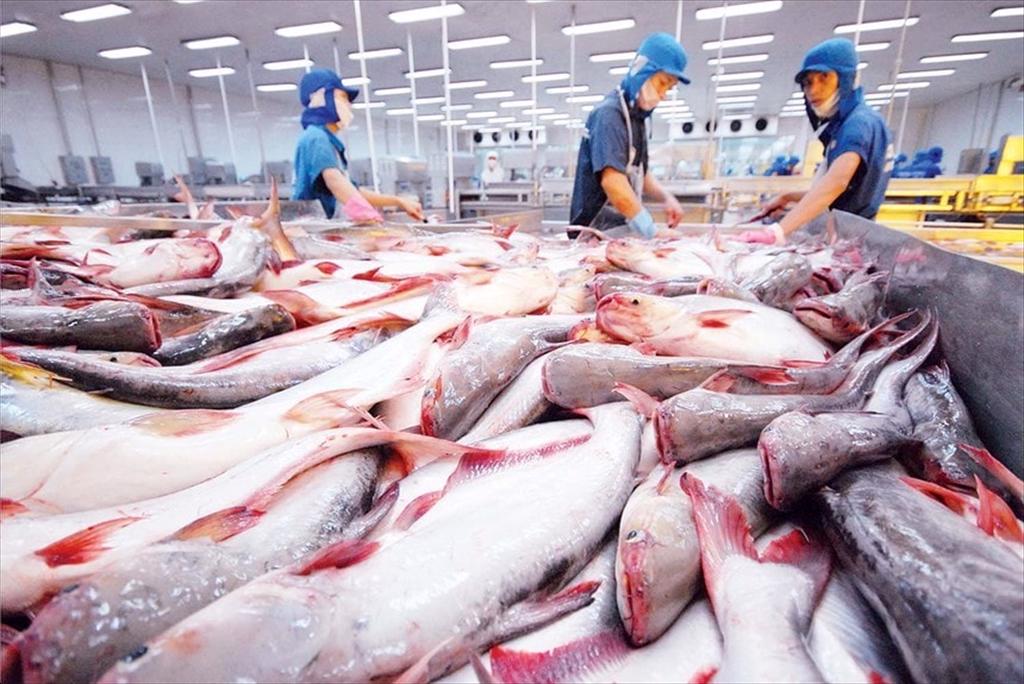
However, for this recovery to translate into sustainable growth, the pangasius industry must continue strengthening key foundations throughout the value chain—from seed quality and raw material supply stability to environmental risk management, processing efficiency, and by-product utilization. These are not only immediate requirements but also essential conditions for enhancing the competitiveness of Vietnamese pangasius as global markets increasingly demand higher standards of quality, traceability, and value addition.
Seed Quality: A Foundation That Needs Continued Improvement
Seed quality remains one of the most critical factors directly affecting farming performance and the competitiveness of the entire pangasius value chain.
While seed supply is relatively abundant in terms of quantity, quality remains inconsistent among hatcheries and breeding facilities. The survival rate from fry to fingerlings is still modest, and losses during the nursery stage continue to be a challenge that requires further improvement.
Improving seed quality should therefore remain a long-term priority for the industry. Healthy, uniform, and well-managed fingerlings can help farmers reduce disease risks, improve survival rates, increase productivity, and contribute to a more stable raw material supply for processing and export enterprises.
Raw Material Supply: Enhancing Stability for Long-Term Production Planning
For processors and exporters, fluctuations in raw material supply can affect production schedules, delivery commitments, and the ability to fulfill long-term contracts.
Strengthening linkages among processors, farming areas, hatcheries, and farmers remains a key solution for reducing volatility, sharing risks, and creating a more stable foundation for the entire pangasius value chain.
Deep Processing and By-products: Significant Potential for Value Creation
Beyond farming, processing and by-product utilization offer substantial opportunities to enhance the value of the pangasius industry.
Producing 1 kilogram of finished pangasius fillet typically requires about 2.8 kilograms of whole fish. The remaining portions—including heads, bones, skin, fat, trimmings, and other by-products—can become valuable raw materials for industries such as food processing, animal feed, pharmaceuticals, cosmetics, and other value-added products if utilized effectively.
In fact, several leading pangasius companies have already invested in deep processing and by-product utilization to produce fish oil, fishmeal, collagen, gelatin, and other higher-value products. This approach aligns with circular economy principles, helping businesses reduce waste, improve resource efficiency, and enhance profit margins.
However, at the industry level, by-product utilization remains uneven. A considerable portion of by-products is still not being fully exploited. With better organization and investment, this segment could become an important pillar helping Vietnamese pangasius shift from a volume-driven advantage to a value-driven advantage.
Climate Change and Disease Risks: Challenges Requiring Proactive Management
The pangasius industry in the Mekong Delta is increasingly affected by climate variability, salinity intrusion, water quality changes, and disease risks.
Due to its intensive farming characteristics, pangasius is particularly sensitive to fluctuations in temperature, water quality, and pond environmental conditions.
In this context, the industry's priority is not merely to expand production but also to strengthen farming area management, environmental monitoring, disease control, and the adoption of safer and more resource-efficient farming practices.
Proactive adaptation to climate-related challenges will help farmers reduce risks while enabling processors to maintain a stable supply and better meet sustainability requirements from importing markets.
Strengthening the Entire Value Chain to Enhance Competitiveness
The export recovery seen in the first months of 2026 is a positive signal for Vietnam’s pangasius sector. However, for growth to be driven by more than just production volume and raw material prices, the entire value chain must continue evolving toward greater stability, efficiency, and value addition.
This requires close coordination among hatcheries, farmers, processors, local authorities, and government agencies. Key priorities include improving seed quality, developing integrated farming areas, stabilizing raw material supplies, expanding deep processing, maximizing by-product utilization, and adopting circular economy models.
With a stronger and better-organized value chain, Vietnamese pangasius will be better positioned to enhance its competitiveness, maintain market share in traditional destinations, and expand into higher-value market segments worldwide.
(vasep.com.vn) At the international B2B seminar (Hosted Buyer Program) held as part of Vietfish 2026, Mr. Nguyen Hoang Pham, Sales Director of Tai Kim Anh Seafood Processing Joint Stock Company, delivered a presentation entitled “Vietnam’s Shrimp Industry: Changing for Sustainability.” From the perspective of a seafood processor, the presentation highlighted that Vietnam’s shrimp industry continues to play a leading role in seafood exports, but is entering a new phase of competition in which change is no longer an option, but a prerequisite for growth.
(seafood.vasep.com.vn) VIETFISH 2026 may have concluded after three dynamic days in Ho Chi Minh City, but conversations around the exhibition continue to resonate across international trade media, industry organizations, and the social media channels of participating companies.
(seafood.vasep.com.vn) Vietnam’s tilapia industry is maintaining strong growth momentum, with significant room for further expansion in the coming years. In 2025, total tilapia production reached approximately 420,000 tonnes, up 33% from 2024 and 2.2 times higher than in 2015. During 2015–2025, production grew at an average annual rate of around 8.4%. As production and exports continue to expand, food safety control is receiving increasing attention to ensure product quality, meet the increasingly stringent requirements of international markets, and provide a foundation for the sustainable development of Vietnam’s tilapia industry.
(seafood.vasep.com.vn) On the afternoon of August 19, 2026, as part of the Vietnam International Seafood Exhibition – Vietfish 2026, the Hosted Buyer Program continued with the seminar “Vietnam Seafood Outlook 2026–2027: A Strategic Sourcing Destination,” followed by 1-to-1 B2B meetings between international buyers and Vietnamese seafood businesses.
(seafood.vasep.com.vn) Speaking at the Opening Ceremony of VIETFISH 2026 on August 19 at the Saigon Exhibition and Convention Center (SECC), U.S. Consul General Melissa Brown highlighted the important role of the exhibition in connecting Vietnam’s growing seafood industry with buyers, suppliers, and partners from the United States and around the world.
(vasep.com.vn) Tomorrow, August 19, 2026, the Vietnam International Seafood Exhibition – Vietfish 2026 will officially open at the Saigon Exhibition and Convention Center (SECC) in Ho Chi Minh City. Taking place over three days, from August 19–21, Vietfish 2026 promises to provide a dynamic platform for business networking, trend updates, product experiences and comprehensive cooperation across the domestic and international seafood community.
(vasep.com.vn) The global tilapia market continues to grow, creating significant opportunities for countries with strengths in aquaculture, processing, and exports. Against this backdrop, Vietnam’s tilapia industry is gradually developing toward higher quality, greater product diversification, and broader market reach. At Vietfish 2026, the Vietnam Association of Seafood Exporters and Producers (VASEP), together with the VASEP Tilapia Producers and Exporters Club, will host a joint booth to promote the image and potential of Vietnamese tilapia to domestic and international buyers.
(seafood.vasep.com.vn) Vietnam’s seafood exports are heading towards $12 billion this year, potentially the highest level on record. Yet one of the country’s export strengths is facing a growing list of challenges.
(seafood.vasep.com.vn) The first six months of 2026 indicate that Vietnam’s tilapia industry is entering a new phase of development, with strong export growth but also greater demands for production scale, quality and international competitiveness.
(seafood.vasep.com.vn) Vietfish 2026, the Vietnam International Seafood Exhibition, will officially take place from 19–21 August 2026 in Ho Chi Minh City. As Vietnam’s largest annual seafood trade event, organized by the Vietnam Association of Seafood Exporters and Producers (VASEP), Vietfish 2026 will once again bring together leading seafood companies, industry experts, and international partners from across the global seafood value chain.
VASEP - HIỆP HỘI CHẾ BIẾN VÀ XUẤT KHẨU THỦY SẢN VIỆT NAM
Chịu trách nhiệm: Ông Nguyễn Hoài Nam - Phó Tổng thư ký Hiệp hội
Đơn vị vận hành trang tin điện tử: Trung tâm VASEP.PRO
Trưởng Ban Biên tập: Bà Phùng Thị Kim Thu
Giấy phép hoạt động Trang thông tin điện tử tổng hợp số 138/GP-TTĐT, ngày 01/10/2013 của Bộ Thông tin và Truyền thông
Tel: (+84 24) 3.7715055 – (ext.203); email: kimthu@vasep.com.vn
Trụ sở: Số 7 đường Nguyễn Quý Cảnh, Phường An Phú, Quận 2, Tp.Hồ Chí Minh
Tel: (+84) 28.628.10430 - Fax: (+84) 28.628.10437 - Email: vasephcm@vasep.com.vn
VPĐD: số 10, Nguyễn Công Hoan, Ngọc Khánh, Ba Đình, Hà Nội
Tel: (+84 24) 3.7715055 - Fax: (+84 24) 37715084 - Email: vasephn@vasep.com.vn