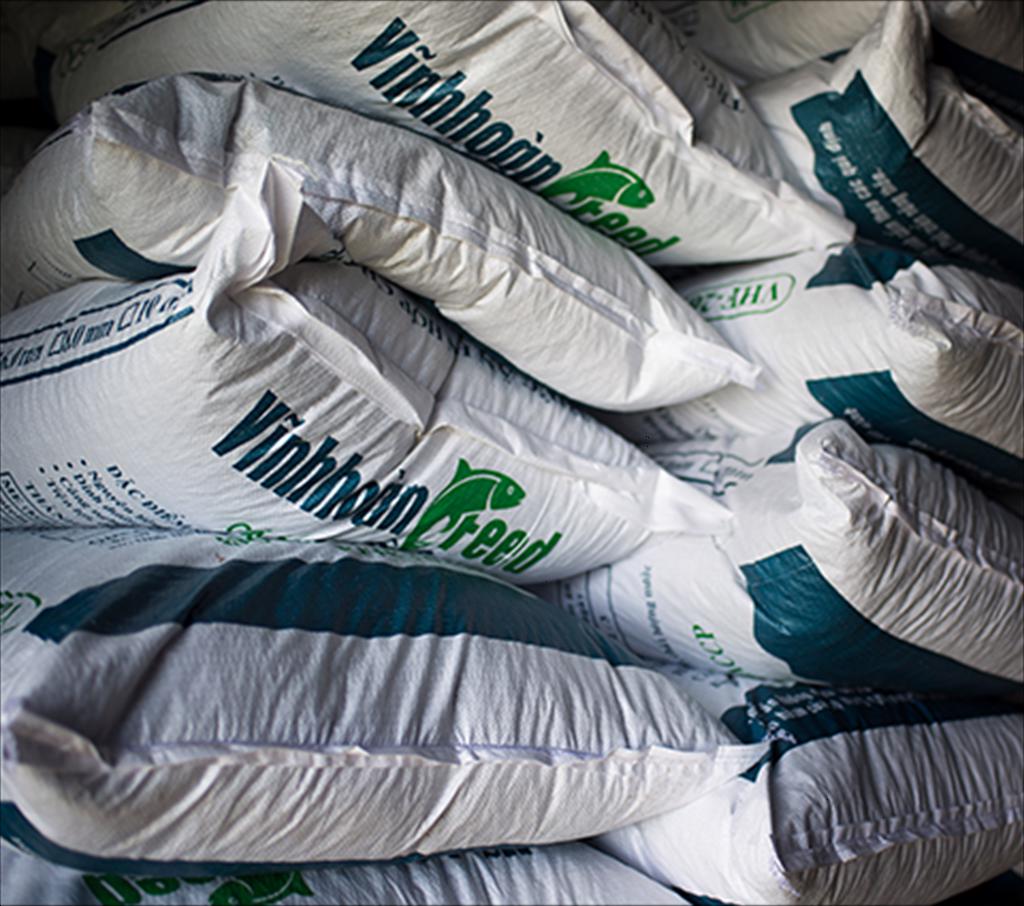
Once left the aquatic feed segment to focus on pangasius and collagen
Year of 2021 marks Vinh Hoan's return to the aquafeed segment when starting construction of Feed One aquatic feed factory with a total investment of VND 800 billion, with a capacity of 400,000 tons of feed/year.
This was also an area that helped Vinh Hoan significantly reduce the cost of raising pangasius, but then the company had to say goodbye after 6 years of working together.
Back in 2008, Vinh Hoan realized that the cost of fish feed accounted for 70% of the product's cost, so the company decided to establish Vinh Hoan 1. This factory specializes in the production of aquafeed, helping Vinh Hoan can control inputs, perfect the model of livestock production - closed processing, and reduce costs. At the same time, profit margin also improved significantly when there was a fish feed factory.
But at the end of 2014, Vinh Hoan suddenly said "hands over" this aquatic feed factory to its Philippine partner, Pilmico International, for 414 billion VND.
Explaining this decision, Mrs. Truong Thi Le Khanh, Chairman of the Board of Directors of Vinh Hoan Joint Stock Company, said that at that time (2014), the animal feed market has no room for inexperienced companies and Vinh Hoan wants to focus on training, the core business of raising, processing, and exporting pangasius plus focusing on investing in collagen projects.
“The Philippine partner has decades of experience in the field of animal feed. As for Vinh Hoan, it is not possible to invest in further research in this area. Selling the factory to them, the company also reduces the risk of having to compete on price with so many competitors like today," she explained.
Alongside the sale of Vinh Hoan 1 factory, the company expects to buy feed from its partners at a lower price.
Anyway, the sale of the feed factory in Vinh Hoan also earned a "good" profit when the initial investment capital for the factory was only about 70 billion VND.
At the same time, Vinh Hoan also sold the whole rice segment to focus on the core of pangasius.
What does Vinh Hoan expect this time around?
At the 2022 general meeting of shareholders held in mid-April, Mrs. Khanh said that this year Vinh Hoan will release the first shipment from Feed One factory. The initial capacity of the plant is 350,000 tons/year (out of a total expected capacity of 400,000 tons/year).
Some shareholders questioned why this segment's profit margin is not high, but Vinh Hoan still does it? And this time coming back to this aquatic food, what does Vinh Hoan expect?
According to the head of Vinh Hoan, people still only consider the processing segment of the pangasius industry, but there is still a very large segment with potential for breakthroughs that businesses have not yet paid attention to, which is fish feed.
“For investors, the profit margin of the aquafeed segment is low, but from the perspective of a producer, Vinh Hoan considers this a strategic step because currently feed prices are very high, and there is a lack in supply. Meanwhile, food constitutes up to 70% of the cost of production," Khanh said.
In 2021, Vinh Hoan's gross profit margin is 21% with the main revenue coming from pangasius fillets.
Vinh Hoan believes that in the near future there will be at least 50% of space to develop the profit margin of the pangasius segment, in which, the animal feed segment is part of the company's 5-year long-term strategy to improve profit margin.
In the past time, the disruption of the supply chain caused by COVID-19 and the tension between Russia - Ukraine has made the price of input materials for animal feed production continuously increase sharply. This pulls the price of finished feed up to about 35% at one point.
Therefore, the expansion of the aquaculture chain to produce aquatic feed is expected to be the most effective, especially in the context that this year the company will increase the farming area by 100-150 hectares to reach the ratio of 100 to 150 hectares. The self-control ratio of pangasius raw materials is up to 70%, making a significant contribution to the group's profit starting from 2022.
“Currently, the aquatic feed segment has two big problems that have not been resolved, which are nutrition and how to manage the feed to ensure the fish culture environment. If the environment is dirty, the quality of the fish will be affected. We have done a lot of experiments and this will be the most modern fish feed factory in Vietnam,” said Ms. Khanh.
With the Feed One project, Vinh Hoan sets an ambition to put vaccines into food so that the pangasius has good resistance from an early age, improving the survival rate.
At the same time, the self-control of food production helps the company control the nutritional content of the fish, thereby improving the quality of the meat and moving to bring pangasius to the Sushi table.
"If one day pangasius is displayed on the Sushi table, then Vinh Hoan can beat his chest to claim that he has reached the pinnacle of the industry. A foreign shareholder once asked us how we can raise pangasius how the meat can be Mango flavor? Of course, it depends on the food, and how much is the selling price,” said Ms. Khanh.
Currently Vinh Hoan is looking for a foreign partner to jointly develop the aquatic feed segment.
Compiled by Minh Trang
(vasep.com.vn) Vietnam’s shrimp exports reached US$3.7 billion in the first nine months of 2026, up 11% year on year. Although growth has been supported by China and several markets within the CPTPP, momentum is slowing as exports to the United States and the European Union decline. Tariff pressures, international competition, and raw material challenges are creating significant hurdles for exporters in the final months of the year.
(vasep.com.vn) Markets are changing faster, buyer requirements are becoming more demanding, and trade barriers are growing increasingly complex. In this environment, seafood businesses need more than an understanding of current market conditions. They need a longer-term perspective to answer a critical question: Where will growth opportunities come from in 2027–2029, and what should businesses do now to prepare? This is one of the key reasons why VASEP is organizing Vietnam Seafood Summit 2026.
(vasep.com.vn) In the first eight months of 2026, Vietnam’s pangasius exports to the Middle East reached US$113 million, up 7% year on year from the same period in 2025. Growth has become more pronounced in recent months. In August alone, exports to the region totaled US$20 million, an increase of 24%. This indicates that demand for Vietnamese pangasius in the Middle East is gradually recovering after a slowdown in March, although the pace of recovery varies across markets.
(vasep.com.vn) China’s shrimp imports continued to grow strongly in 2026, while Vietnam’s shrimp exports to the market also recorded notable growth. However, behind these positive figures lie two distinct trends: Chinese consumption is growing more slowly than imports, and lobster accounts for a substantial share of Vietnam’s shrimp exports to China, making its product mix significantly different from those of Ecuador and India. Exporters therefore need to assess each segment carefully to understand the opportunities and risks.
(vasep.com.vn) Changing markets, shifting buyer demand, and increasingly complex trade barriers are raising a key question for Vietnam’s seafood industry: Where will the new growth opportunities lie in 2027–2029?
(seafood.vasep.com.vn) As of the end of August 2026, Vietnam’s tilapia exports to the United States reached $21 million, representing a steep 48% year-over-year decline and accounting for 23% of the country's total tilapia export turnover. Frozen fillets accounted for 78% with the remainder consisting of whole frozen tilapia and frozen cuts.
(seafood.vasep.com.vn) After a volatile first half of the year, Vietnam’s pangasius exports to Brazil registered robust growth in July and August 2026. In August alone, export turnover reached $19 million, surging 73% compared to the same period in 2025. Cumulatively for the first eight months, total export value reached $124 million, reflecting an 8% year-over-year increase.
(seafood.vasep.com.vn) Besides modifying their boats, many fishermen in Dak Lak province are making efforts to venture out to sea to harvest seafood during the rough sea season.
(seafood.vasep.com.vn) At the Responsible Seafood Summit and TCRS Shrimp Summit 2026, organized by the GSA (Global Seafood Alliance) in Bangkok, Thailand, the conversation about the future of the shrimp industry began with one of its most important foundations: seedstock quality.
(seafood.vasep.com.vn) In the first eight months of 2026, Vietnam’s tuna exports to Lithuania surpassed $14 million, up 8% year on year. While the increase remains modest, it is notable given the continued pressure on Vietnamese tuna exports to the EU as a whole. More importantly, export turnover to Lithuania has shown a clearer recovery in recent months, making the market a destination worth monitoring for Vietnamese businesses in Europe.
VASEP - HIỆP HỘI CHẾ BIẾN VÀ XUẤT KHẨU THỦY SẢN VIỆT NAM
Chịu trách nhiệm: Ông Nguyễn Hoài Nam - Phó Tổng thư ký Hiệp hội
Đơn vị vận hành trang tin điện tử: Trung tâm VASEP.PRO
Trưởng Ban Biên tập: Bà Phùng Thị Kim Thu
Giấy phép hoạt động Trang thông tin điện tử tổng hợp số 138/GP-TTĐT, ngày 01/10/2013 của Bộ Thông tin và Truyền thông
Tel: (+84 24) 3.7715055 – (ext.203); email: kimthu@vasep.com.vn
Trụ sở: Số 7 đường Nguyễn Quý Cảnh, Phường An Phú, Quận 2, Tp.Hồ Chí Minh
Tel: (+84) 28.628.10430 - Fax: (+84) 28.628.10437 - Email: vasephcm@vasep.com.vn
VPĐD: số 10, Nguyễn Công Hoan, Ngọc Khánh, Ba Đình, Hà Nội
Tel: (+84 24) 3.7715055 - Fax: (+84 24) 37715084 - Email: vasephn@vasep.com.vn