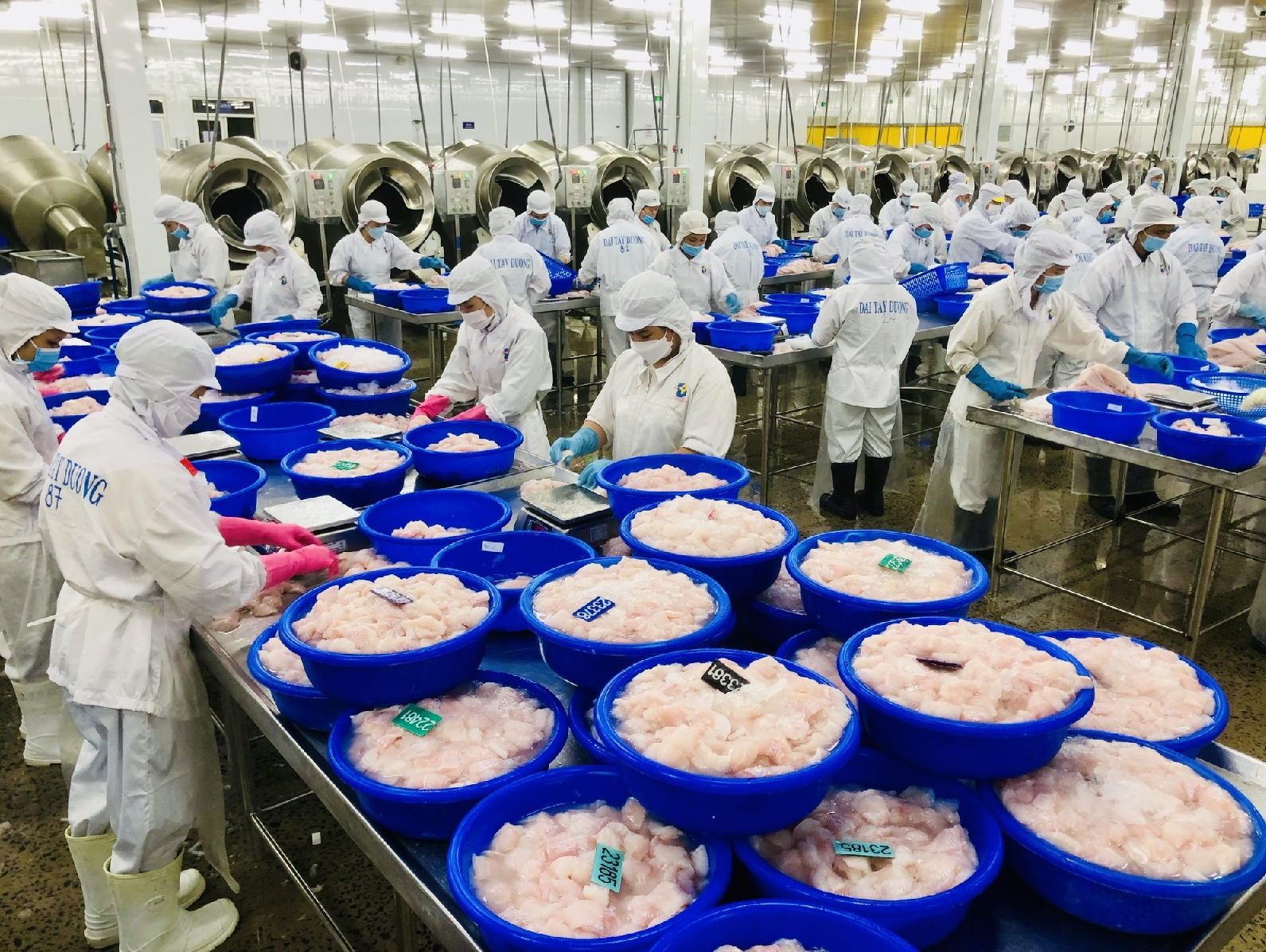
After the very gloomy first half of 2023, the Vietnam Association of Seafood Exporters and Producers (VASEP) said that there have been the clearest signs of recovery in the Chinese market.Particularly, in July, seafood exports to this market have increased by 45% over the same period last year, with sales reaching nearly 180 million USD.
In addition, the inflation situation in the US is also gradually cooling down, consumer demand is improving, and the amount of inventory is also gradually decreasing, so it will be necessary to increase imports to serve the year-end holidays.
VASEP expects that seafood exports to the US market at the end of the year will increase by 40 - 50% compared to the same period last year.
Ms. Le Hang, Communications Director of VASEP, highlighted three pivotal factors contributing to an optimistic export scenario for the second half of this year. Firstly, major markets are anticipated to experience positive economic developments during this period. Secondly, countries such as the US and China are witnessing a resurgence in import demand, driven by diminishing inventories and increasing orders for year-end festivals like Christmas and New Year's Eve.
According to VASEP, seafood exports in 2023 will reach over 9 billion USD. In particular, it is forecast that shrimp products will bring in about 3.5-3.6 billion USD; Pangasius 1.7-1.8 billion USD; Tuna and cephalopods will reach 870 million USD and 650 million USD respectively; Marine fish is estimated to reach 1.9-2 billion USD.
Seafood processing and exporting enterprises have received timely support in terms of capital, production and business conditions
Seafood processing and exporting enterprises have received timely support in terms of capital, production and business conditions. At the same time, exported products also have a stable supply and reduced costs, with competitive prices compared to other countries.
Besides, China's ban on importing seafood from Japan will create more favorable conditions for Vietnam's seafood industry, but according to experts, the export product structure of Vietnam and Japan is quite different. so the impact level may not be too great.
Mr. Tran Anh Khoa, General Director of Anh Khoa Seafoods shared: "Recently, our business has come into contact with many new customers, especially China. Compared to the same period last year, businesses have more export orders, and expect positive business results at the end of the year."
Take the chance
Seizing this opportunity, many seafood export enterprises have readied their goods and human resources to meet the growing market demand
Seizing this opportunity, many seafood export enterprises have readied their goods and human resources to meet the growing market demand.
According to Mr. Ho Quoc Luc, Chairman of the Board of Directors of Sao Ta Food Joint Stock Company, in the third quarter, seafood businesses accelerated processing and exporting to compensate for the decline in the first half of this year.
Speaking with reporters from Investment Newspaper, Mr. Chiem Cuong, Sales Director of FATIFISHCO, the primary trading entity specializing in pangasius products, shared the company's resilient strategy during a challenging period for seafood exports. Despite a gloomy market, the company remained steadfast in its commitment to maintaining stable production levels. They refrained from implementing long-term output cuts, a decision driven by their dedication to retaining their workforce, nurturing customer relationships, and strategically stockpiling inventory. This strategic approach positions FATIFISHCO to capitalize on market opportunities for expansion when they arise.
To do so, according to Mr. Cuong, in recent months, businesses have had to suffer a profit deficit due to low sales, but expenses still have to be spent the same, even some expenses such as warehousing and materials are rising.
However, these difficulties will be offset by positive signals when the market recovers, businesses do not have to spend money and time recruiting and training new human resources. Old customers will quickly return because they still maintain contact.
In addition, Mr. Cuong added that during the time the EU market was shrinking, Phat Tien Seafood Company actively sought and expanded markets in the Middle East and South America.
Meanwhile, Mr. Le Van Nghia, Deputy Director of Ca Mau Aquatic Foods Co., Ltd., shared that in recent times, this business has sought more suitable investment directions to improve comprehensive product quality.
According to Mr. Nghia, large markets like the EU are increasingly difficult, to meet 100% of the standards and conditions of this market is very difficult. Ca Mau Aquatic Foods Co., Ltd has focused on retraining its professional workforce to improve product quality comprehensively, from food safety and hygiene, to packaging, to packaging, and preservation.
"Ca Mau Aquatic Food Company urgently updating standards as it diligently works to promptly align with the latest regulatory standards mandated by authorities. This proactive effort is essential to guarantee that our export orders smoothly navigate through the stringent quality checkpoints and avoid any potential delays due to non-compliance. In addition, businesses are fervently mobilizing their resources to expedite the procurement of raw materials, preemptively safeguarding against potential shortages that could hinder our ability to meet the demands of the market," emphasized Mr. Nghia.
Compiled by Thuy Linh
(vasep.com.vn) Markets are changing faster, buyer requirements are becoming more demanding, and trade barriers are growing increasingly complex. In this environment, seafood businesses need more than an understanding of current market conditions. They need a longer-term perspective to answer a critical question: Where will growth opportunities come from in 2027–2029, and what should businesses do now to prepare? This is one of the key reasons why VASEP is organizing Vietnam Seafood Summit 2026.
(vasep.com.vn) In the first eight months of 2026, Vietnam’s pangasius exports to the Middle East reached US$113 million, up 7% year on year from the same period in 2025. Growth has become more pronounced in recent months. In August alone, exports to the region totaled US$20 million, an increase of 24%. This indicates that demand for Vietnamese pangasius in the Middle East is gradually recovering after a slowdown in March, although the pace of recovery varies across markets.
(vasep.com.vn) China’s shrimp imports continued to grow strongly in 2026, while Vietnam’s shrimp exports to the market also recorded notable growth. However, behind these positive figures lie two distinct trends: Chinese consumption is growing more slowly than imports, and lobster accounts for a substantial share of Vietnam’s shrimp exports to China, making its product mix significantly different from those of Ecuador and India. Exporters therefore need to assess each segment carefully to understand the opportunities and risks.
(vasep.com.vn) Changing markets, shifting buyer demand, and increasingly complex trade barriers are raising a key question for Vietnam’s seafood industry: Where will the new growth opportunities lie in 2027–2029?
(seafood.vasep.com.vn) As of the end of August 2026, Vietnam’s tilapia exports to the United States reached $21 million, representing a steep 48% year-over-year decline and accounting for 23% of the country's total tilapia export turnover. Frozen fillets accounted for 78% with the remainder consisting of whole frozen tilapia and frozen cuts.
(seafood.vasep.com.vn) After a volatile first half of the year, Vietnam’s pangasius exports to Brazil registered robust growth in July and August 2026. In August alone, export turnover reached $19 million, surging 73% compared to the same period in 2025. Cumulatively for the first eight months, total export value reached $124 million, reflecting an 8% year-over-year increase.
(seafood.vasep.com.vn) Besides modifying their boats, many fishermen in Dak Lak province are making efforts to venture out to sea to harvest seafood during the rough sea season.
(seafood.vasep.com.vn) At the Responsible Seafood Summit and TCRS Shrimp Summit 2026, organized by the GSA (Global Seafood Alliance) in Bangkok, Thailand, the conversation about the future of the shrimp industry began with one of its most important foundations: seedstock quality.
(seafood.vasep.com.vn) In the first eight months of 2026, Vietnam’s tuna exports to Lithuania surpassed $14 million, up 8% year on year. While the increase remains modest, it is notable given the continued pressure on Vietnamese tuna exports to the EU as a whole. More importantly, export turnover to Lithuania has shown a clearer recovery in recent months, making the market a destination worth monitoring for Vietnamese businesses in Europe.
(seafood.vasep.com.vn) Vietnam’s squid and octopus exports exceeded $527 million in the first eight months of 2026, marking a 15% year-on-year increase. This growth is particularly notable given the strong baseline established in 2025, when export turnover for the same period reached $458 million, a 13% rise from 2024.
VASEP - HIỆP HỘI CHẾ BIẾN VÀ XUẤT KHẨU THỦY SẢN VIỆT NAM
Chịu trách nhiệm: Ông Nguyễn Hoài Nam - Phó Tổng thư ký Hiệp hội
Đơn vị vận hành trang tin điện tử: Trung tâm VASEP.PRO
Trưởng Ban Biên tập: Bà Phùng Thị Kim Thu
Giấy phép hoạt động Trang thông tin điện tử tổng hợp số 138/GP-TTĐT, ngày 01/10/2013 của Bộ Thông tin và Truyền thông
Tel: (+84 24) 3.7715055 – (ext.203); email: kimthu@vasep.com.vn
Trụ sở: Số 7 đường Nguyễn Quý Cảnh, Phường An Phú, Quận 2, Tp.Hồ Chí Minh
Tel: (+84) 28.628.10430 - Fax: (+84) 28.628.10437 - Email: vasephcm@vasep.com.vn
VPĐD: số 10, Nguyễn Công Hoan, Ngọc Khánh, Ba Đình, Hà Nội
Tel: (+84 24) 3.7715055 - Fax: (+84 24) 37715084 - Email: vasephn@vasep.com.vn