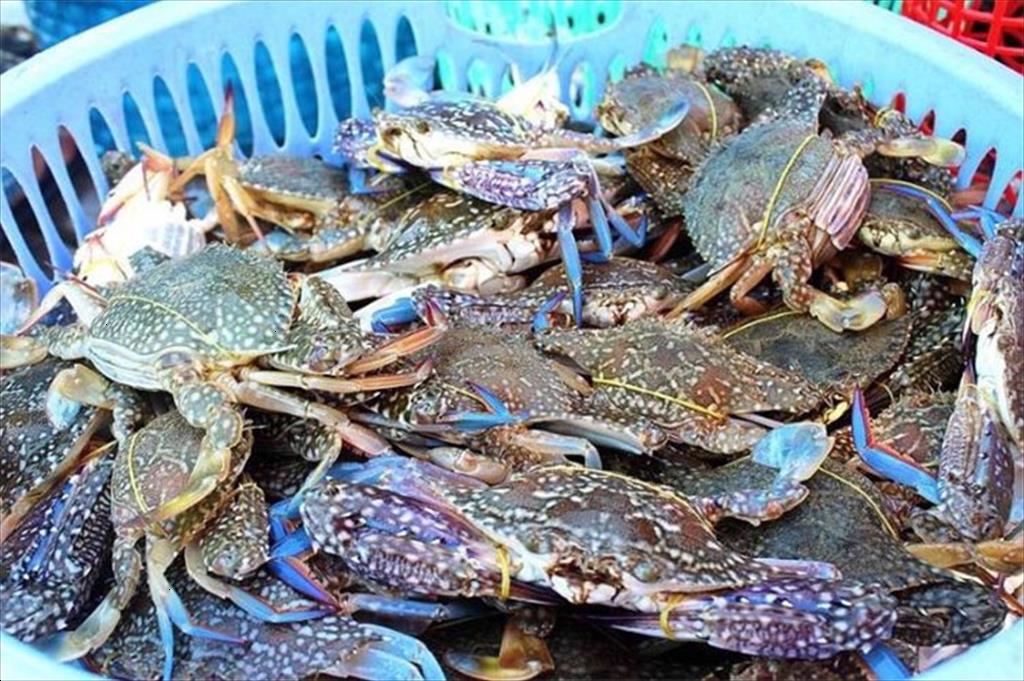
While red crab is fished in many areas, the blue swimming crab (BSC) is primarily harvested in Kien Giang province , with annual catches fluctuating between 6,000–8,000 tons/year. This fishery involves approximately 20,000 fishermen from the province’s coastal areas.
Beyond meeting domestic food demand, blue swimming crab catches are primarily processed and exported, mainly to the U.S. market.
Sustainable Development of the Blue Swimming Crab Fishery
The Kien Giang Blue Swimming Crab Fishery Improvement Project (FIP) is implemented by the People's Committee of Kien Giang Province and the Crab Council of the Vietnam Association of Seafood Exporters and Producers (VASEP). Coordinating partners include WWF Vietnam , with consultation from the Research Institute for Marine Fisheries (RIMF) and the Nha Trang Institute of Oceanography (IO).
The VASEP Crab Council comprises businesses that process and export crab to the U.S. market. The U.S. is a demanding market where raw materials must be proven to originate from sustainable fisheries. The standard for assessing sustainable fisheries is certification by the Marine Stewardship Council (MSC).
In 2009, the VASEP Crab Council began the process of evaluating the blue swimming crab fishery against the MSC standard to minimize trade barriers for BSC exports to the U.S. The Council hired an independent consultant from Poseidon Ltd., Australia for the MSC pre-assessment. The initial evaluation from 2009–2011 revealed a lack of data on stock, ecosystem, and management aspects.
Addressing these limitations, the Kien Giang Provincial People's Committee and the VASEP Crab Council coordinated with WWF Vietnam and research institutes to implement the Fishery Improvement Project (FIP), aiming for MSC certification within five years. A Plan of Action for the BSC FIP was developed, with specific activities agreed upon by stakeholders in 2012. A Memorandum of Understanding for the BSC FIP implementation was signed by the four parties: the Kien Giang Provincial People's Committee, the VASEP Crab Council, WWF Vietnam, and the Research Institute for Marine Fisheries.
The Kien Giang BSC FIP officially began in November 2012, with WWF Vietnam serving as the coordinator. All FIP activities and results are periodically updated and tracked on the website https://fisheryprogress.org/. Annual action plans are adjusted based on the achievements of the preceding year.
During the FIP implementation, the Kien Giang blue swimming crab fishery saw positive changes. Starting from a position of lacking information across most fields (stock, ecosystem, and fishery management), annual assessments noted significant information updates and improvements. By 2016, achieving MSC certification within five years was deemed highly feasible, with only one performance indicator still needing improvement.
However, from 2017–2019, environmental impacts caused a sharp decline in crab catches (only 2,072 tons in 2018, a 73% drop compared to 2013). Consequently, the FIP was suspended, becoming inactive since 2020.
In 2023, VASEP, in coordination with the Research Institute for Marine Fisheries, initiated the re-activation of the BSC FIP to help mitigate trade barriers for BSC exports to the U.S.
Through the efforts of VASEP and supporting consultants, the Kien Giang BSC FIP was revived in 2024 and officially listed as "Active" on the https://fisheryprogress.org/ website in September 2024. FIP activities and progress are based on the Action Plan and are tracked online, with status updated periodically.
The blue swimming crab catch volume in 2023 recovered to levels comparable to the 2013–2016 period.
As of September 2025, the Kien Giang Blue Swimming Crab Fishery Improvement Project in Vietnam has been upgraded from a "C" to an "A" rating. This "A" status signifies good progress, adherence to the plan, transparency, and multiple activities aimed at improving resource management and stock health.
Bycatch of the Blue Swimming Crab Fishery
In the overall catch of the blue swimming crab fishery, data analysis from at-sea observer trips conducted by the FIP from 2013–2018 documented a total of 288 species belonging to 108 families. This means that, aside from the target species, the fishery's catch includes approximately 287 species of incidental catch (bycatch).
Among the bycatch, some species were identified as belonging to the Endangered, Threatened, and Protected (ETP) species group, including sea turtles, sharks, and rays. Although ETP species were recorded in the catches, their frequency of encounter was low.
Analysis of 23,480 catch records from 3,270 logbooks and 365 hauls from 74 observer trips on BSC fishing vessels found no recorded presence of marine mammals. Thus, it can be confirmed that the blue swimming crab fishery in the Kien Giang sea area has not been shown to impact marine mammals.
The Kien Giang blue swimming crab fishery uses three main gear types: bottom gillnets (BG), collapsible traps (CT), and Chinese traps (ChT).
Management efforts for the Kien Giang BSC fishery in recent years have been guided by the MSC Fishery Standard assessment criteria. The fishery has evolved from one with insufficient management information to one that has seen significant improvement since the FIP's implementation. It is one of the pioneering fisheries in Vietnam to base its management on MSC information standards.
On August 26, 2025, the U.S. National Oceanic and Atmospheric Administration (NOAA) informed the Department of Fisheries and Fisheries Surveillance (under Vietnam’s Ministry of Agriculture and Environment) that it would deny equivalence recognition for 12 Vietnamese fisheries, including the Blue Swimming Crab/Crab fishery (ID 2988). The banned gear types specified for this fishery include:
This denial of equivalence for 12 Vietnamese fisheries, including the crab fishery, means that the export of blue swimming crab to the U.S. market will be affected starting January 1, 2026.
The Kien Giang BSC fishery is a small-scale operation, utilizing bottom gillnets and traps, with vessels mostly under 12m, operating near-shore. Rerunning the analysis of logbook and at-sea observer data confirmed no recorded information about marine mammal interactions with the fishing gear. Therefore, the Kien Giang BSC fishery is confirmed not to affect marine mammals.
Overall Assessment
The Kien Giang Blue Swimming Crab fishery has been actively implementing a fishery improvement program under the MSC standard for several years. The FIP's management plan includes solutions for resource conservation and mitigating the bycatch of non-target species. Project information is publicly accessible online via https://fisheryprogress.org/. Given its history of improvement and transparency, the Kien Giang blue swimming crab fishery meets the necessary and sufficient conditions for consideration for equivalence recognition with U.S. fisheries.
(vasep.com.vn) On November 11, 2026, in Can Tho, the Vietnam Association of Seafood Exporters and Producers (VASEP) will organize the Vietnam Seafood Summit 2026 (VSS 2026) under the theme “Seafood Market Outlook 2027–2029: Opportunities and Headroom for Double-Digit Export Growth.”
(seafood.vasep.com.vn) Business leader Do Ngoc Tai, General Director of Tai Kim Anh Seafood Processing Joint Stock Company, was honored by the Vietnam Chamber of Commerce and Industry (VCCI) with the title “Outstanding Vietnamese Entrepreneur – Thanh Giong Cup 2026” at a ceremony celebrating Vietnam Entrepreneurs’ Day (October 13). The event took place on the evening of October 11, 2026, at the National Convention Center in Hanoi.
(vasep.com.vn) The global tilapia market is becoming increasingly segmented, not only among producing countries but also by product type and destination market. Supply is divided into groups with distinct competitive advantages: large volumes of whole fish and frozen fillets from Asia, high-value fresh fillets from Latin America, and substantial domestic consumption in several major producing countries.
(vasep.com.vn) Vietnam’s tuna exports to the UK grew in the first eight months of 2026, despite signs of slowing import demand in the market. However, sharp fluctuations in orders, competition from major suppliers, and new traceability requirements are creating challenges for Vietnamese exporters.
(seafood.vasep.com.vn) Vietnam is stepping up efforts to combat illegal fishing, protect marine ecosystems, expand digital monitoring, and develop science-based management to ensure the sea can support communities and the economy for generations to come.
(seafood.vasep.com.vn) The EU remains a critical market for Vietnamese shrimp; however, purchasing demand and import patterns are undergoing notable changes. According to Vietnam Customs data, as of September 15, 2026, Vietnam’s shrimp exports to the EU reached nearly $374 million, down 5% year-over-year and accounting for 10.7% of the country’s total shrimp export value. Meanwhile, the EU’s stotal shrimp imports through July 2026 contracted by 7% in volume, exhibiting divergent trends across Southern Europe, Northwestern Europe and Eastern Europe. These dynamics necessitate that Vietnamese enterprises closely monitor individualized market demand, rather than approaching the EU as a monolithic consumer block.
(seafood.vasep.com.vn) In the first eight months of 2026, Vietnam’s exports of surimi and fish cakes remained relatively stable year-over-year compared to 2025. Following a contraction in the initial months, export performance demonstrated improvement from June onward, peaking in August. However, the recovery has been uneven, characterized by divergent trends across major markets: robust growth was recorded in China, Japan, Malaysia, the United States, and Taiwan, whereas export volumes to South Korea, Indonesia, and select European markets contracted.
(seafood.vasep.com.vn) Pangasius remains one of Dong Thap’s key aquaculture species, with the province focusing on developing an integrated value chain covering seed production, commercial farming, deep processing and by-product utilization. The province is promoting high-tech, circular pangasius farming models featuring reduced water exchange and enhanced biosecurity, aiming to improve production efficiency and strengthen control over raw material quality.
(vasep.com.vn) Vietnam’s seafood exports in September 2026 are estimated at US$1.135 billion, up 11.9% year-on-year, bringing total exports in the first nine months of the year to US$9.103 billion, up 11.4%. Behind this double-digit growth, however, increasingly divergent market trends are emerging: China–Hong Kong and ASEAN posted strong growth, while the U.S., EU and Japan all recorded declines in September.
(vasep.com.vn) In the first eight months of 2026, Brazil became the largest market for Vietnamese tilapia, with export value reaching US$44 million, up 22,142% year-on-year and accounting for 49% of Vietnam’s total tilapia exports. In August alone, exports to Brazil reached US$4 million. However, behind this remarkable growth is a market that is imposing increasingly stringent requirements on imported supplies.
VASEP - HIỆP HỘI CHẾ BIẾN VÀ XUẤT KHẨU THỦY SẢN VIỆT NAM
Chịu trách nhiệm: Ông Nguyễn Hoài Nam - Phó Tổng thư ký Hiệp hội
Đơn vị vận hành trang tin điện tử: Trung tâm VASEP.PRO
Trưởng Ban Biên tập: Bà Phùng Thị Kim Thu
Giấy phép hoạt động Trang thông tin điện tử tổng hợp số 138/GP-TTĐT, ngày 01/10/2013 của Bộ Thông tin và Truyền thông
Tel: (+84 24) 3.7715055 – (ext.203); email: kimthu@vasep.com.vn
Trụ sở: Số 7 đường Nguyễn Quý Cảnh, Phường An Phú, Quận 2, Tp.Hồ Chí Minh
Tel: (+84) 28.628.10430 - Fax: (+84) 28.628.10437 - Email: vasephcm@vasep.com.vn
VPĐD: số 10, Nguyễn Công Hoan, Ngọc Khánh, Ba Đình, Hà Nội
Tel: (+84 24) 3.7715055 - Fax: (+84 24) 37715084 - Email: vasephn@vasep.com.vn