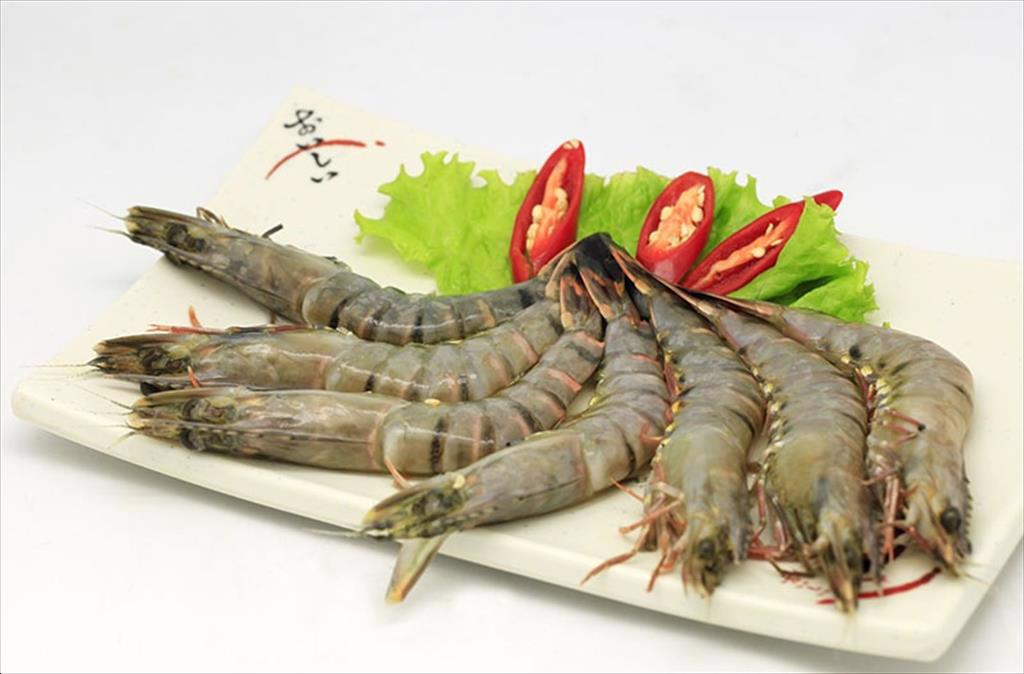
Raw shrimp price, especially black tiger shrimp, is quite stable; which creates motivation for shrimp farmers in Ca Mau. For instance, from the beginning of May 2022 to now, the price of intensive farmed whiteleg shrimps of all size has risen slightly from 2,000 to 4,000 VND/kg, while shrimp sized 100 pc/kg are priced at about 95,000 - 97,000 VND/kg.
Meanwhile, the price of large black tiger shrimp from 10 to 20 pc/kg remains high and stable. Prices of raw black tiger shrimp sized 20 pc/kg ranged from 225,000 to 235,000 VND/kg, up 10,000 VND/kg; 30 pc/kg prices range from 185,000 to 195,000 VND/kg, up 5,000 VND/kg; Prices of shrimp sized 40 pc/kg are consistent at 160,000 to 170,000 VND/kg.
According to the People's Committee of Ca Mau province, in the first 5 months of 2022, the fishery output reached 259,715 tons, up 1.6% over the same period last year. Shrimp production reached nearly 98,000 tons, up 10.9% over the same period in 2021.
Ca Mau currently has more than 10,340 intensive and super-intensive shrimp farming households with a farming area of over 7,390 ha. Particularly, the area of super-intensive farming in the first 5 months of this year is more than 3,860 ha with 3,934 farming households. Most of the ponds and lagoons for intensive, super-intensive, and extensive shrimp farming in the province have stocked seeds for the new crop.
To improve the efficiency of aquaculture in the coming time, the People's Committee of Ca Mau province strengthens the guidance for departments, branches, and localities to implement urgent solutions promoting development in the direction of high productivity, high quality, and efficiency. These solutions must focus on developing a good shrimp farming model that can bring high productivity, be environmentally friendly, and can adapt to climate change.
At the same time, specified provincial authorities should actively monitor the weather as well as hydrometeorology to respond quickly to any problems, and also minimize damage caused by natural disasters.
In 2022, the province strives to put the total output of fishing and aquaculture to 630,000 tons; shrimp production to 230,000 tons, and shrimp processing output to 157,000 tons.
Compiled by Thuy Linh
Source: NDH
(vasep.com.vn) China’s shrimp imports continued to grow strongly in 2026, while Vietnam’s shrimp exports to the market also recorded notable growth. However, behind these positive figures lie two distinct trends: Chinese consumption is growing more slowly than imports, and lobster accounts for a substantial share of Vietnam’s shrimp exports to China, making its product mix significantly different from those of Ecuador and India. Exporters therefore need to assess each segment carefully to understand the opportunities and risks.
(vasep.com.vn) Changing markets, shifting buyer demand, and increasingly complex trade barriers are raising a key question for Vietnam’s seafood industry: Where will the new growth opportunities lie in 2027–2029?
(seafood.vasep.com.vn) As of the end of August 2026, Vietnam’s tilapia exports to the United States reached $21 million, representing a steep 48% year-over-year decline and accounting for 23% of the country's total tilapia export turnover. Frozen fillets accounted for 78% with the remainder consisting of whole frozen tilapia and frozen cuts.
(seafood.vasep.com.vn) After a volatile first half of the year, Vietnam’s pangasius exports to Brazil registered robust growth in July and August 2026. In August alone, export turnover reached $19 million, surging 73% compared to the same period in 2025. Cumulatively for the first eight months, total export value reached $124 million, reflecting an 8% year-over-year increase.
(seafood.vasep.com.vn) Besides modifying their boats, many fishermen in Dak Lak province are making efforts to venture out to sea to harvest seafood during the rough sea season.
(seafood.vasep.com.vn) At the Responsible Seafood Summit and TCRS Shrimp Summit 2026, organized by the GSA (Global Seafood Alliance) in Bangkok, Thailand, the conversation about the future of the shrimp industry began with one of its most important foundations: seedstock quality.
(seafood.vasep.com.vn) In the first eight months of 2026, Vietnam’s tuna exports to Lithuania surpassed $14 million, up 8% year on year. While the increase remains modest, it is notable given the continued pressure on Vietnamese tuna exports to the EU as a whole. More importantly, export turnover to Lithuania has shown a clearer recovery in recent months, making the market a destination worth monitoring for Vietnamese businesses in Europe.
(seafood.vasep.com.vn) Vietnam’s squid and octopus exports exceeded $527 million in the first eight months of 2026, marking a 15% year-on-year increase. This growth is particularly notable given the strong baseline established in 2025, when export turnover for the same period reached $458 million, a 13% rise from 2024.
(seafood.vasep.com.vn) Vietnamese pangasius is gaining traction in Japan, where competitive prices and reliable supplies have helped the fish enter professional distribution channels and a major sushi chain.
(vasep.com.vn) A circular economy does not create a “new type of shrimp” or a new certification. Its value lies in helping the shrimp value chain use resources more efficiently, stabilize production, generate additional value from by-products and build the data and evidence needed to meet increasingly stringent market requirements. This was the perspective shared by VASEP at the Public-Private Partnership (PPP) Forum on Promoting a Circular Economy in the Shrimp Industry in the Mekong Delta, held in Can Tho on September 21.
VASEP - HIỆP HỘI CHẾ BIẾN VÀ XUẤT KHẨU THỦY SẢN VIỆT NAM
Chịu trách nhiệm: Ông Nguyễn Hoài Nam - Phó Tổng thư ký Hiệp hội
Đơn vị vận hành trang tin điện tử: Trung tâm VASEP.PRO
Trưởng Ban Biên tập: Bà Phùng Thị Kim Thu
Giấy phép hoạt động Trang thông tin điện tử tổng hợp số 138/GP-TTĐT, ngày 01/10/2013 của Bộ Thông tin và Truyền thông
Tel: (+84 24) 3.7715055 – (ext.203); email: kimthu@vasep.com.vn
Trụ sở: Số 7 đường Nguyễn Quý Cảnh, Phường An Phú, Quận 2, Tp.Hồ Chí Minh
Tel: (+84) 28.628.10430 - Fax: (+84) 28.628.10437 - Email: vasephcm@vasep.com.vn
VPĐD: số 10, Nguyễn Công Hoan, Ngọc Khánh, Ba Đình, Hà Nội
Tel: (+84 24) 3.7715055 - Fax: (+84 24) 37715084 - Email: vasephn@vasep.com.vn