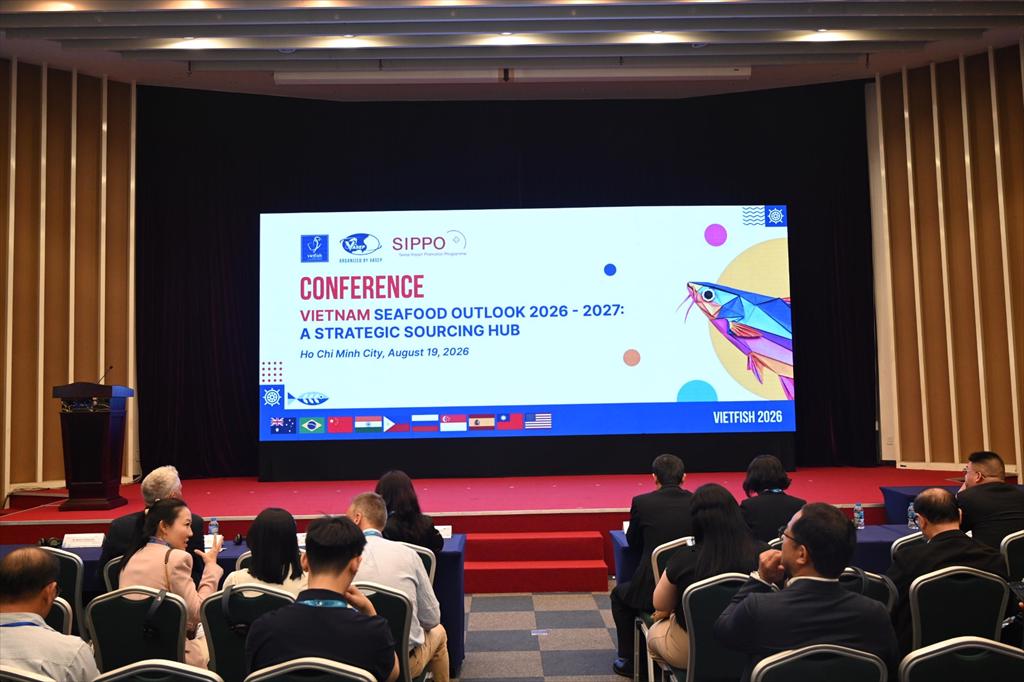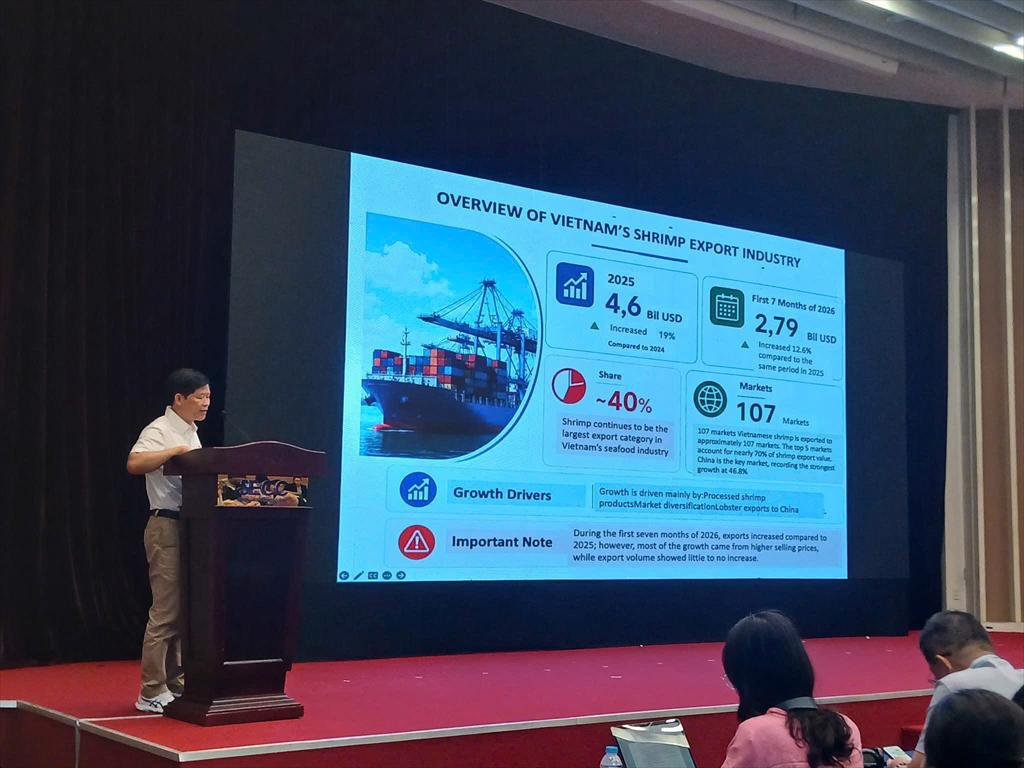
According to the presentation, shrimp remains Vietnam’s largest seafood export commodity, accounting for approximately 40% of total seafood export value. In 2025, Vietnam’s shrimp exports reached US$4.6 billion, up 19% from 2024. In the first seven months of 2026, shrimp exports reached US$2.79 billion, up 13.5% year on year. Vietnamese shrimp is currently exported to around 107 markets, with the five largest markets accounting for nearly 70% of total export value.
These figures show that Vietnam’s shrimp industry continues to benefit from a broad market base and retain its ability to grow amid considerable volatility in global seafood trade. However, an important point is that growth during the first seven months was driven primarily by higher selling prices, while export volumes did not increase at the same pace. This reflects a reality that warrants careful consideration: growth in export value does not necessarily translate into sustainable improvements in output, profitability or competitiveness.
Vietnam’s Strength Lies in Value-Added Processing
In the global competitive landscape, each major shrimp-exporting country has its own distinct advantage. Ecuador benefits from large-scale farming and low production costs; India is strong in raw and frozen shrimp; while Indonesia is investing heavily in high-tech aquaculture and focusing on the US market. Vietnam, meanwhile, is seen as having an advantage in value-added processing and the ability to serve a wide range of market segments.
This is a key differentiating factor for Vietnamese shrimp. While many competitors compete on scale, volume and low prices, Vietnamese companies have strengths in deep processing, convenience products, customized products, order flexibility, and extensive experience in meeting quality standards across multiple importing markets.
However, this advantage is not permanent. As markets increasingly emphasize transparency, sustainability certification, traceability, social responsibility and carbon emissions, processing capacity alone represents only one part of competitiveness. To retain orders, companies must demonstrate that their entire supply chains are reliable—from farming areas and raw materials to processing plants and finished products.
Global Competition Is Shifting from Volume to Efficiency and Standards
Mr. Pham’s presentation also highlighted notable developments among major shrimp-exporting countries. Ecuador is an example of restructuring as prolonged low selling prices put pressure on both businesses and farmers. Many smaller processing plants have had to be sold or merged, while larger companies have expanded farming areas and integrated their supply chains. Production growth is beginning to show signs of slowing, while competition is gradually shifting toward efficiency and scale.
India is also facing pressure as shrimp prices decline while input costs rise. Farmers are reducing farming areas or stocking densities, while competition from Ecuador in the US and Chinese markets is becoming increasingly intense. At the same time, India is increasing investment in broodstock, biosecurity and high-tech aquaculture.
These developments offer an important lesson for Vietnam. If the industry focuses solely on short-term export growth, it may overlook deeper changes taking place in the structure of global competition. Competitors are not competing on price alone; they are restructuring supply chains, strengthening control over raw material supplies, investing in technology and improving production efficiency.
International Buyers Are Setting New Requirements
The global shrimp market is also changing significantly from the consumer and buyer perspective. Consumption trends are shifting more strongly toward convenient, ready-to-cook and easy-to-use products. Consumers are paying greater attention to health and food safety, while sustainability is increasingly influencing purchasing decisions. At the same time, requirements for traceability and supply-chain transparency are becoming more stringent.
For international buyers, new expectations include electronic traceability systems, sustainability certification, compliance with labor, environmental and social responsibility requirements, as well as the measurement and reduction of carbon emissions.
This means Vietnamese shrimp can no longer compete solely on product quality at the processing plant. Market access in the coming period will depend increasingly on data, documentation, certification, transparency, supply-chain management capabilities, and the ability to demonstrate responsibility toward the environment, workers, communities and consumers.
Domestic Pressures Facing Vietnam’s Shrimp Industry
In addition to market requirements, Vietnam’s shrimp industry is also facing a number of internal pressures. At the farming stage, the costs of feed, electricity, fuel and other inputs are rising; disease outbreaks are becoming more frequent; electricity, irrigation, transport and logistics infrastructure remains uneven; climate change is increasing production risks; and raw shrimp prices remain volatile.
At the processing stage, exports continue to grow, but domestic raw material supplies remain unstable. Fluctuating raw material prices are causing many farmers to reduce stocking densities or leave ponds idle. Processing capacity at factories continues to expand while raw material supplies remain limited and access to markets is increasingly subject to multiple standards. Companies are also facing labor shortages, rising production costs and declining profit margins despite higher export values.
This is a major bottleneck for Vietnam’s shrimp industry. Without stabilizing farming areas and raw material supplies, the full potential of Vietnam’s value-added processing advantage will be difficult to realize. A strong processing sector must be built on a foundation of stable raw materials, controlled production and genuine supply-chain linkages.
Change Is a Prerequisite for Sustainable Development
The concluding message of Mr. Pham’s presentation was particularly noteworthy: Vietnamese shrimp businesses view change not as an option, but as a prerequisite for growth and development. Vietnam will focus on its strengths in processing capacity, product quality and its ability to meet market requirements in order to supply clean, green, safe and responsible seafood products. The long-term goal is to become a trusted and responsible global shrimp supplier.
From a market perspective, this is also the most appropriate direction for Vietnamese shrimp. In competing with Ecuador, India and Indonesia, Vietnam is unlikely to succeed by simply pursuing lower prices or larger volumes. Its competitive advantage needs to be reinforced through deep processing, value-added products, flexible order fulfillment, quality control, traceability and the development of more sustainable raw material supply chains.
In other words, Vietnam’s shrimp industry needs to shift from thinking “export more” to “retain more value”; from competing for short-term orders to building long-term trust; from fragmented production to supply-chain integration; and from simply meeting market requirements to proactively standardizing and upgrading its capabilities.
Shrimp remains the largest pillar of Vietnam’s seafood exports. But to maintain that position, the industry can no longer rely on its traditional advantages. The next phase will be a competition based on efficiency, transparency, technology, responsibility and value addition. With its established processing capabilities, Vietnam’s shrimp industry still has a strong opportunity to consolidate its position as a reliable source of supply in the global shrimp trade—provided it can effectively address the challenges of raw material supply, supply-chain integration and the evolving requirements of international buyers.
(seafood.vasep.com.vn) As of the end of August 2026, Vietnam’s tilapia exports to the United States reached $21 million, representing a steep 48% year-over-year decline and accounting for 23% of the country's total tilapia export turnover. Frozen fillets accounted for 78% with the remainder consisting of whole frozen tilapia and frozen cuts.
(seafood.vasep.com.vn) After a volatile first half of the year, Vietnam’s pangasius exports to Brazil registered robust growth in July and August 2026. In August alone, export turnover reached $19 million, surging 73% compared to the same period in 2025. Cumulatively for the first eight months, total export value reached $124 million, reflecting an 8% year-over-year increase.
(seafood.vasep.com.vn) Besides modifying their boats, many fishermen in Dak Lak province are making efforts to venture out to sea to harvest seafood during the rough sea season.
(seafood.vasep.com.vn) At the Responsible Seafood Summit and TCRS Shrimp Summit 2026, organized by the GSA (Global Seafood Alliance) in Bangkok, Thailand, the conversation about the future of the shrimp industry began with one of its most important foundations: seedstock quality.
(seafood.vasep.com.vn) In the first eight months of 2026, Vietnam’s tuna exports to Lithuania surpassed $14 million, up 8% year on year. While the increase remains modest, it is notable given the continued pressure on Vietnamese tuna exports to the EU as a whole. More importantly, export turnover to Lithuania has shown a clearer recovery in recent months, making the market a destination worth monitoring for Vietnamese businesses in Europe.
(seafood.vasep.com.vn) Vietnam’s squid and octopus exports exceeded $527 million in the first eight months of 2026, marking a 15% year-on-year increase. This growth is particularly notable given the strong baseline established in 2025, when export turnover for the same period reached $458 million, a 13% rise from 2024.
(seafood.vasep.com.vn) Vietnamese pangasius is gaining traction in Japan, where competitive prices and reliable supplies have helped the fish enter professional distribution channels and a major sushi chain.
(vasep.com.vn) A circular economy does not create a “new type of shrimp” or a new certification. Its value lies in helping the shrimp value chain use resources more efficiently, stabilize production, generate additional value from by-products and build the data and evidence needed to meet increasingly stringent market requirements. This was the perspective shared by VASEP at the Public-Private Partnership (PPP) Forum on Promoting a Circular Economy in the Shrimp Industry in the Mekong Delta, held in Can Tho on September 21.
(vasep.com.vn) Vietnam’s pangasius exports to CPTPP markets reached $264 million in the first eight months of 2026, up 12% year-on-year and accounting for 17% of the nation’s total pangasius export turnover. In August alone, export value reached $34 million, inching up 3%.
(seafood.vasep.com.vn) Golden pompano is being selected as a high-value species for the development of high-tech marine aquaculture in Lam Dong Province. In 2026, the provincial Agricultural Extension Center launched a golden pompano farming model using circular HDPE cages in Lien Huong Commune, opening opportunities to apply technology to marine farming at a scale suited to local coastal conditions.
VASEP - HIỆP HỘI CHẾ BIẾN VÀ XUẤT KHẨU THỦY SẢN VIỆT NAM
Chịu trách nhiệm: Ông Nguyễn Hoài Nam - Phó Tổng thư ký Hiệp hội
Đơn vị vận hành trang tin điện tử: Trung tâm VASEP.PRO
Trưởng Ban Biên tập: Bà Phùng Thị Kim Thu
Giấy phép hoạt động Trang thông tin điện tử tổng hợp số 138/GP-TTĐT, ngày 01/10/2013 của Bộ Thông tin và Truyền thông
Tel: (+84 24) 3.7715055 – (ext.203); email: kimthu@vasep.com.vn
Trụ sở: Số 7 đường Nguyễn Quý Cảnh, Phường An Phú, Quận 2, Tp.Hồ Chí Minh
Tel: (+84) 28.628.10430 - Fax: (+84) 28.628.10437 - Email: vasephcm@vasep.com.vn
VPĐD: số 10, Nguyễn Công Hoan, Ngọc Khánh, Ba Đình, Hà Nội
Tel: (+84 24) 3.7715055 - Fax: (+84 24) 37715084 - Email: vasephn@vasep.com.vn