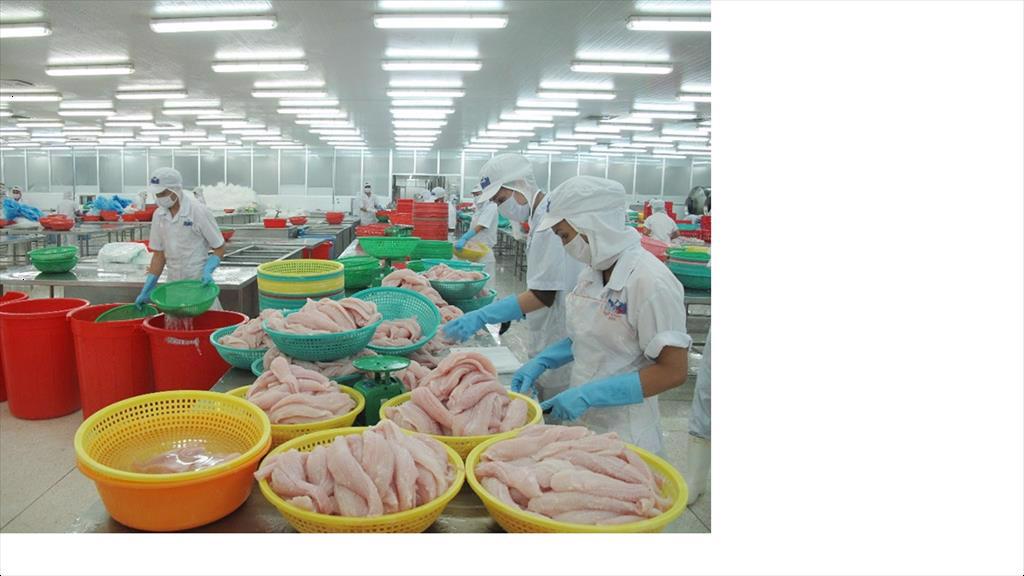
Continuing the recovery momentum from the last 2 months of the year, seafood enterprises have promoted the export of many strong aquatic species.
Accordingly, whiteleg shrimp exports increased by 39%, and black tiger shrimp exports increased by 92%. Total shrimp exports brought in $313 million, up 43%. Pangasius exports increased by 78%, bringing in nearly 214 million USD, tuna increased by 108% with a turnover of 88 million USD. Squid increased by 57% and octopus increased by 31%, the total turnover of these two species increased by 45% to 63 million USD...
Aquatic production and processing have almost returned to normal as before the peak of the epidemic. The demand of the markets is very high, businesses receive many orders. The price of domestic raw materials also increased, so both farmers, fishermen and businesses are optimistic about a bountiful year, all are excited to actively produce.
In January, enterprises exported seafood to 117 markets. Exports to all major markets increased by leaps and bounds. The top 6 markets with a proportion of 4-23% of Vietnam's seafood export value include: the US, Japan, Korea, China, Australia and Canada. These markets increased from 17 to 84% of seafood imports from Vietnam in the first month of 2022.
With nearly 200 million dollars, the US still holds the dominant share of 23%. The US sharply increased imports of seafood products from Vietnam: shrimp increased by 61%, pangasius increased by 92%, tuna increased more than 3 times, other fish species increased by nearly 30%...
After a slight decrease in 2021, exports to Japan in January this year recovered by 21% to $134 million. In which, 40% is shrimp products with 54 million USD, up 23%. Japan also sharply increased imports of squid and octopus from Vietnam with a growth rate of 55%.
Japan is the number 1 market for Vietnam's exported marine fish products. In the past month, this market has imported 57 million USD of marine fish from Vietnam, up 14%. In which, Vietnamese enterprises mainly export salmon - which is a raw material product imported for processing and exporting to this market.
Although shrimp exports to China still fell by 16%, exports of pangasius, squid, and octopus have returned strongly with a figure that has more than tripled compared to the same period last year. As a result, seafood exports to China recovered 64% with $62 million.
With $69 million in imports from Vietnam, the Korean market still accounts for a higher proportion than China. In which, exports of two main products, shrimp and octopus, increased by 33% and 18% respectively.
The Australian and Canadian markets both increased strongly in importing Vietnamese seafood, up 29% and 85% respectively, of which increased in all main products.
Seafood exports to the EU increased by 70% to 108 million USD. In which, the major markets in the bloc increased very strongly importing seafood from Vietnam: Germany increased by 28%, Belgium increased by 85%, France increased by 131%... The good news is that pangasius exports to this market group broke out strongly, increasing by 70%, shrimp by 79%, tuna by 81%, cephalopod by 90%...
With many orders, hopefully seafood enterprises will gradually solve the problem of lack of labor and raw materials to take advantage of opportunities this year. With that optimism, we believe that exports in February and the coming months will continue to record positive results. Accordingly, seafood exports in the first quarter of this year may bring in about 2 billion USD, up about 15% over the same period last year.
Please subscribe to VASEP's Quarterly Report on Vietnam Seafood Exports to get more detailed monthly and quarterly assessments and statistical data on Vietnam's seafood exports to markets, raw material price movements. , export prices, export enterprises and comparison with other countries such as India, Ecuador, Thailand, Indonesia...
(seafood.vasep.com.vn) In the first eight months of 2026, Vietnam’s exports of surimi and fish cakes remained relatively stable year-over-year compared to 2025. Following a contraction in the initial months, export performance demonstrated improvement from June onward, peaking in August. However, the recovery has been uneven, characterized by divergent trends across major markets: robust growth was recorded in China, Japan, Malaysia, the United States, and Taiwan, whereas export volumes to South Korea, Indonesia, and select European markets contracted.
(seafood.vasep.com.vn) Pangasius remains one of Dong Thap’s key aquaculture species, with the province focusing on developing an integrated value chain covering seed production, commercial farming, deep processing and by-product utilization. The province is promoting high-tech, circular pangasius farming models featuring reduced water exchange and enhanced biosecurity, aiming to improve production efficiency and strengthen control over raw material quality.
(vasep.com.vn) Vietnam’s seafood exports in September 2026 are estimated at US$1.135 billion, up 11.9% year-on-year, bringing total exports in the first nine months of the year to US$9.103 billion, up 11.4%. Behind this double-digit growth, however, increasingly divergent market trends are emerging: China–Hong Kong and ASEAN posted strong growth, while the U.S., EU and Japan all recorded declines in September.
(vasep.com.vn) In the first eight months of 2026, Brazil became the largest market for Vietnamese tilapia, with export value reaching US$44 million, up 22,142% year-on-year and accounting for 49% of Vietnam’s total tilapia exports. In August alone, exports to Brazil reached US$4 million. However, behind this remarkable growth is a market that is imposing increasingly stringent requirements on imported supplies.
(vasep.com.vn) Vietnam’s tuna exports sustained their upward trajectory in August 2026, though the pace remained modest at just 2%. The month saw divergent trends across key markets: the US maintained its leading position, Japan and Canada improved, Russia surged and the EU continued to experience a steep downturn. These developments suggest that exporters are entering the final months of the year amid a market environment marked by greater uncertainty.
(seafood.vasep.com.vn) Congalsa has acquired the entire charter capital of Lenger Seafood Vietnam, giving it full ownership of the business and its Nam Dinh processing facility.
(seafood.vasep.com.vn) Ninh Binh Province is entering a peak period of action against illegal, unreported and unregulated (IUU) fishing, focusing on thoroughly addressing violations, closely monitoring fishing vessels at ports and preventing vessels from violating regulations and operating illegally in foreign waters ahead of the European Commission’s (EC) upcoming inspection in 2026.
(vasep.com.vn) The application of biotechnology in seed production is increasingly viewed as a strategic imperative to upgrade pangasius fingerling quality, optimize farming efficiency and anchor sustainable industry development.
(vasep.com.vn) On September 15, 2026, in Can Tho, VASEP and ASC jointly organized a training course titled “New ASC standards: updates and practical implementation guidance for farms, businesses and aquafeed mills”. Beyond briefing stakeholders on updated ASC requirements for aquaculture facilities and feed production, the workshop dedicated substantial floor time to directly addressing on-the-ground compliance bottlenecks encountered by Vietnamese enterprises.
(searfood.vasep.com.vn) Vietnam’s tilapia exports continued to post positive results in the first eight months of 2026, with total export value reaching US$90 million, up 43% year-on-year. However, exports in August alone stood at US$11 million, down 8%, reflecting uneven market developments. Brazil remained the leading market, while Japan recorded notable growth, opening up new opportunities for Vietnamese tilapia products.
VASEP - HIỆP HỘI CHẾ BIẾN VÀ XUẤT KHẨU THỦY SẢN VIỆT NAM
Chịu trách nhiệm: Ông Nguyễn Hoài Nam - Phó Tổng thư ký Hiệp hội
Đơn vị vận hành trang tin điện tử: Trung tâm VASEP.PRO
Trưởng Ban Biên tập: Bà Phùng Thị Kim Thu
Giấy phép hoạt động Trang thông tin điện tử tổng hợp số 138/GP-TTĐT, ngày 01/10/2013 của Bộ Thông tin và Truyền thông
Tel: (+84 24) 3.7715055 – (ext.203); email: kimthu@vasep.com.vn
Trụ sở: Số 7 đường Nguyễn Quý Cảnh, Phường An Phú, Quận 2, Tp.Hồ Chí Minh
Tel: (+84) 28.628.10430 - Fax: (+84) 28.628.10437 - Email: vasephcm@vasep.com.vn
VPĐD: số 10, Nguyễn Công Hoan, Ngọc Khánh, Ba Đình, Hà Nội
Tel: (+84 24) 3.7715055 - Fax: (+84 24) 37715084 - Email: vasephn@vasep.com.vn