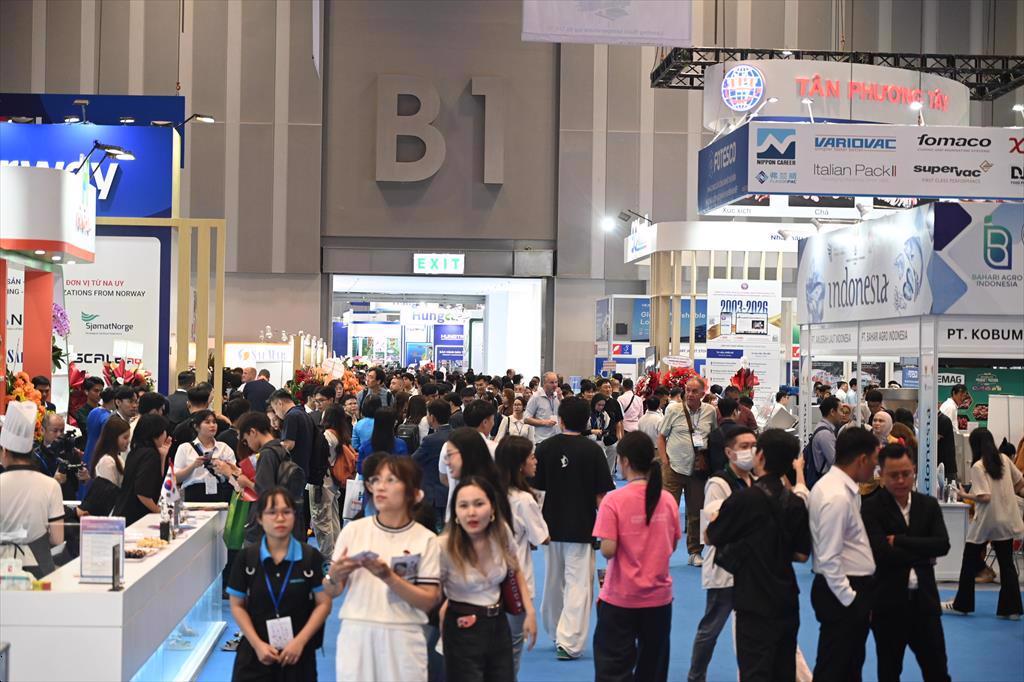
After three days, from August 19–21 at the Saigon Exhibition and Convention Center (SECC), Vietfish 2026 concluded with more than 14,000 m² of exhibition space, 335 companies, 568 booths, representatives from 17 countries and territories, and nearly 15,000 visitors.
But the value of a trade show is not measured only by the number of people walking through the doors or the size of the exhibition floor. The more important question is: What did businesses and buyers actually find at Vietfish?
Buyers Found More Through Business Matching Programs
One of the notable changes at Vietfish 2026 was the effort to make buyer connections more closely aligned with real sourcing needs.
As part of the Hosted Buyer Program, selected international buyers took part in one-on-one B2B meetings with Vietnamese businesses. Meetings were organized by product categories such as shrimp, pangasius, tuna and other seafood products, allowing buyers to connect with suppliers that matched their sourcing requirements.
The discussions went far beyond pricing. Buyers were interested in production capacity, product specifications, supply volumes, certifications, traceability, logistics, sustainability standards and risk management throughout the supply chain.
At a seminar for international buyers, representatives from Vinh Hoan presented their pangasius supply capabilities, emphasizing traceability, responsibility and reliability. Meanwhile, Tai Kim Anh highlighted the strengths of Vietnamese shrimp in processing capacity, value-added products, retail and foodservice solutions, as well as private-label production.
In other words, what buyers found at Vietfish was not simply a product, but the ability to answer a series of questions behind that product: Who produces it? Where do the raw materials come from? How does the company control quality? Can supply be maintained consistently? Can the product be customized to meet the requirements of individual markets?
Importantly, business matching was extended beyond the exhibition venue to companies, farming areas and processing plants in the Mekong Delta. This approach allowed buyers to directly verify production capacity, raw material sources and quality-control systems, rather than relying solely on catalogues or booth discussions.
Businesses Found New Customers
On company websites and social media platforms following the exhibition, phrases such as “meeting long-standing partners,” “new customers,” “new connections” and “business opportunities” appeared frequently.
Meksea said Vietfish 2026 provided an opportunity to reconnect with long-standing partners, welcome new customers and explore cooperation opportunities across different markets. According to the company, discussions at the show also helped answer important questions: What products are buyers looking for? Which trends are gaining momentum? How are consumer preferences changing? And what challenges are importers facing?
A concrete business outcome came from Russian company Tikhrybkom Magadan Seafood. According to the Russian Association of Fishery Enterprises – VARPE, this was the company's first time participating in the exhibition and business activities at Vietfish. Tikhrybkom's management confirmed that the company met new partners and signed its first contract at the exhibition.
The Russian company also noted strong interest from Vietnamese businesses in jointly developing deep-processed products using wild-caught seafood such as crab, scallops and shrimp to create premium product lines. While the value and specific details of the contract have not been disclosed, the case provides direct evidence that connections made at Vietfish can translate into commercial results.
For the Turkish delegation, eight companies participating under the “Turkish Salmon from Black Sea” brand held numerous bilateral meetings over the three-day exhibition. The Turkish side said these meetings helped establish new trade connections and strengthen existing business relationships in Vietnam and neighboring Asian markets.
Notably, Turkish salmon attracted considerable interest from visitors. The delegation viewed Vietfish as a strategic starting point for building product awareness and sustainable trade relationships in Vietnam and Southeast Asia.
On LinkedIn, a representative of the Turkish salmon delegation described the three days at Vietfish as “productive,” with numerous meetings and new connections. Norway's Benchmark Genetics also described the first day as “busy and rewarding,” with many visitors, technical discussions and new connections at the Norwegian pavilion.
These results show that Vietfish is operating in both directions: Vietnamese businesses are looking for buyers and export markets, while international companies are looking for partners, customers and development opportunities in Vietnam.
The Seafood Supply Chain Found Technology Solutions
Another important feature of Vietfish is that participants found more than finished seafood products.
Eleven Norwegian companies and organizations showcased solutions ranging from genetics, animal health and feed to farming equipment, processing automation and waste reduction.
These included breeding programs designed to improve animal health and growth rates; vaccines and diagnostic services to control disease and reduce the need for antibiotics; equipment and digital systems for farms; automation technologies for handling and processing; and solutions that turn fish heads, viscera and other by-products into useful raw materials rather than waste.
According to ScandAsia, Norway's presence at Vietfish demonstrated that seafood cooperation is not simply about selling salmon to Vietnam. It also involves transferring technology, knowledge and equipment to improve the efficiency and sustainability of Vietnam's aquaculture and seafood processing sectors.
Keisho Ka, Chairman and CEO of JARN, a Japanese media organization specializing in refrigeration, said JARN attended Vietfish primarily to explore refrigeration equipment manufacturers. This perspective highlights another value of the exhibition: Vietfish is not only a place to source seafood, but also a platform for exploring technology, cold-chain systems, processing equipment and solutions serving the entire value chain.
Domestic Buyers Found Products Suited to a New Market
In 2026, Vietfish organized a domestic B2B program for the first time, connecting seafood companies with distributors, retail chains and domestic sales channels.
At the one-on-one matchmaking tables, the two sides discussed their needs, products, supply capabilities and potential cooperation opportunities. The meetings showed that domestic buyers are increasingly interested in products with clear origins, consistent quality, convenience and alignment with modern consumer trends.
This opens another pathway for seafood businesses: products developed to meet export standards do not have to be limited to overseas markets. They can be adapted in terms of specifications, taste, pack size and pricing to better serve Vietnam's market of nearly 100 million people.
A livestreaming program organized by VASEP in cooperation with TikTok Shop and FoodMap opened another channel for reaching consumers. Convenient, processed and value-added seafood products were introduced directly to younger consumers during the exhibition.
At the same time, Tasty Kitchen brought products beyond the display cabinets and into real-life experiences. Visitors could see, taste and better understand how seafood products can be incorporated into everyday meals.
Visitors Found an Exhibition Worth Returning To
Public feedback under Vietfish and VASEP's posts does not constitute a representative survey, but it provides additional direct impressions from visitors.
Ngo Minh Phuong, Director of Viet Truong Seafood Co., Ltd., said he had attended Vietfish continuously for around 10 years and considered the 2026 edition the most successful in terms of scale, quality and trade-promotion activities. Another business, which had attended the exhibition five or six times, described this as the most impressive Vietfish edition thanks to its organization, side events and number of international visitors.
Some visitors emphasized that they found not only new products, but also new experiences, knowledge and opportunities to meet and network with others. Others said that after returning to Vietfish for the first time in three years, they found the event more impressive, with more diverse food experiences and products from different countries.
On social media, businesses frequently mentioned reputable exhibitors, product quality, cooking areas, interactive experiences and the feeling that there was “so much to see that you could walk around the exhibition forever.” These comments suggest that the Vietfish experience is gradually expanding beyond a specialized trade exhibition into a space for business, knowledge-sharing and product discovery.
Vietfish Is a Destination Where:
The next value of Vietfish 2026 will be determined in the weeks and months following the exhibition — when samples are sent, factories are audited, quotations are exchanged, products are adjusted, and initial connections turn into orders or long-term partnerships.
Because the most important thing businesses and buyers found at Vietfish may not be inside the gift bag they took home after the show.
It may be the right partner, a problem they can solve together, and a strong enough reason to continue the conversation after the exhibition halls have closed.
(vasep.com.vn) China’s shrimp imports continued to grow strongly in 2026, while Vietnam’s shrimp exports to the market also recorded notable growth. However, behind these positive figures lie two distinct trends: Chinese consumption is growing more slowly than imports, and lobster accounts for a substantial share of Vietnam’s shrimp exports to China, making its product mix significantly different from those of Ecuador and India. Exporters therefore need to assess each segment carefully to understand the opportunities and risks.
(vasep.com.vn) Changing markets, shifting buyer demand, and increasingly complex trade barriers are raising a key question for Vietnam’s seafood industry: Where will the new growth opportunities lie in 2027–2029?
(seafood.vasep.com.vn) As of the end of August 2026, Vietnam’s tilapia exports to the United States reached $21 million, representing a steep 48% year-over-year decline and accounting for 23% of the country's total tilapia export turnover. Frozen fillets accounted for 78% with the remainder consisting of whole frozen tilapia and frozen cuts.
(seafood.vasep.com.vn) After a volatile first half of the year, Vietnam’s pangasius exports to Brazil registered robust growth in July and August 2026. In August alone, export turnover reached $19 million, surging 73% compared to the same period in 2025. Cumulatively for the first eight months, total export value reached $124 million, reflecting an 8% year-over-year increase.
(seafood.vasep.com.vn) Besides modifying their boats, many fishermen in Dak Lak province are making efforts to venture out to sea to harvest seafood during the rough sea season.
(seafood.vasep.com.vn) At the Responsible Seafood Summit and TCRS Shrimp Summit 2026, organized by the GSA (Global Seafood Alliance) in Bangkok, Thailand, the conversation about the future of the shrimp industry began with one of its most important foundations: seedstock quality.
(seafood.vasep.com.vn) In the first eight months of 2026, Vietnam’s tuna exports to Lithuania surpassed $14 million, up 8% year on year. While the increase remains modest, it is notable given the continued pressure on Vietnamese tuna exports to the EU as a whole. More importantly, export turnover to Lithuania has shown a clearer recovery in recent months, making the market a destination worth monitoring for Vietnamese businesses in Europe.
(seafood.vasep.com.vn) Vietnam’s squid and octopus exports exceeded $527 million in the first eight months of 2026, marking a 15% year-on-year increase. This growth is particularly notable given the strong baseline established in 2025, when export turnover for the same period reached $458 million, a 13% rise from 2024.
(seafood.vasep.com.vn) Vietnamese pangasius is gaining traction in Japan, where competitive prices and reliable supplies have helped the fish enter professional distribution channels and a major sushi chain.
(vasep.com.vn) A circular economy does not create a “new type of shrimp” or a new certification. Its value lies in helping the shrimp value chain use resources more efficiently, stabilize production, generate additional value from by-products and build the data and evidence needed to meet increasingly stringent market requirements. This was the perspective shared by VASEP at the Public-Private Partnership (PPP) Forum on Promoting a Circular Economy in the Shrimp Industry in the Mekong Delta, held in Can Tho on September 21.
VASEP - HIỆP HỘI CHẾ BIẾN VÀ XUẤT KHẨU THỦY SẢN VIỆT NAM
Chịu trách nhiệm: Ông Nguyễn Hoài Nam - Phó Tổng thư ký Hiệp hội
Đơn vị vận hành trang tin điện tử: Trung tâm VASEP.PRO
Trưởng Ban Biên tập: Bà Phùng Thị Kim Thu
Giấy phép hoạt động Trang thông tin điện tử tổng hợp số 138/GP-TTĐT, ngày 01/10/2013 của Bộ Thông tin và Truyền thông
Tel: (+84 24) 3.7715055 – (ext.203); email: kimthu@vasep.com.vn
Trụ sở: Số 7 đường Nguyễn Quý Cảnh, Phường An Phú, Quận 2, Tp.Hồ Chí Minh
Tel: (+84) 28.628.10430 - Fax: (+84) 28.628.10437 - Email: vasephcm@vasep.com.vn
VPĐD: số 10, Nguyễn Công Hoan, Ngọc Khánh, Ba Đình, Hà Nội
Tel: (+84 24) 3.7715055 - Fax: (+84 24) 37715084 - Email: vasephn@vasep.com.vn