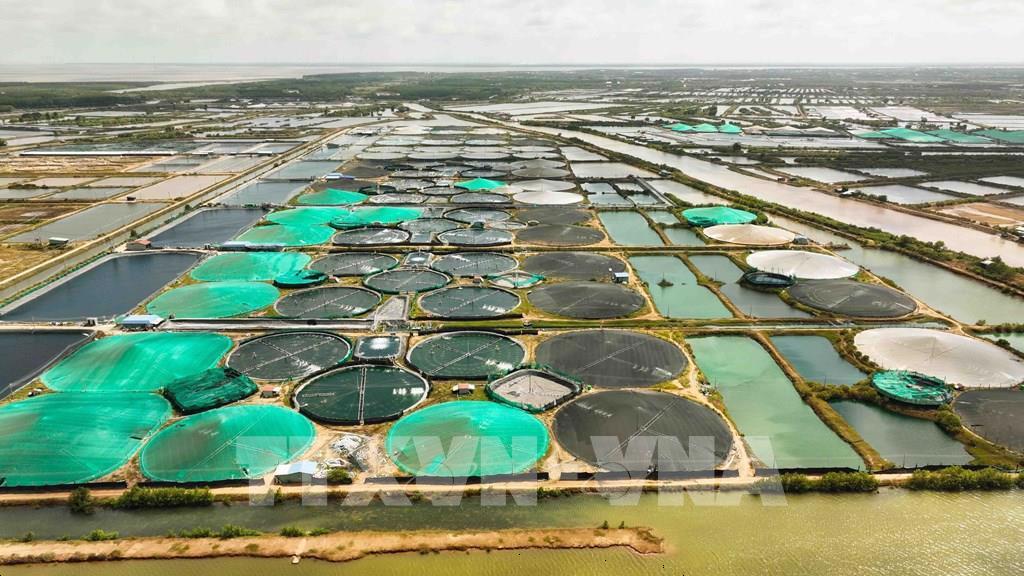
Ben Tre province alone hosts approximately 36,000 hectares of brackish water shrimp farming, including 12,500 hectares dedicated to intensive, high-tech farming practices. Photo: Vu Sinh – VNA
In today’s deeply integrated global economy, with sustainability requirements becoming ever more stringent, Vietnam’s shrimp industry stands at a critical juncture. Despite mounting challenges, this moment is also ripe with potential to transition toward a green growth model—an essential path to elevating the industry’s standing and value in the global seafood supply chain.
According to Deputy Minister of Agriculture and Environment Phung Duc Tien, shrimp has consistently played a key role in Vietnam’s aquaculture exports and agricultural economic development for over two decades. Thanks to the concerted efforts of both enterprises and shrimp farmers, Vietnamese shrimp has emerged as one of the country’s core export commodities, propelling Vietnam to rank among the world’s leading shrimp exporters, accounting for approximately 13–14% of global export value.
Nguyen Viet Thang, Chairman of the Vietnam Fisheries Society (VINAFIS), noted that Vietnam exports shrimp to more than 100 countries, including highly demanding markets such as the United States, the European Union, Japan, South Korea, Australia, and Canada. Despite retaining a strong presence in many key markets and maintaining a positive export outlook for 2025, the industry must contend with persistent headwinds: climate change, escalating input costs, disease risks, fierce competition from major producers such as Ecuador and India, geopolitical instability, and increasingly stringent demands related to food safety, traceability, and environmental protection.
Faced with this reality, Deputy Minister Phung Duc Tien emphasized that in order to advance, Vietnamese shrimp enterprises must radically transform their production models from conventional to modern, sustainable systems. This includes leveraging technology and digital transformation throughout farming operations, optimizing energy efficiency, and adopting renewable energy sources. From a market development perspective, Le Hang, Deputy Secretary General of the Vietnam Association of Seafood Exporters and Producers (VASEP), added that green growth is no longer a mere strategic choice but an indispensable requirement to enhance competitive advantage.
To implement its green development policies, Vietnam’s shrimp sector has begun applying a range of advanced technologies to promote sustainable farming practices. Modern systems such as Biofloc, Micro-Nano Bubble Oxygen, Recirculating Aquaculture Systems (RAS), and the three-phase farming model are being adopted to minimize waste discharge and mitigate environmental impacts.
In particular, the application of probiotics in shrimp aquaculture is becoming a key trend. These biological agents help improve water quality, strengthen shrimp immune systems, and inhibit pathogenic bacteria. A notable case is the MP BIO biological farming protocol developed by Minh Phu Seafood Corporation, which emphasizes the use of antagonistic microorganisms, the generation of Biofloc as a natural feed source, environmental control, and the enhancement of shrimp immunity—all without the use of chlorine in water treatment. The protocol also focuses on producing nutrient-rich natural feed from algae and Biofloc, and fermenting feed with probiotics to improve nutrient absorption and conversion.
Beyond farming, Vietnam is also striving to promote a circular economy within its shrimp processing sector. By 2030, the industry aims to recycle 100% of by-products—such as shrimp shells, heads, wastewater, and sludge—into high-value products like chitin and chitosan. The National Science and Technology Development Strategy for Promoting Circular Agriculture through 2030 emphasizes developing and deploying scientific research and technological solutions to foster circular practices in the aquaculture sector, thus supporting the broader goal of sustainable shrimp development.
A model of integrated mangrove-shrimp and crab farming in Long Vinh commune, Duyen Hai district, Tra Vinh province. Photo: Thanh Hoa – VNA
Internationally, Vietnam can draw valuable lessons from countries with advanced and sustainable shrimp industries, particularly Ecuador. Now the world’s leading shrimp exporter, Ecuador owes its success to large-scale production and strong growth in major markets such as China and the U.S. Key takeaways for Vietnam include investing in research and the selective breeding of high-quality domestic shrimp strains to reduce reliance on imported broodstock; adopting extensive and semi-intensive farming models integrated with biological solutions to maintain water quality and shrimp health; strengthening linkages among companies, cooperatives, and farming households to build a streamlined supply chain; and shifting from raw shrimp exports to value-added processing. Effective coordination among stakeholders is essential to elevating the global position of Vietnamese shrimp.
Domestically, Ca Mau province is leading the charge in sustainable shrimp development. According to Vice Chairman of the Ca Mau Provincial People’s Committee Le Van Su, the province has around 280,000 hectares of shrimp farming, primarily through environmentally friendly models such as shrimp–mangrove, shrimp–rice, and integrated extensive farming. Ca Mau also pioneers in producing ecological and organic shrimp, with tens of thousands of hectares certified by international organizations. The province’s ecological shrimp products have carved out a niche in high-value markets such as the EU and Japan, generating substantial added value and reinforcing the brand of Vietnamese shrimp.
According to the Ministry of Agriculture and Environment, Vietnam’s shrimp sector has set a target of producing 1.3–1.4 million tons of shrimp and reaching export revenues of USD 4–4.3 billion by 2025. Green growth has been identified as the primary driver to achieve these goals. Encouragingly, in the first two months of 2025, shrimp exports reached over USD 605 million, marking a 46% increase compared to the same period last year. This performance underscores the sector’s breakthrough potential—particularly if it can effectively capitalize on opportunities arising from free trade agreements and the global shift toward green consumption.
Deputy Minister Phung Duc Tien affirmed that Vietnam’s shrimp industry is entering a green revolution marked by profound transformation. The industry is no longer focused solely on increasing output, but also prioritizing quality, safeguarding consumer health, and generating sustainable added value. These efforts are vital to ensuring Vietnamese shrimp continues to strengthen its position in the global market.
Source: bnews.vn
(vasep.com.vn) Vietnam’s shrimp exports reached US$3.7 billion in the first nine months of 2026, up 11% year on year. Although growth has been supported by China and several markets within the CPTPP, momentum is slowing as exports to the United States and the European Union decline. Tariff pressures, international competition, and raw material challenges are creating significant hurdles for exporters in the final months of the year.
(vasep.com.vn) Markets are changing faster, buyer requirements are becoming more demanding, and trade barriers are growing increasingly complex. In this environment, seafood businesses need more than an understanding of current market conditions. They need a longer-term perspective to answer a critical question: Where will growth opportunities come from in 2027–2029, and what should businesses do now to prepare? This is one of the key reasons why VASEP is organizing Vietnam Seafood Summit 2026.
(vasep.com.vn) In the first eight months of 2026, Vietnam’s pangasius exports to the Middle East reached US$113 million, up 7% year on year from the same period in 2025. Growth has become more pronounced in recent months. In August alone, exports to the region totaled US$20 million, an increase of 24%. This indicates that demand for Vietnamese pangasius in the Middle East is gradually recovering after a slowdown in March, although the pace of recovery varies across markets.
(vasep.com.vn) China’s shrimp imports continued to grow strongly in 2026, while Vietnam’s shrimp exports to the market also recorded notable growth. However, behind these positive figures lie two distinct trends: Chinese consumption is growing more slowly than imports, and lobster accounts for a substantial share of Vietnam’s shrimp exports to China, making its product mix significantly different from those of Ecuador and India. Exporters therefore need to assess each segment carefully to understand the opportunities and risks.
(vasep.com.vn) Changing markets, shifting buyer demand, and increasingly complex trade barriers are raising a key question for Vietnam’s seafood industry: Where will the new growth opportunities lie in 2027–2029?
(seafood.vasep.com.vn) As of the end of August 2026, Vietnam’s tilapia exports to the United States reached $21 million, representing a steep 48% year-over-year decline and accounting for 23% of the country's total tilapia export turnover. Frozen fillets accounted for 78% with the remainder consisting of whole frozen tilapia and frozen cuts.
(seafood.vasep.com.vn) After a volatile first half of the year, Vietnam’s pangasius exports to Brazil registered robust growth in July and August 2026. In August alone, export turnover reached $19 million, surging 73% compared to the same period in 2025. Cumulatively for the first eight months, total export value reached $124 million, reflecting an 8% year-over-year increase.
(seafood.vasep.com.vn) Besides modifying their boats, many fishermen in Dak Lak province are making efforts to venture out to sea to harvest seafood during the rough sea season.
(seafood.vasep.com.vn) At the Responsible Seafood Summit and TCRS Shrimp Summit 2026, organized by the GSA (Global Seafood Alliance) in Bangkok, Thailand, the conversation about the future of the shrimp industry began with one of its most important foundations: seedstock quality.
(seafood.vasep.com.vn) In the first eight months of 2026, Vietnam’s tuna exports to Lithuania surpassed $14 million, up 8% year on year. While the increase remains modest, it is notable given the continued pressure on Vietnamese tuna exports to the EU as a whole. More importantly, export turnover to Lithuania has shown a clearer recovery in recent months, making the market a destination worth monitoring for Vietnamese businesses in Europe.
VASEP - HIỆP HỘI CHẾ BIẾN VÀ XUẤT KHẨU THỦY SẢN VIỆT NAM
Chịu trách nhiệm: Ông Nguyễn Hoài Nam - Phó Tổng thư ký Hiệp hội
Đơn vị vận hành trang tin điện tử: Trung tâm VASEP.PRO
Trưởng Ban Biên tập: Bà Phùng Thị Kim Thu
Giấy phép hoạt động Trang thông tin điện tử tổng hợp số 138/GP-TTĐT, ngày 01/10/2013 của Bộ Thông tin và Truyền thông
Tel: (+84 24) 3.7715055 – (ext.203); email: kimthu@vasep.com.vn
Trụ sở: Số 7 đường Nguyễn Quý Cảnh, Phường An Phú, Quận 2, Tp.Hồ Chí Minh
Tel: (+84) 28.628.10430 - Fax: (+84) 28.628.10437 - Email: vasephcm@vasep.com.vn
VPĐD: số 10, Nguyễn Công Hoan, Ngọc Khánh, Ba Đình, Hà Nội
Tel: (+84 24) 3.7715055 - Fax: (+84 24) 37715084 - Email: vasephn@vasep.com.vn