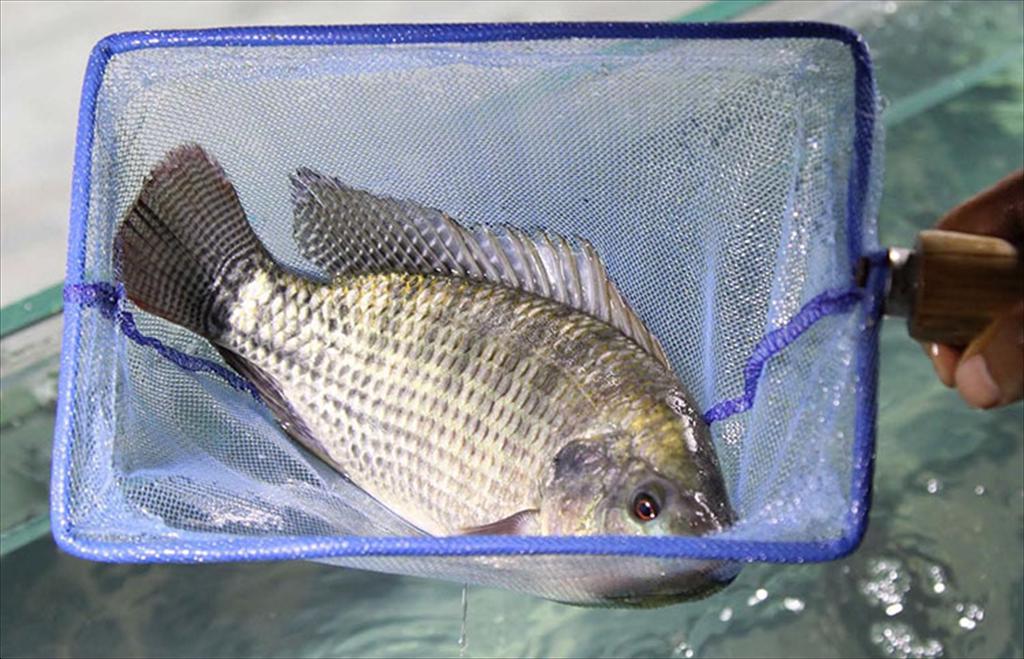
Despite this decline, the United States remains an important market for Vietnam’s tilapia industry, accounting for more than 20% of total export value during the first seven months of the year. Notably, frozen tilapia fillets accounted for approximately 84% of Vietnam’s export product mix to the US, indicating that this remains the market’s preferred product line and has the potential to sustain demand over the longer term.
However, the outlook for the final months of the year remains challenging. The US market currently has relatively ample inventories, while importers are mainly purchasing to meet immediate needs rather than building up large stocks. This cautious approach is limiting new orders while putting pressure on prices and suppliers’ profit margins.
Meanwhile, Vietnamese tilapia faces competition from suppliers in China, Indonesia and Brazil. China continues to maintain relatively stable supply and remains a notable competitor in the US market. However, China’s tilapia industry is facing pressure from raw material shortages and rising production costs. Signs of higher raw material prices in August could lead to further price adjustments for Chinese tilapia, but not enough to give Vietnam a clear competitive advantage.
In addition, uncertainty surrounding tariff policies, including the additional 12.5% tariff under Section 301 on imported tilapia, continues to influence purchasing decisions among US businesses. While the policy could create some competitive space for alternative suppliers, high inventories and cautious importer sentiment mean that this opportunity has yet to translate into immediate export growth for Vietnam.
From now through the end of the year, US importers are likely to maintain a cautious purchasing strategy, waiting for inventories to decline and for greater clarity on tariff developments. With supply sources becoming increasingly diversified, Vietnamese tilapia will find it difficult to compete on price alone.
Vietnamese exporters should therefore focus less on a rapid recovery in the US market and more on improving product quality, securing stable raw material supplies, meeting international certification requirements and developing value-added products. At the same time, expanding into other markets would help reduce dependence on the US and create greater room for more sustainable growth.
The US remains a large and high-potential market, but growth driven by simply expanding volumes has become increasingly difficult. For Vietnamese tilapia, competitive advantages in the coming period will depend increasingly on quality, consistency and the ability to meet the market’s increasingly demanding requirements.
(vasep.com.vn) Changing markets, shifting buyer demand, and increasingly complex trade barriers are raising a key question for Vietnam’s seafood industry: Where will the new growth opportunities lie in 2027–2029?
(seafood.vasep.com.vn) As of the end of August 2026, Vietnam’s tilapia exports to the United States reached $21 million, representing a steep 48% year-over-year decline and accounting for 23% of the country's total tilapia export turnover. Frozen fillets accounted for 78% with the remainder consisting of whole frozen tilapia and frozen cuts.
(seafood.vasep.com.vn) After a volatile first half of the year, Vietnam’s pangasius exports to Brazil registered robust growth in July and August 2026. In August alone, export turnover reached $19 million, surging 73% compared to the same period in 2025. Cumulatively for the first eight months, total export value reached $124 million, reflecting an 8% year-over-year increase.
(seafood.vasep.com.vn) Besides modifying their boats, many fishermen in Dak Lak province are making efforts to venture out to sea to harvest seafood during the rough sea season.
(seafood.vasep.com.vn) At the Responsible Seafood Summit and TCRS Shrimp Summit 2026, organized by the GSA (Global Seafood Alliance) in Bangkok, Thailand, the conversation about the future of the shrimp industry began with one of its most important foundations: seedstock quality.
(seafood.vasep.com.vn) In the first eight months of 2026, Vietnam’s tuna exports to Lithuania surpassed $14 million, up 8% year on year. While the increase remains modest, it is notable given the continued pressure on Vietnamese tuna exports to the EU as a whole. More importantly, export turnover to Lithuania has shown a clearer recovery in recent months, making the market a destination worth monitoring for Vietnamese businesses in Europe.
(seafood.vasep.com.vn) Vietnam’s squid and octopus exports exceeded $527 million in the first eight months of 2026, marking a 15% year-on-year increase. This growth is particularly notable given the strong baseline established in 2025, when export turnover for the same period reached $458 million, a 13% rise from 2024.
(seafood.vasep.com.vn) Vietnamese pangasius is gaining traction in Japan, where competitive prices and reliable supplies have helped the fish enter professional distribution channels and a major sushi chain.
(vasep.com.vn) A circular economy does not create a “new type of shrimp” or a new certification. Its value lies in helping the shrimp value chain use resources more efficiently, stabilize production, generate additional value from by-products and build the data and evidence needed to meet increasingly stringent market requirements. This was the perspective shared by VASEP at the Public-Private Partnership (PPP) Forum on Promoting a Circular Economy in the Shrimp Industry in the Mekong Delta, held in Can Tho on September 21.
(vasep.com.vn) Vietnam’s pangasius exports to CPTPP markets reached $264 million in the first eight months of 2026, up 12% year-on-year and accounting for 17% of the nation’s total pangasius export turnover. In August alone, export value reached $34 million, inching up 3%.
VASEP - HIỆP HỘI CHẾ BIẾN VÀ XUẤT KHẨU THỦY SẢN VIỆT NAM
Chịu trách nhiệm: Ông Nguyễn Hoài Nam - Phó Tổng thư ký Hiệp hội
Đơn vị vận hành trang tin điện tử: Trung tâm VASEP.PRO
Trưởng Ban Biên tập: Bà Phùng Thị Kim Thu
Giấy phép hoạt động Trang thông tin điện tử tổng hợp số 138/GP-TTĐT, ngày 01/10/2013 của Bộ Thông tin và Truyền thông
Tel: (+84 24) 3.7715055 – (ext.203); email: kimthu@vasep.com.vn
Trụ sở: Số 7 đường Nguyễn Quý Cảnh, Phường An Phú, Quận 2, Tp.Hồ Chí Minh
Tel: (+84) 28.628.10430 - Fax: (+84) 28.628.10437 - Email: vasephcm@vasep.com.vn
VPĐD: số 10, Nguyễn Công Hoan, Ngọc Khánh, Ba Đình, Hà Nội
Tel: (+84 24) 3.7715055 - Fax: (+84 24) 37715084 - Email: vasephn@vasep.com.vn