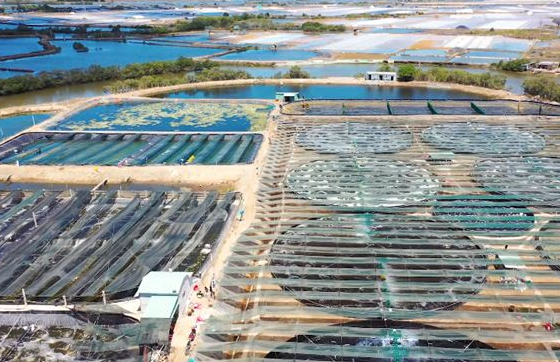
For years, Bac Lieu has been known as Vietnam’s “shrimp capital,” with extensive farming areas and high production volumes—particularly for black tiger shrimp and whiteleg shrimp. However, to maintain and maximize this advantage in the face of globalization and climate change, transitioning to high-tech shrimp farming has become essential. This shift is not just a trend—it is the key for Bac Lieu to maintain its leadership and elevate Vietnam’s shrimp value chain on the global stage.
The Mekong Delta in general—and Bac Lieu in particular—is one of the regions most vulnerable to the impacts of climate change. Deep saltwater intrusion, droughts, erratic flooding, and rising shrimp diseases have created significant challenges for farmers. Traditional farming models such as extensive or semi-intensive systems are particularly susceptible to these factors, resulting in unstable productivity and high risk.
Global Standards Driving Innovation International consumers, especially in major import markets like the US, the EU, and Japan, are placing increasing emphasis on the origin, quality, and sustainability of shrimp products. Certifications such as ASC (Aquaculture Stewardship Council), GlobalG.A.P, and BAP (Best Aquaculture Practices) present technical challenges—but also opportunities—to boost the value of Vietnamese shrimp. High-tech farming enables better control over inputs, farming processes, and antibiotic residues, making it easier to comply with strict international standards.
Recognizing the sector’s importance, the Vietnamese government and relevant ministries have introduced policies to encourage investment in high-tech shrimp farming. Since 2024, Bac Lieu has made notable progress in applying advanced technologies. According to provincial reports, the area under high-tech shrimp farming—including super-intensive, intensive, and semi-intensive models—reached approximately 32,987 hectares in 2024, fulfilling 112.2% of the year’s plan and marking a 113.14% increase compared to 2023. This growth reaffirms Bac Lieu’s commitment to leading the nation in high-tech aquaculture.
Supportive Policies and Smart Technologies To achieve these results, Bac Lieu has proactively developed specific programs and initiatives, facilitating land access, credit, and technical support for businesses and farmers. The province has intensified investment promotion efforts for its High-Tech Agricultural Zone for Shrimp Development, attracting major investors.
High-tech farming models—such as super-intensive systems in greenhouses or lined ponds with roofing—have become increasingly popular. Key innovations include widespread adoption of recirculating aquaculture systems (RAS) or semi-recirculating systems.
Many large companies have invested in expanding or building new farming zones, applying automation in water supply, feeding, and environmental management. These models deliver exceptional yields—averaging 40–60 tons per hectare per crop, and in some cases reaching 80–100 tons—far surpassing traditional methods. Shrimp survival rates have also improved significantly, reducing the risk of disease.
Data-Driven Farming Industry 4.0 technologies are being deployed directly at pond level. Sensors continuously monitor key water parameters such as dissolved oxygen, pH, salinity, temperature, alkalinity, and toxic gases (NH₃, H₂S). The data is transmitted to centralized control systems or smartphone apps, allowing farmers to monitor and adjust conditions in real time.
Bac Lieu’s high-tech shrimp farming model aims to meet global certifications like ASC, GlobalG.A.P, and BAP, thereby enhancing its reputation and competitiveness on international markets. Many enterprises have developed integrated value chains covering broodstock production, grow-out farming, processing, and marketing, ensuring traceability and strict quality control.
With better quality control and high yields, Bac Lieu shrimp has strong export growth potential, contributing significantly to both provincial and national GDP. In 2024, the province's shrimp export turnover showed promising signs, and further growth is projected for 2025 and beyond.
A Vision for the Future Bac Lieu’s high-tech shrimp farming model is on a strong upward trajectory, becoming a key driver of Vietnam’s blue economy. With its achievements to date, the province is steadily asserting its pioneering role in building a modern and sustainable shrimp industry—contributing not only to food security and export growth but also to elevating the global presence of Vietnamese shrimp. Continued collaboration between the government, businesses, and farmers will be crucial for Bac Lieu to reach new heights and bring Vietnamese shrimp to the most demanding markets worldwide.
(vasep.com.vn) Vietnam’s shrimp exports reached US$3.7 billion in the first nine months of 2026, up 11% year on year. Although growth has been supported by China and several markets within the CPTPP, momentum is slowing as exports to the United States and the European Union decline. Tariff pressures, international competition, and raw material challenges are creating significant hurdles for exporters in the final months of the year.
(vasep.com.vn) Markets are changing faster, buyer requirements are becoming more demanding, and trade barriers are growing increasingly complex. In this environment, seafood businesses need more than an understanding of current market conditions. They need a longer-term perspective to answer a critical question: Where will growth opportunities come from in 2027–2029, and what should businesses do now to prepare? This is one of the key reasons why VASEP is organizing Vietnam Seafood Summit 2026.
(vasep.com.vn) In the first eight months of 2026, Vietnam’s pangasius exports to the Middle East reached US$113 million, up 7% year on year from the same period in 2025. Growth has become more pronounced in recent months. In August alone, exports to the region totaled US$20 million, an increase of 24%. This indicates that demand for Vietnamese pangasius in the Middle East is gradually recovering after a slowdown in March, although the pace of recovery varies across markets.
(vasep.com.vn) China’s shrimp imports continued to grow strongly in 2026, while Vietnam’s shrimp exports to the market also recorded notable growth. However, behind these positive figures lie two distinct trends: Chinese consumption is growing more slowly than imports, and lobster accounts for a substantial share of Vietnam’s shrimp exports to China, making its product mix significantly different from those of Ecuador and India. Exporters therefore need to assess each segment carefully to understand the opportunities and risks.
(vasep.com.vn) Changing markets, shifting buyer demand, and increasingly complex trade barriers are raising a key question for Vietnam’s seafood industry: Where will the new growth opportunities lie in 2027–2029?
(seafood.vasep.com.vn) As of the end of August 2026, Vietnam’s tilapia exports to the United States reached $21 million, representing a steep 48% year-over-year decline and accounting for 23% of the country's total tilapia export turnover. Frozen fillets accounted for 78% with the remainder consisting of whole frozen tilapia and frozen cuts.
(seafood.vasep.com.vn) After a volatile first half of the year, Vietnam’s pangasius exports to Brazil registered robust growth in July and August 2026. In August alone, export turnover reached $19 million, surging 73% compared to the same period in 2025. Cumulatively for the first eight months, total export value reached $124 million, reflecting an 8% year-over-year increase.
(seafood.vasep.com.vn) Besides modifying their boats, many fishermen in Dak Lak province are making efforts to venture out to sea to harvest seafood during the rough sea season.
(seafood.vasep.com.vn) At the Responsible Seafood Summit and TCRS Shrimp Summit 2026, organized by the GSA (Global Seafood Alliance) in Bangkok, Thailand, the conversation about the future of the shrimp industry began with one of its most important foundations: seedstock quality.
(seafood.vasep.com.vn) In the first eight months of 2026, Vietnam’s tuna exports to Lithuania surpassed $14 million, up 8% year on year. While the increase remains modest, it is notable given the continued pressure on Vietnamese tuna exports to the EU as a whole. More importantly, export turnover to Lithuania has shown a clearer recovery in recent months, making the market a destination worth monitoring for Vietnamese businesses in Europe.
VASEP - HIỆP HỘI CHẾ BIẾN VÀ XUẤT KHẨU THỦY SẢN VIỆT NAM
Chịu trách nhiệm: Ông Nguyễn Hoài Nam - Phó Tổng thư ký Hiệp hội
Đơn vị vận hành trang tin điện tử: Trung tâm VASEP.PRO
Trưởng Ban Biên tập: Bà Phùng Thị Kim Thu
Giấy phép hoạt động Trang thông tin điện tử tổng hợp số 138/GP-TTĐT, ngày 01/10/2013 của Bộ Thông tin và Truyền thông
Tel: (+84 24) 3.7715055 – (ext.203); email: kimthu@vasep.com.vn
Trụ sở: Số 7 đường Nguyễn Quý Cảnh, Phường An Phú, Quận 2, Tp.Hồ Chí Minh
Tel: (+84) 28.628.10430 - Fax: (+84) 28.628.10437 - Email: vasephcm@vasep.com.vn
VPĐD: số 10, Nguyễn Công Hoan, Ngọc Khánh, Ba Đình, Hà Nội
Tel: (+84 24) 3.7715055 - Fax: (+84 24) 37715084 - Email: vasephn@vasep.com.vn