(seafood.vasep.com.vn) Among Vietnam’s wild-caught sector,blue swimming crab fishing is one of the sectors with the highest export value, ranking only after tuna fishing and currently employing around 20,000 fishers. Vietnam’s crab fishing focuses mainly on two species: the red swimming crab and the blue swimming crab (BSC). While red swimming crab is caught across the country, blue BSC is primarily harvested in An Giang province.
Fishing gears used in BSC fishing
BSC is benthic species found in coastal estuaries and nearshore islands. They tend to bury themselves in sandy areas at depths of 10–20 meters. To harvest BSC, fishers use several types of bottom fishing gears such as bottom gillnets, Collapsible Trap, Chinese Trap.
Collapsible Traps are traditional fishing gear used in nearshore areas such as Ha Tien, Hon Heo, Bai Bon, and Ham Ninh. A crab pot is rectangular, about 40 cm long and 30 cm wide, with a steel frame covered in thick netting. Each end has funnel-shaped mesh entrances that allow crabs to crawl in to eat the bait but prevent them from escaping. Each pot is tied to a long rope, the other end of which is connected to a main line laid along the seabed.
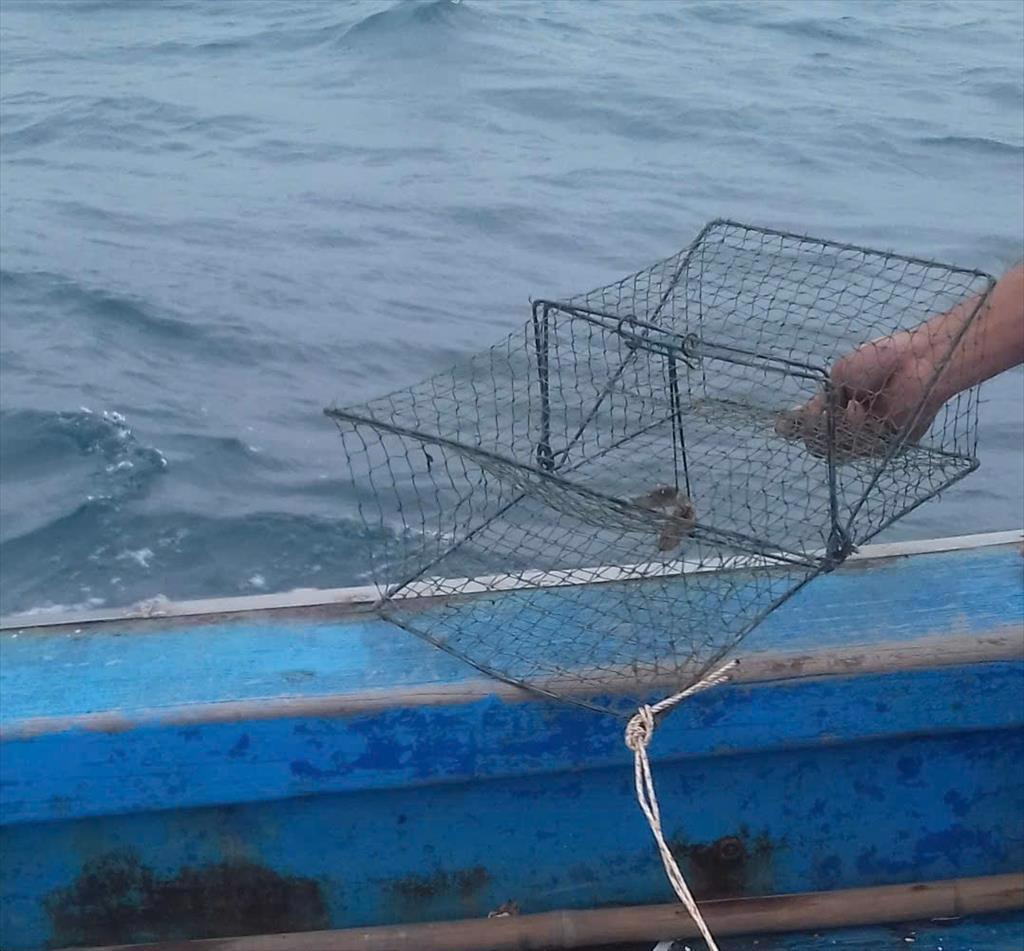
Collapsible Trap
The Chinese Trap, also known as the bẫy lú, is 5–10 meters long and consists of several box-shaped frames connected in series by a mesh covering (mesh size <10 mm). Along the trap’s body are multiple funnel-shaped entrances that let marine animals enter but not exit. This type of gear has been banned since 2018 under Circular No. 19/2018/TT-BNNPTNT issued by the Ministry of Agriculture and Rural Development (now the Ministry of Agriculture and Environment) on November 15, 2018, which provides guidelines for the protection and development of aquatic resources.
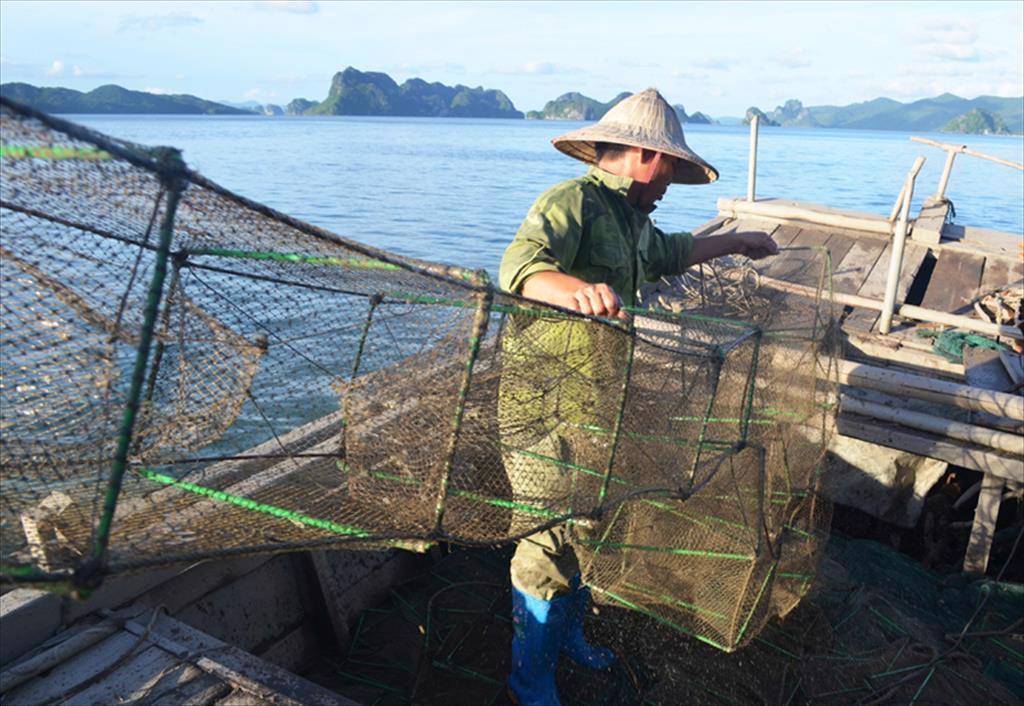
(The Chinese Trap also known as bát quái or bẫy lú)
In addition to pots and crab funnel trap, fishers also use bottom gillnets to catch BSC. These nets are 1.2–1.5 meters high when stretched, with mesh sizes of about 80–100 mm.
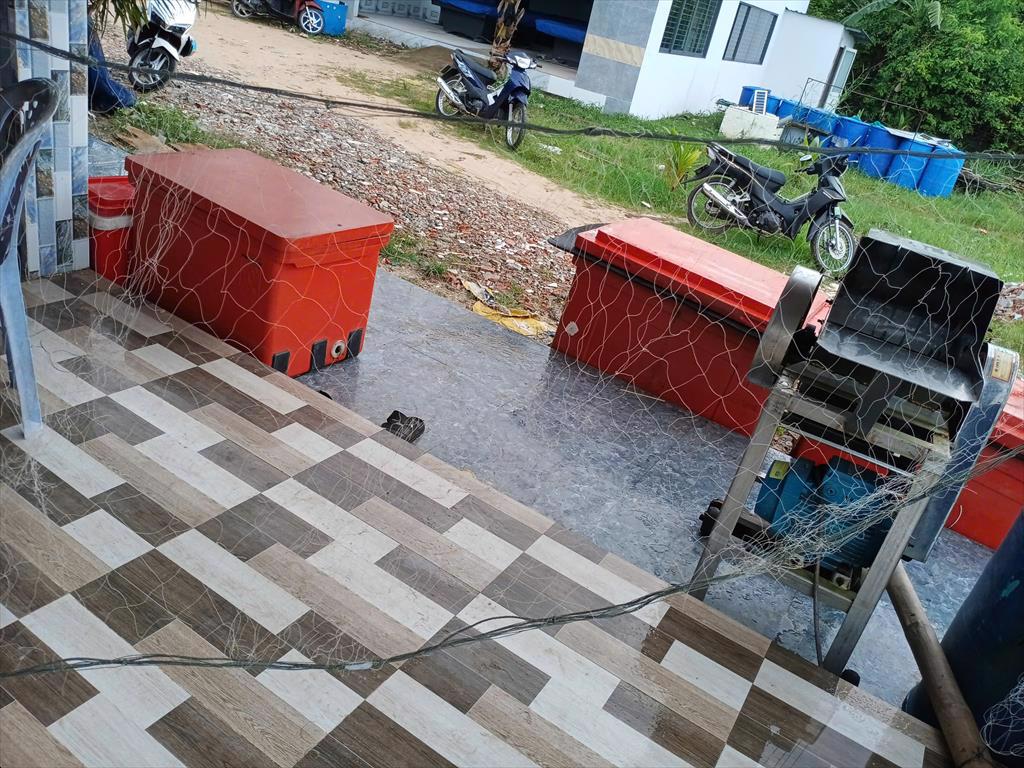
Bottom gillnets
Among these gears, Collapsible Trap and Chinese Trap are considered non-threatening to marine mammals, whereas bottom gillnets may pose some entanglement risk.
Logbook statistics on crab fishing operations
| Gear types |
No. of logbooks |
No. of fishing trips |
Trips encountering sea turtles |
Rays |
Sharks |
Marine mammals |
| Funnel traps |
1,019 |
5,297 |
1 |
121 |
11 |
0 |
| Bottom gillnets |
1,561 |
9,982 |
0 |
2,171 |
578 |
0 |
| Crab pots |
690 |
8,201 |
0 |
2 |
2 |
0 |
| Total |
3,270 |
23,480 |
1 |
2,294 |
591 |
0 |
Red swimming crab fishing
Red swimming crab fishing in Vietnam is mainly concentrated in waters from Phú Quý Island to the southern part of Côn Sơn Island. The fishing grounds have an average depth of 30–60 meters. The main gears used are bottom gillnets and cylindrical traps.
Cylindrical traps have a diameter of 550–600 mm and a height of 200–250 mm. The frame is made of round steel (4–8 mm thick), with circular top and bottom rings connected by six vertical bars forming six equal sections, all covered with netting. Each trap has three funnel-shaped entrances and a bait box suspended by a wire between the top and bottom frames. The traps are connected to a main line, spaced 20–25 meters apart.
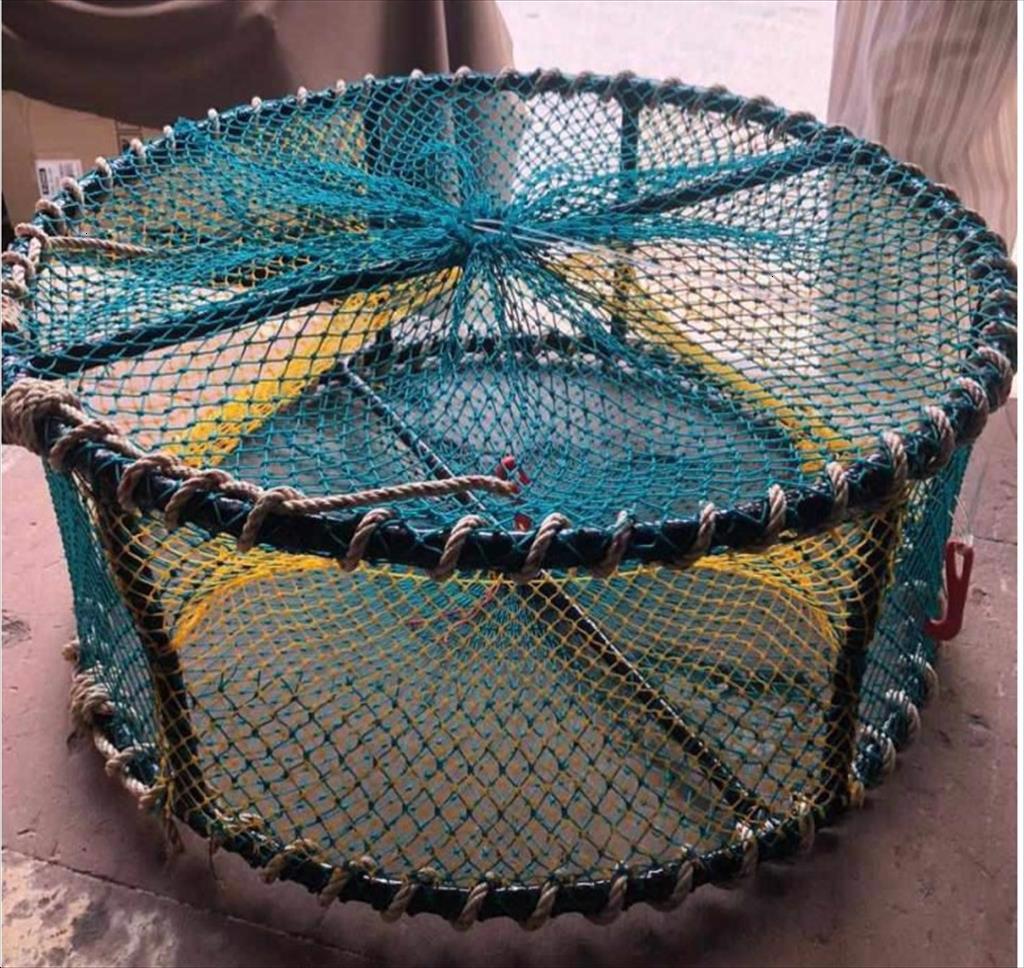
Cylindrical traps
Bottom gillnets used for red crab fishing are made of monofilament nylon, 1.2–1.5 meters high and 80–100 meters long, with 90–100 mm mesh size. The nets have a float line on top and a lead line below. During fishing, one end of the net is anchored while the other end is tied to the boat.
Fishing vessels and techniques
Swimming brab fishing boats in Vietnam are typically 6–12 meters or 12–15 meters in length. The number of traps or nets used depends on the vessel size—usually from 200–1,000 traps or 7–12 km of gillnets.
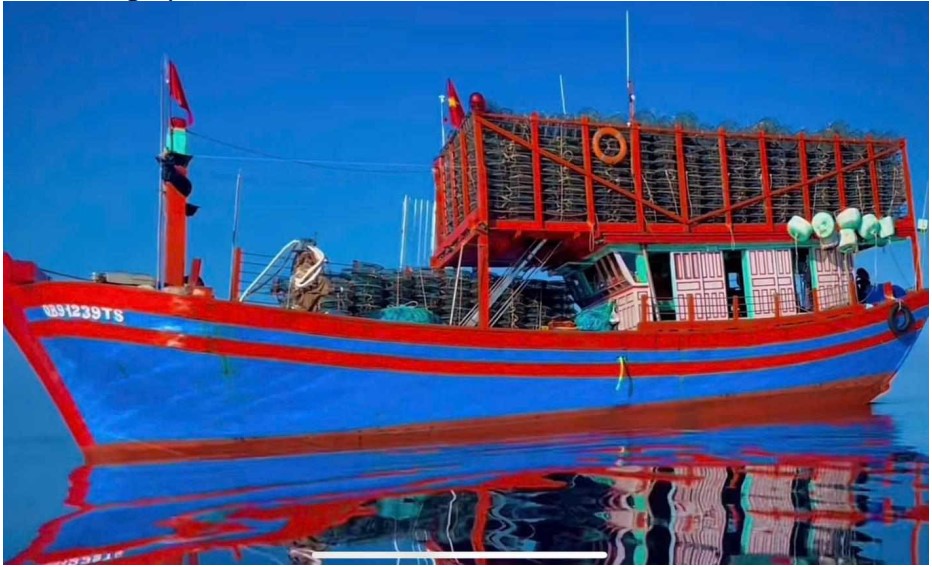
Crab fishing boats
For crab trap fishing: small fish such as sardines or mackerel scad are commonly used as bait, which are placed inside bait boxes within the pots.
Pot fishing process: At the fishing ground, fishers prepare the bait boxes and place them into the pots before arranging the pots in order for deployment.
Setting the traps: The process of setting the pots begins with preparation and continues until all pots are deployed. During deployment, the pots are connected sequentially to the main line and released one after another into the water.
Hauling the traps: Small boats usually haul the main line manually, while larger vessels use winches. During the hauling process, crabs are removed and the bait is replaced for the next set.
Typically, one crew member adjusts the pulley to guide the rope and pull up the pot line, another loosens the knots and removes the crabs, while two others replace the old bait boxes with new ones. Another crew member ties the mouth of each pot and hooks it to the frame, while the rest of the crew stack the pots in order on the working deck, manage the main line, and secure the ends to metal posts.

Fishing method using gillnets: This method mainly involves setting weighted bottom-set gillnets so that the nets sink close to the seabed, trapping crabs as they crawl across. Fishers typically use nets with large mesh sizes, deployed in coastal waters or around small islands. After leaving the nets on the seabed for a certain soaking time, they are hauled back onboard. Crabs entangled in the nets are then removed.
After being collected from the pots or gillnets, crabs are quickly tied and placed in plastic containers for temporary storage and sorting. Smaller crabs are released back into the sea, while larger ones are transferred to seawater tanks for proper preservation on board.
Based on the above information, the US National Oceanic and Atmospheric Administration (NOAA)’s evaluation that Vietnam’s swimming crab fisheries (Code 2988) failed to achieve comparability under the Marine Mammal Protection Act (MMPA) is inaccurate.Vietnam’s swimming crab fisheries meets all necessary conditions and standards to be recognized as comparable to US fisheries under the MMPA framework.
Source: https://vasep.com.vn/san-pham-xuat-khau/ghe/chuong-trinh-cai-thien-nghe-khai-thac-ghe-viet-nam/nghe-khai-thac-ghe-viet-nam-dap-ung-tieu-chuan-bao-ve-dong-vat-bien-theo-mmpa-35124.html