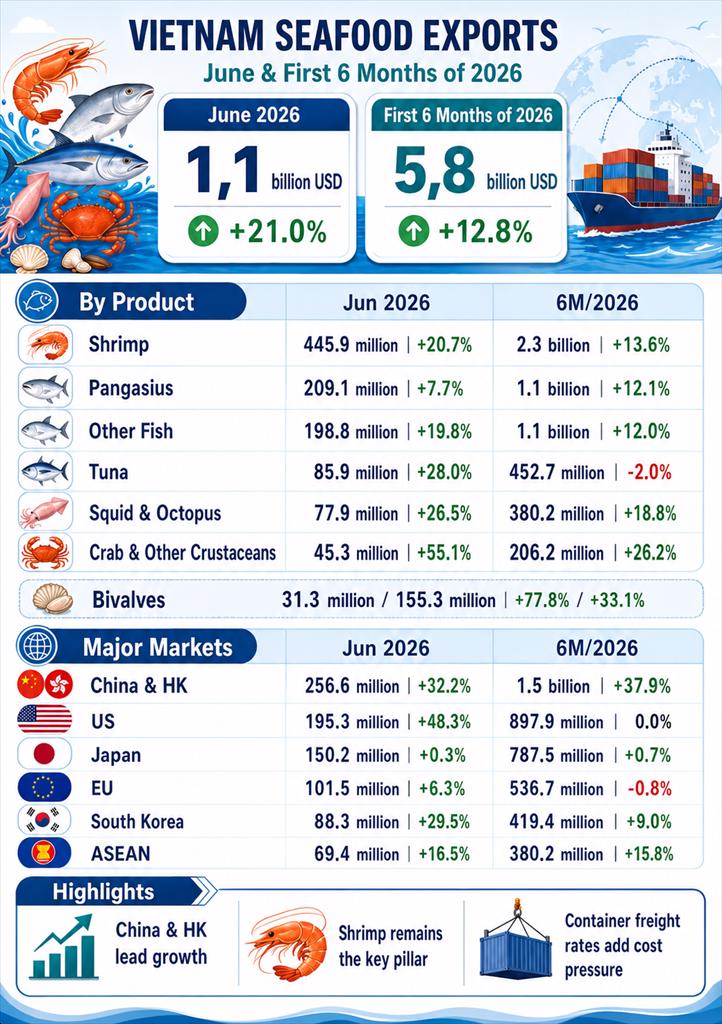
The industry's growth during the first six months of 2026 reflects more than just recovering global demand. It also demonstrates Vietnamese exporters' ability to diversify markets, adjust product portfolios, and capitalize on geographically closer markets with stable demand and lower logistics costs. According to VASEP, this adaptability has become increasingly important as overseas buyers place smaller, shorter-term orders, demand more competitive pricing, and impose stricter requirements on food safety, certifications, traceability, and delivery schedules.
Shrimp remains the industry's growth engine
Shrimp continued to be Vietnam's largest seafood export category. In June 2026, shrimp exports reached US$445.9 million, up 20.7% year-on-year. During the first six months, shrimp exports totaled US$2.3 billion, an increase of 13.6%, accounting for 40.5% of Vietnam's total seafood export value.
Growth was largely driven by rising demand from China and Hong Kong, particularly for black tiger shrimp, lobster, frozen shrimp, and premium products destined for the foodservice sector.
However, the U.S. market remains a major challenge. Although Vietnam's overall seafood exports to the United States rebounded in June, shrimp exporters continue to face intense competition from Ecuador, India, and Indonesia, whose industries benefit from lower production costs, abundant raw materials, and larger production scales.
Meanwhile, anti-dumping duties, countervailing duties, the Seafood Import Monitoring Program (SIMP), the Marine Mammal Protection Act (MMPA), and increasingly stringent traceability requirements continue to raise compliance costs for Vietnamese exporters.
Pangasius maintains its position as the second-largest export category
Pangasius exports reached US$209.1 million in June, up 7.7%, while first-half exports totaled US$1.1 billion, increasing 12.1% and accounting for 19.4% of total seafood exports.
The steady performance reflects continued global demand for affordable whitefish as consumers in many markets remain price-conscious. Vietnamese pangasius continues to benefit from competitive pricing, reliable supply, flexible processing capabilities, and broad applications across retail, foodservice, industrial catering, and secondary processing.
As supplies of other whitefish species such as cod and pollock remain constrained due to quota adjustments and trade policies, pangasius has gained additional opportunities in several markets.
Nevertheless, the sector still faces rising feed costs, higher raw material prices, increasing logistics expenses, and ongoing U.S. trade reviews. To sustain growth, exporters are encouraged to expand value-added offerings, including portioned products, marinated fillets, consumer-ready packaging, and convenient retail products.
Other fish products continue to diversify Vietnam's export portfolio
Exports of other fish species—primarily marine fish and selected freshwater species—reached US$198.8 million in June, up 19.8%, while six-month exports totaled US$1.1 billion, rising 12.0% and accounting for 19.3% of total seafood exports.
This category highlights the increasing diversification of Vietnam's seafood export basket. However, marine capture fisheries continue to face challenges related to raw material availability, legal catch certification, traceability requirements, the EU's IUU regulations, and MMPA compliance in the United States.
Tuna begins to recover but first-half exports remain below last year
Tuna exports reached US$85.9 million in June, up 28.0%, suggesting signs of recovery. However, cumulative exports during the first half totaled US$452.7 million, down 2.0% year-on-year.
The sector continues to face weak consumer demand, volatile raw material prices, rising canning costs, and increasingly stringent sustainability requirements. In the EU, tighter controls on catch documentation, certification, and electronic traceability systems are expected to continue affecting customs clearance and import planning.
Squid, octopus and shellfish emerge as bright spots
Among Vietnam's fastest-growing seafood categories were squid, octopus, crabs, shellfish, and other mollusks. Squid and octopus exports reached US$380.2 million in the first half, up 18.8%, supported by strong demand from South Korea, Japan, Thailand, and China. Crab and other crustacean exports increased 26.2% to US$206.2 million. Bivalve mollusks recorded particularly strong growth, rising 33.1% to US$155.3 million. Other mollusks, although representing a relatively small segment, surged 84.4% during the first half.
China remains Vietnam's fastest-growing market
China and Hong Kong remained Vietnam's largest seafood market and the industry's strongest growth driver. Exports reached US$256.6 million in June, up 32.2%, while first-half exports climbed to US$1.5 billion, representing a remarkable 37.9% increase and accounting for 25.8% of Vietnam's total seafood exports.
Demand remained particularly strong for shrimp, pangasius, lobster, live seafood, mollusks, and frozen seafood products.
U.S. rebounds in June, while Japan and the EU remain subdued
Seafood exports to the United States reached US$195.3 million in June, up 48.3% year-on-year. However, cumulative exports during the first half remained virtually unchanged at US$897.9 million, suggesting that June's improvement was largely driven by short-term purchasing rather than a sustained recovery.
Inventory adjustments, cautious consumer spending, price competition, tariff uncertainty, and technical trade measures continue to weigh on the U.S. market.
Exports to Japan totaled US$787.5 million during the first half, rising only 0.7%, while exports to the European Union reached US$536.7 million, down 0.8%. Weak consumer demand, the depreciation of the Japanese yen, the EU's IUU yellow card, and increasingly stringent certification requirements continue to constrain growth.
Meanwhile, exports to the Middle East remained nearly unchanged at US$166.6 million, indicating that the region still holds untapped growth potential.
On a more positive note, exports to South Korea increased 9.0% to US$419.4 million, while ASEAN imports rose 15.8% to US$380.2 million. Exports to other markets collectively reached US$1.1 billion, up 17.1%, highlighting the effectiveness of Vietnam's ongoing market diversification strategy.
Rising container freight rates pose new challenges
Beyond market-related risks, soaring global container freight rates are emerging as another significant concern for seafood exporters during the second half of the year. Seafood products rely heavily on refrigerated container transportation, making exporters particularly vulnerable to increases in ocean freight, reefer surcharges, fuel costs, insurance premiums, port congestion, and vessel capacity shortages.
Major shipping benchmarks, including the Drewry World Container Index and the Shanghai Containerized Freight Index (SCFI), have climbed sharply as U.S. importers accelerate shipments ahead of potential tariff increases. This early peak-season demand has placed additional pressure on freight markets, particularly on routes to the United States and Europe, where refrigerated transport costs are already substantially higher than dry cargo.
Outlook
Vietnam's seafood exports reaching US$5.8 billion in the first half of 2026 provides a solid foundation for achieving double-digit export growth this year.
Looking ahead, sustaining momentum in fast-growing markets such as China, ASEAN, and South Korea, while strengthening compliance in the United States, the European Union, and Japan, will remain critical. At the same time, exporters will need to control production and logistics costs, expand value-added product offerings, and strengthen supply chain resilience.
As international buyers continue to place smaller, more price-sensitive orders while demanding higher compliance standards, exporters' ability to manage costs, logistics, and market risks will be the key determinant of Vietnam's seafood export performance throughout the remainder of 2026.
(vasep.com.vn) The global tilapia market is becoming increasingly segmented, not only among producing countries but also by product type and destination market. Supply is divided into groups with distinct competitive advantages: large volumes of whole fish and frozen fillets from Asia, high-value fresh fillets from Latin America, and substantial domestic consumption in several major producing countries.
(vasep.com.vn) Vietnam’s tuna exports to the UK grew in the first eight months of 2026, despite signs of slowing import demand in the market. However, sharp fluctuations in orders, competition from major suppliers, and new traceability requirements are creating challenges for Vietnamese exporters.
(seafood.vasep.com.vn) Vietnam is stepping up efforts to combat illegal fishing, protect marine ecosystems, expand digital monitoring, and develop science-based management to ensure the sea can support communities and the economy for generations to come.
(seafood.vasep.com.vn) The EU remains a critical market for Vietnamese shrimp; however, purchasing demand and import patterns are undergoing notable changes. According to Vietnam Customs data, as of September 15, 2026, Vietnam’s shrimp exports to the EU reached nearly $374 million, down 5% year-over-year and accounting for 10.7% of the country’s total shrimp export value. Meanwhile, the EU’s stotal shrimp imports through July 2026 contracted by 7% in volume, exhibiting divergent trends across Southern Europe, Northwestern Europe and Eastern Europe. These dynamics necessitate that Vietnamese enterprises closely monitor individualized market demand, rather than approaching the EU as a monolithic consumer block.
(seafood.vasep.com.vn) In the first eight months of 2026, Vietnam’s exports of surimi and fish cakes remained relatively stable year-over-year compared to 2025. Following a contraction in the initial months, export performance demonstrated improvement from June onward, peaking in August. However, the recovery has been uneven, characterized by divergent trends across major markets: robust growth was recorded in China, Japan, Malaysia, the United States, and Taiwan, whereas export volumes to South Korea, Indonesia, and select European markets contracted.
(seafood.vasep.com.vn) Pangasius remains one of Dong Thap’s key aquaculture species, with the province focusing on developing an integrated value chain covering seed production, commercial farming, deep processing and by-product utilization. The province is promoting high-tech, circular pangasius farming models featuring reduced water exchange and enhanced biosecurity, aiming to improve production efficiency and strengthen control over raw material quality.
(vasep.com.vn) Vietnam’s seafood exports in September 2026 are estimated at US$1.135 billion, up 11.9% year-on-year, bringing total exports in the first nine months of the year to US$9.103 billion, up 11.4%. Behind this double-digit growth, however, increasingly divergent market trends are emerging: China–Hong Kong and ASEAN posted strong growth, while the U.S., EU and Japan all recorded declines in September.
(vasep.com.vn) In the first eight months of 2026, Brazil became the largest market for Vietnamese tilapia, with export value reaching US$44 million, up 22,142% year-on-year and accounting for 49% of Vietnam’s total tilapia exports. In August alone, exports to Brazil reached US$4 million. However, behind this remarkable growth is a market that is imposing increasingly stringent requirements on imported supplies.
(vasep.com.vn) Vietnam’s tuna exports sustained their upward trajectory in August 2026, though the pace remained modest at just 2%. The month saw divergent trends across key markets: the US maintained its leading position, Japan and Canada improved, Russia surged and the EU continued to experience a steep downturn. These developments suggest that exporters are entering the final months of the year amid a market environment marked by greater uncertainty.
(seafood.vasep.com.vn) Congalsa has acquired the entire charter capital of Lenger Seafood Vietnam, giving it full ownership of the business and its Nam Dinh processing facility.
VASEP - HIỆP HỘI CHẾ BIẾN VÀ XUẤT KHẨU THỦY SẢN VIỆT NAM
Chịu trách nhiệm: Ông Nguyễn Hoài Nam - Phó Tổng thư ký Hiệp hội
Đơn vị vận hành trang tin điện tử: Trung tâm VASEP.PRO
Trưởng Ban Biên tập: Bà Phùng Thị Kim Thu
Giấy phép hoạt động Trang thông tin điện tử tổng hợp số 138/GP-TTĐT, ngày 01/10/2013 của Bộ Thông tin và Truyền thông
Tel: (+84 24) 3.7715055 – (ext.203); email: kimthu@vasep.com.vn
Trụ sở: Số 7 đường Nguyễn Quý Cảnh, Phường An Phú, Quận 2, Tp.Hồ Chí Minh
Tel: (+84) 28.628.10430 - Fax: (+84) 28.628.10437 - Email: vasephcm@vasep.com.vn
VPĐD: số 10, Nguyễn Công Hoan, Ngọc Khánh, Ba Đình, Hà Nội
Tel: (+84 24) 3.7715055 - Fax: (+84 24) 37715084 - Email: vasephn@vasep.com.vn