Kien Gian fisheries production from capture and aquaculture reached over 304.240 tons, achieving 36.64% of the annual plan and increasing by 9.81% compared to the same period last year; of which, capture fisheries accounted for approximately 169,759 tons, reaching 40.42% of the plan.
According to the Department of Agriculture and Environment of Kiên Giang, the province's total seafood production from both capture and aquaculture exceeded 304,240 tons, reaching 36.64% of the annual plan and marking a 9.81% increase compared to the same period last year. Of this total, capture fisheries contributed approximately 169,759 tons, fulfilling 40.42% of the year's target.
Accordingly, Kien Giang province is in the process of restructuring its fishing industry in a rational, sustainable manner, focusing on offshore fishing areas and environmentally friendly fishing methods, while also restoring and regenerating natural marine aquatic resources. The issue of illegal fishing in fishing grounds has gradually been addressed with complying with regulations to combat illegal, unreported, and unregulated (IUU) fishing. Several aquatic species have achieved relatively high capture yields such as pomfret, tuna, anchovy, sea shrimp, squid, crab...
Functional authorities have also ensured 100% monitoring of the unloading of aquatic products and traceability of seafood origins at the two designated fishing ports of Tac Cau (Chau Thanh) and An Thoi (Phu Quoc), as well as other fishing ports assigned for management and operation in the province in accordance with regulations.
However, efforts to protect and regenerate aquatic resources in the province have not been effective, as some vessel owners still engage in violations during fishing activities such as using banned fishing gear, toxic substances, explosives... Additionally, excessive fishing pressure beyond permissible limits, an unsuitable fleet structure and fishing methods, unstable financial resources and workforce for offshore operations have caused many vessels to operate at minimal capacity.
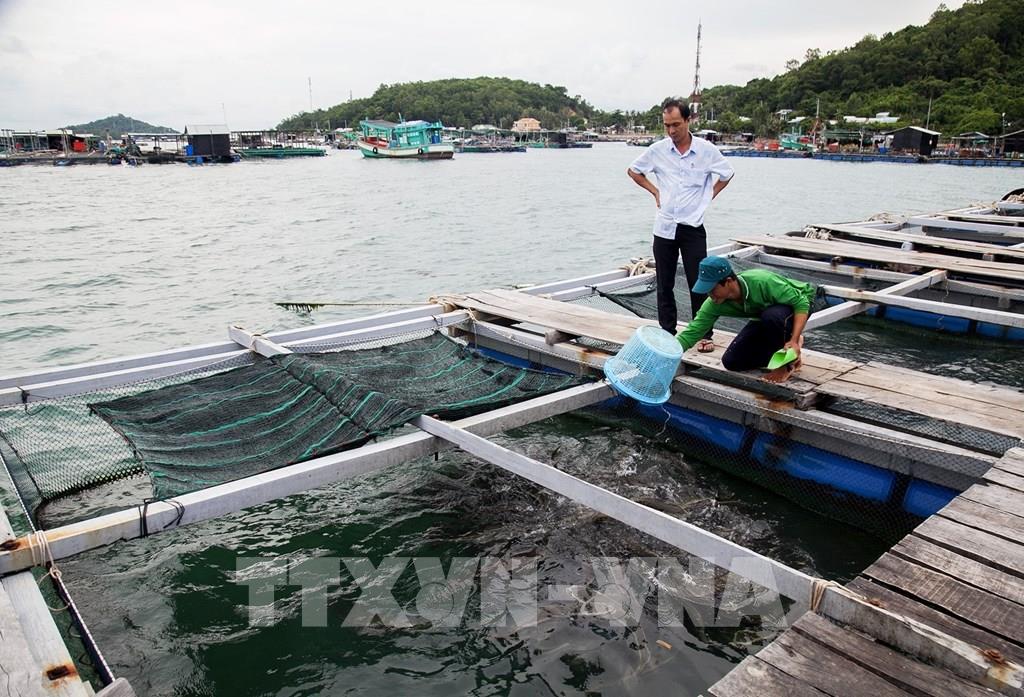
Aquaculture production reached over 134,482 tons, achieving 32.78% of the annual plan. Of this, farmed shrimp accounted for more than 56,174 tons, an increase of 17.18%; marine aquaculture contributed over 44,330 tons, up 36.48% compared to the same period last year with the remainder coming from other aquatic species.
Accordingly, the total aquaculture area in Kien Giang province is approximately 145,493 hectares, including 135,019 hectares out of 137,050 hectares dedicated to brackish water shrimp farming, encompassing industrial shrimp farming, shrimp-rice integration and improved extensive shrimp farming with species such as black tiger shrimp, white-leg shrimp, and giant freshwater prawn.
Despite maintaining steady development, aquaculture in Kiên Giang faced several challenges in the early months of 2025 due to unfavorable weather conditions. Many shrimp farmers were affected by prolonged heat, high temperatures, and increased salinity, which created adverse farming environments and led to the outbreak of certain diseases such as environmental shock-related illnesses, white spot disease, and EMS...
Since the beginning of the year, approximately 1,107 hectares of brackish water shrimp farms in the province have been affected by disease outbreaks, including white spot disease, white spot disease combined with hepatopancreatic necrosis, hepatopancreatic necrosis alone, and environmental damage. Functional authorities have distributed 17,930 kg of 20% Sodium Chlorine disinfectant to 80 shrimp farming households to manage the outbreaks. Additionally, farmers promptly reported disease incidents to specialized departments in the districts, enabling timely control and suppression of diseases, reducing the spread of outbreaks in shrimp farms. Local agricultural departments have also advised farmers to strictly follow technical farming protocols and seasonal stocking schedules to reduce disease risks.
According to Lê Hữu Toàn, Director of the Kiên Giang Department of Agriculture and Environment, the province's agricultural sector is developing its fisheries economy around three main pillars: capture fisheries, aquaculture and conservation of seafood resources. This strategy aims to ensure sustainable development, enhance value and efficiency, and contribute significantly to the province’s double-digit economic growth in 2025. In addition to effectively implementing IUU fishing prevention measures, the province is closely monitoring weather conditions, aquatic resource trends, fishing grounds, and seasonal patterns to provide timely information to fishermen for efficient operations.Additionally, the province is promoting organized fishing through value chains and fishing groups or teams to support each other in logistics services, weather updates and fishing ground information, enabling safer and longer offshore fishing operations.
Additionally, in the field of aquaculture, functional agencies in coordination with local authorities have advised farmers and shrimp farming facilities to strictly follow the 2025 seasonal stocking schedule for brackish water shrimp. At the same time, they are closely monitoring the shrimp farming situation across the province to guide farmers in achieving effective shrimp farming, particularly in preventing and controlling harmful diseases to minimize risks and potential losses.
Furthermore, functional agencies have intensified inspections of seed stock entering the province and circulating in the market to prevent poor-quality seeds from affecting the productivity of aquaculture seasons. Additionally, efforts are being made to monitor and provide early warnings about water quality in aquaculture areas, promptly addressing adverse environmental changes. Alongside this, the implementation of the 2025 aquatic disease prevention and control plan continues with increased recommendations for farmers to apply technical measures to mitigate the adverse impacts of climate change on aquaculture production.
The province is also focusing on developing high-tech industrial shrimp farming and marine cage fish farming models to improve both the output and quality of aquatic products; fostering value chain linkages through cooperatives and enterprises to enhance coordination from production to consumption, ensuring stable markets for aquaculture products. Furthermore, the province supports and invests in the robust development of the seafood processing industry to increase the added value of export products.
By BNews